Direct Answer and Key Takeaways
Direct Answer
An informed consent claim may arise when a patient undergoes medical treatment without receiving legally required information about important risks, alternatives, or the nature of the proposed procedure, and the inadequate disclosure causes legally compensable harm. A signed consent form does not automatically defeat such a claim, while an undisclosed risk or poor outcome does not automatically establish medical malpractice. State law controls many of the key legal standards.
Key Takeaways
Informed consent is a communication and decision-making process, not merely a patient's signature on a form. The American Medical Association describes the process as communication that results in authorization for a specific medical intervention after relevant information has been provided and understood.
A signed form can document consent, but it does not automatically prove that every disclosure required by applicable law occurred.
Lack of informed consent and negligent medical treatment are separate issues. A procedure may be performed competently yet still raise a disclosure issue, while valid consent does not excuse negligent performance.
A poor medical outcome or undisclosed risk does not automatically establish liability. Disclosure, causation, injury, damages, and applicable state law must be analyzed separately.
Emergency treatment, incapacity, surrogate decision-making, language barriers, and other circumstances can change the ordinary consent analysis.
This article explains what informed consent involves, how it differs from ordinary medical negligence and unauthorized treatment, what evidence can support a claim, and how compensation is evaluated without relying on guaranteed outcomes or settlement formulas.
Legal Information Notice
This article provides general U.S. legal and health-care information and is not legal advice.
This material is also not medical advice.
Informed-consent standards vary by state. Jurisdictions can use different disclosure tests, causation standards, statutes of limitation, expert-witness requirements, damages rules, and distinctions between negligence and intentional unauthorized treatment.
Federal hospital regulations and professional ethical guidance help explain the consent process, but they do not establish one nationwide medical malpractice rule.
What Informed Consent Actually Requires
Informed consent is a process of communication leading to a voluntary medical decision.
The American Medical Association's Opinion 2.1.1 states that physicians seeking informed consent should assess the patient's ability to understand relevant medical information and treatment alternatives and make an independent, voluntary decision.
The discussion should include the diagnosis when known, the nature and purpose of recommended interventions, expected benefits, burdens and risks, alternatives, and the option of forgoing treatment. The discussion and decision should also be documented.
The practical sequence is:
Information
→ Understanding
→ Voluntary Decision
→ Authorization
A signature may document the final authorization.
It does not replace the preceding communication.
Federal rules for Medicare-participating hospitals reinforce this principle. Under 42 CFR §482.13, a patient or authorized representative has the right to make informed decisions regarding care, participate in treatment planning, and request or refuse treatment.
Does Signing a Consent Form Prevent an Informed Consent Claim?
No.
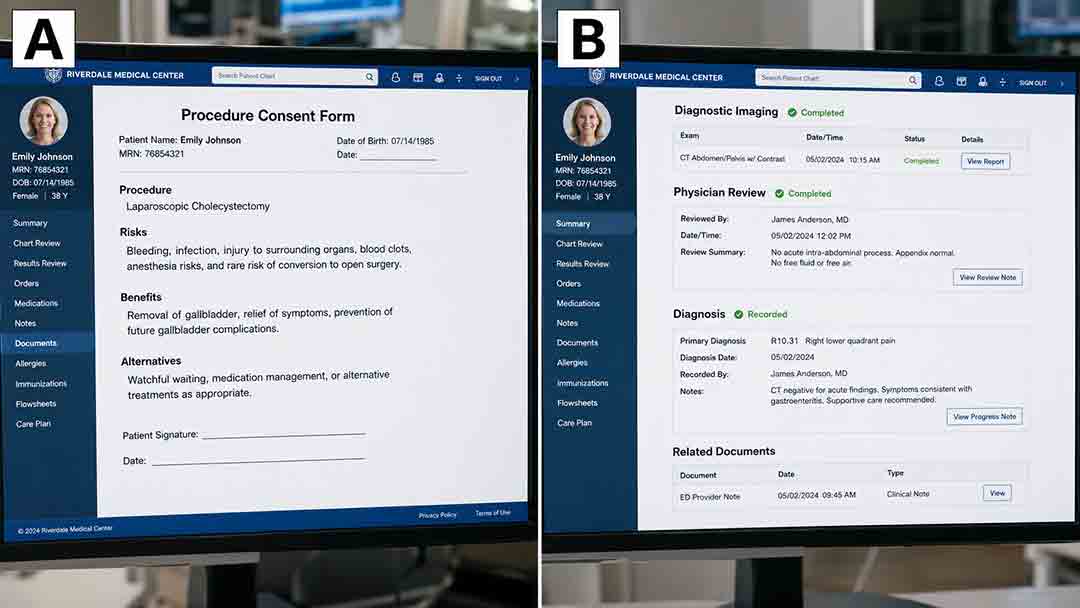
A signed consent form can be important evidence, but it does not automatically establish that the patient received every disclosure required by applicable law.
42 CFR §482.24 requires hospital records to contain properly executed informed-consent forms for procedures and treatments that medical staff, federal law, or state law require to have written consent.
For surgery, 42 CFR §482.51 requires a properly executed informed-consent form to be in the patient's chart before surgery, except in emergencies.
Those documentation requirements do not make the form conclusive proof of the entire consent conversation.
A useful evidence framework is:
Signed form = documentation evidence.
Consent conversation = disclosure evidence.
Applicable law = determines what information had to be disclosed.
Causation and damages = determine whether an alleged disclosure failure supports compensation.
A form stating that “risks were discussed” may therefore be relevant without automatically resolving a dispute over whether a particular material risk or reasonable alternative was actually explained.
What Information May Need to Be Disclosed?
The exact legal requirement depends on state law and the medical circumstances.
Common informed-consent subjects include the nature and purpose of the proposed treatment, expected benefits, significant risks or burdens, reasonable alternatives, and the consequences of declining treatment.
AMA Opinion 2.1.1 specifically includes the diagnosis when known, the nature and purpose of the intervention, burdens, risks, expected benefits, available options, and forgoing treatment as relevant parts of the informed-consent process.
That does not mean a physician must necessarily list every theoretically possible complication.
Whether a risk is legally significant enough to require disclosure depends on the jurisdiction's informed-consent standard and the facts of the medical decision.
A case evaluation should therefore ask what information applicable law required, not simply whether a complication appeared somewhere on a generic form.
Informed Consent vs. Ordinary Medical Negligence
The two theories focus on different conduct.
An ordinary medical negligence claim generally asks whether a health-care professional failed to satisfy the applicable standard of care while diagnosing, treating, monitoring, or otherwise caring for the patient.
An informed-consent claim focuses on whether legally sufficient information was provided before the patient made the treatment decision.
Consider a surgery that is technically performed according to the applicable medical standard but results in a recognized complication.
If the allegation is that the surgeon performed the operation improperly, the claim concerns the quality of treatment.
If the allegation is that the patient should have been told about a significant risk or reasonable alternative before deciding whether to undergo surgery, the dispute concerns informed consent.
Both issues may arise from the same procedure, but one does not automatically prove the other.
Adequate consent ≠ non-negligent treatment.
Negligent treatment ≠ automatically inadequate consent.
Informed Consent vs. Medical Battery or Unauthorized Treatment
In some jurisdictions, inadequate disclosure after a patient agrees to a procedure is treated differently from intentionally performing a procedure the patient did not authorize.
California provides a useful state-specific example.
The Judicial Council of California Civil Jury Instructions distinguish medical battery claims involving no consent or conduct outside the scope of consent from negligence-based informed-consent claims involving inadequate disclosure of risks or alternatives.
Relevant California instructions include CACI No. 530A, Medical Battery; CACI No. 532, Informed Consent—Definition; and CACI No. 533, Failure to Obtain Informed Consent—Essential Factual Elements.
California's framework is an example, not a nationwide rule.
A practical distinction is:
Patient agreed to the procedure but allegedly lacked information required for an informed decision → possible informed-consent analysis.
Patient did not authorize the procedure that was intentionally performed, or the provider intentionally exceeded a relevant limitation on consent → possible unauthorized-treatment or medical-battery analysis under applicable state law.
Patient authorized the procedure and received adequate disclosure, but the procedure was allegedly performed below the professional standard of care → possible ordinary medical negligence analysis.
State law determines the exact legal theory.
Does an Undisclosed Risk Automatically Create Liability?
No.
An alleged nondisclosure is only one part of the analysis.
A useful causation chain is:
Medical Decision
→ Required Disclosure
→ Information Provided
→ Patient Decision
→ Treatment
→ Risk or Outcome
→ Causation
→ Injury
→ Damages
Each link matters.
Suppose a patient alleges that Risk A was not disclosed, but the patient's injury resulted from unrelated Complication B.
The nondisclosure of Risk A does not automatically prove that the communication failure caused the injury.
Likewise, even when the undisclosed risk actually occurs, the applicable legal standard may require analysis of whether adequate disclosure would have affected the treatment decision.
The specific causation test varies by jurisdiction.
This is why an informed-consent claim cannot reliably be evaluated solely by identifying an omitted sentence on a form.
Patient Understanding and Limited English Proficiency
Information must be communicated in a way that supports meaningful decision-making.
AMA Opinion 2.1.1 recommends assessing the patient's ability to understand relevant information and treatment alternatives and make an independent, voluntary decision.
CMS has similarly emphasized that hospital informed-consent processes should provide adequate information in a manner the patient or representative can understand so that informed decisions can be made. CMS reinforced these requirements in QSO-24-10-Hospitals.
Relevant facts can include the complexity of the explanation, timing of the discussion, cognitive condition, sedation, interpreter assistance, patient questions, educational materials, and whether there was a meaningful opportunity to consider alternatives.
None of these factors alone automatically proves valid or invalid consent.
The question is whether the overall process satisfied the applicable standard.
What If the Patient Has Limited English Proficiency?
A language barrier can be relevant to informed consent, but it does not automatically prove that consent was invalid.
The analysis may include whether an interpreter was used, whether translated materials were provided, what information was communicated, and whether the patient or authorized representative could meaningfully understand the proposed treatment.
A signed English-language form should not automatically be treated as proof of adequate understanding when there is evidence the patient could not understand English.
At the same time, limited English proficiency alone does not establish negligence.
Medical records may document interpreter services or other communication measures that supported an informed decision.
The legal significance of those facts depends on applicable law and the circumstances.
The Patient's Right to Refuse Treatment
Generally, competent adult patients have important rights to participate in medical decisions and refuse treatment, subject to applicable legal exceptions.
42 CFR §482.13 states that patients in covered hospitals have the right to make informed decisions concerning care and to request or refuse treatment.
Refusal should also be informed.
A patient deciding against a recommended treatment may need information about the reasonably foreseeable consequences of declining it.
Medical records may therefore document informed refusal as well as informed consent.
However, the federal patient-rights regulation also expressly provides that the right to participate in decisions or refuse care does not create a right to demand treatment or services considered medically unnecessary or inappropriate.
Patient right to refuse treatment
≠
right to demand medically inappropriate treatment.
Emergency Treatment Without Prior Consent
Emergency circumstances can create an exception to the ordinary prior-consent process.
AMA Opinion 2.1.1 states that when an urgent decision must be made, the patient cannot participate in decision-making, and an appropriate surrogate is unavailable, physicians may initiate urgently needed treatment without prior informed consent.
The patient or surrogate should be informed at the earliest opportunity and consent obtained for ongoing care.
Federal hospital rules also recognize an emergency exception.
Under 42 CFR §482.51, a properly executed informed-consent form normally must be in the patient's chart before surgery, except in emergencies.
The existence of an emergency should not be assumed simply because treatment happened quickly.
Relevant questions can include the urgency of the condition, the patient's capacity, whether delay posed meaningful danger, whether a surrogate was available, and what applicable state law allows.
When the Patient Cannot Make the Decision
When a patient lacks decision-making capacity, an authorized surrogate may sometimes make treatment decisions under applicable law.
AMA Opinion 2.1.1 expressly addresses obtaining consent from a patient's surrogate when the patient lacks capacity or does not participate in decision-making.
42 CFR §482.13 similarly recognizes patient representatives as allowed by state law.
Depending on the circumstances, the decision-maker might be a health-care agent, guardian, parent, legally authorized surrogate, or another person recognized by state law.
Capacity can also be decision-specific and may change over time.
A patient who lacks capacity during an acute medical crisis may later regain the ability to participate in ongoing treatment decisions.
HIPAA vs. Treatment Informed Consent
HIPAA privacy authorization and treatment informed consent are different legal concepts.
The U.S. Department of Health and Human Services states in HIPAA FAQ 258 that the HIPAA Privacy Rule governs uses and disclosures of protected health information and does not determine whether a patient consents to the health care itself.
HHS explains that informed consent for treatment is addressed by state law.
HIPAA privacy authorization
≠
treatment informed consent.
Signing a HIPAA-related privacy document does not automatically mean the patient authorized a particular surgery or procedure.
Likewise, signing a treatment consent form does not automatically authorize every unrelated disclosure of protected health information.
Privacy authorization and medical treatment authorization address different issues.
A Seven-Question Informed Consent Claim Framework
A practical evaluation can be organized into seven questions.
Question One: What Treatment Was Actually Authorized?
Identify the exact procedure, treatment, body part, physician or practitioner, and scope of the patient's authorization.
Question Two: What Information Was Allegedly Missing?
Identify the specific risk, alternative, expected consequence, or aspect of treatment the patient says was not disclosed.
Question Three: Was That Disclosure Legally Required?
This depends on applicable state law and the medical circumstances.
Question Four: What Evidence Shows What Was Communicated?
Review consent forms, physician notes, nursing documentation, patient education materials, interpreter records, portal communications, videos, and witness accounts.
Question Five: Would the Missing Information Matter Under the Applicable Causation Standard?
The legal analysis may consider whether adequate disclosure would have affected the treatment decision.
Question Six: Did the Relevant Risk or Outcome Actually Occur?
Connect the alleged disclosure failure with the injury rather than assuming any adverse event is sufficient.
Question Seven: What Injury and Damages Resulted?
Identify medical harm and financial consequences attributable to the event.
This is an evidence framework, not a legal scoring system.
No single answer automatically establishes liability.
Practical Example: Daniel's Signed Consent Form
Consider a hypothetical patient named Daniel who undergoes an elective procedure.
Daniel signs a hospital consent form identifying the operation and stating that risks were discussed.
After surgery, Daniel experiences Complication A.
Daniel later says he was never told that Complication A was a significant known risk and says he would have chosen a reasonable alternative if he had known about it.
The medical record contains the signed form but limited detail about the risk discussion. The physician remembers discussing the complication and says it is routinely explained to patients.
The signed form matters, but it does not automatically decide the case.
A proper analysis asks:
What did applicable state law require to be disclosed?
Was Complication A the kind of risk that required disclosure?
What do the medical records document?
Were reasonable alternatives discussed?
What evidence supports Daniel's account?
What evidence supports the physician's account?
Did Complication A cause the claimed injury?
Would adequate disclosure have changed the decision under the jurisdiction's causation standard?
The existence of conflicting evidence is precisely why a signature should not be treated as a substitute for the full legal analysis.
How Medical Records Can Support an Informed Consent Claim
Medical records can help reconstruct both the treatment decision and the consent process.
Potentially relevant materials include consent forms, preoperative consultation notes, physician documentation, nursing records, patient education materials, anesthesia forms, interpreter records, scheduling notes, patient portal communications, operative reports, and discharge documentation.
42 CFR §482.24 requires relevant hospital medical records to contain properly executed informed-consent forms when written consent is required by medical staff rules or applicable federal or state law.
CMS QSO-24-10-Hospitals also reinforced that hospital informed-consent policies, processes, and forms should provide information enabling patients or representatives to make fully informed decisions.
The guidance particularly addressed consent for examinations and participation by practitioners, residents, and students in certain training or educational activities.
Missing documentation does not automatically prove that no discussion occurred.
Detailed documentation does not automatically prove that every legally required disclosure was adequate.
Records must be evaluated together with testimony, medical evidence, and applicable law.
How Compensation Is Evaluated
There is no universal formula for medical malpractice compensation in an informed-consent claim.
Potential damages can include additional medical expenses, documented lost income, reduced earning capacity, future medical needs where properly supported, and noneconomic damages recognized by applicable state law.
Consider a hypothetical claimant with:
Additional medical treatment of $48,000.
Documented lost wages of $17,000.
Other documented injury-related expenses of $4,000.
The arithmetic subtotal is $69,000.
$69,000 is not automatically the value of the medical malpractice claim.
The subtotal does not establish that informed consent was legally inadequate.
It does not prove causation.
It does not determine whether every claimed expense is legally recoverable.
It does not establish noneconomic damages.
It does not account for state-specific damage rules, defenses, or comparative legal issues.
It does not predict a medical malpractice settlement.
There is no responsible universal medical malpractice settlement multiplier, informed-consent multiplier, or medical-bill multiplier.
Compensation should follow evidence and applicable law.
Common Mistakes, Legal Review, and Next Steps
Mistake One: Assuming a Signature Automatically Proves Informed Consent
A signed form is evidence, but informed consent is a broader communication process.
Mistake Two: Assuming No Signed Form Automatically Means Malpractice
Whether written consent is legally required depends on the procedure, setting, state law, and circumstances.
Mistake Three: Assuming Every Undisclosed Risk Establishes Negligence
Applicable law determines what information had to be disclosed, and causation remains a separate issue.
Mistake Four: Treating a Bad Outcome as Proof of Malpractice
Complications can occur even when treatment and consent were appropriate.
Mistake Five: Confusing HIPAA With Treatment Consent
HHS specifically distinguishes HIPAA privacy rules from consent to medical treatment.
Mistake Six: Ignoring Treatment Alternatives
Reasonable alternatives and forgoing treatment can be part of meaningful informed decision-making.
Mistake Seven: Ignoring Causation
A disclosure failure does not automatically establish that the nondisclosure caused the claimed injury.
Mistake Eight: Using a Settlement Formula
There is no universal formula that converts a consent problem into a specific compensation amount.
When Professional Legal Review May Be Useful
A legal evaluation may be useful when a serious injury is accompanied by a genuine dispute about what information was provided before treatment.
A medical malpractice lawyer may examine whether applicable state law required disclosure of a disputed risk or alternative.
An informed consent lawyer may compare consent records, medical documentation, testimony, and expert analysis to determine whether the evidence supports a claim.
A case evaluation may also need to distinguish informed consent from ordinary medical negligence or unauthorized treatment.
Useful questions include which state's law applies, what disclosure standard governs, whether expert testimony is required, how causation will be evaluated, what records should be obtained, which damages may be legally recoverable, and what filing deadline applies.
A medical malpractice attorney, medical negligence lawyer, or patient rights attorney should not guarantee a settlement or compensation amount before the facts and law have been evaluated.
General Considerations for Different Patient Situations
If you are considering treatment and still have unanswered questions, ask the treating professional to explain the purpose, significant risks, expected benefits, reasonable alternatives, and consequences of declining treatment before making a decision.
If the procedure has already occurred and you are unsure what was authorized, preserve the consent paperwork and obtain the relevant medical records.
If you believe a substantially different procedure was performed from the one you authorized, document what you understood would occur and compare that understanding with the operative and consent records.
If an unexpected complication has occurred, seek appropriate medical evaluation for the medical issue. Do not delay necessary care while investigating a possible legal claim.
If serious harm and disputed disclosure are involved, legal deadlines and claim procedures can vary by state, so timely case-specific evaluation may be important.
Practical Conclusion, FAQs, and Sources
An informed consent claim is not simply a dispute about whether a patient signed a document.
The central questions are what treatment was proposed, what information applicable law required, what information was actually provided, whether the patient voluntarily authorized treatment, whether the disputed risk or consent issue caused the claimed injury, and what damages can be supported.
The key distinctions remain:
Consent form ≠ automatically adequate informed consent.
Poor outcome ≠ automatically malpractice.
Undisclosed risk ≠ automatically liability.
Liability ≠ automatic compensation.
A reliable claim analysis starts with the communication process, medical records, applicable state law, causation, and documented harm rather than a predicted settlement amount.
Frequently Asked Questions
Does Signing a Consent Form Prevent a Medical Malpractice Claim?
No.
A signed form is relevant evidence, but it does not automatically establish that every disclosure required under applicable law was made.
Can a Known Surgical Risk Still Support an Informed Consent Claim?
Potentially.
The occurrence of the risk alone is not enough. The analysis may include whether the risk legally required disclosure, what information was actually provided, causation, injury, and applicable state law.
Is Lack of Informed Consent the Same as Medical Negligence During Surgery?
No.
Informed consent focuses on disclosure and decision-making before treatment. Ordinary negligence focuses on whether the medical care itself satisfied the applicable professional standard.
Does HIPAA Require Informed Consent Before Medical Treatment?
No.
HHS explains that HIPAA regulates uses and disclosures of protected health information and does not determine consent to the health care itself.
Can Emergency Treatment Proceed Without Prior Informed Consent?
Potentially.
Emergency exceptions can apply when urgent treatment is required, the patient cannot participate in the decision, and an appropriate surrogate is unavailable.
Does an Undisclosed Risk Automatically Determine Medical Malpractice Compensation?
No.
Compensation depends on whether a legally actionable disclosure failure occurred, whether it caused the claimed injury, what damages are recoverable, and which state law governs.
Sources
American Medical Association. Code of Medical Ethics Opinion 2.1.1, Informed Consent.
https://code-medical-ethics.ama-assn.org/ethics-opinions/informed-consent
AMA Opinion 2.1.1 addresses decision-making capacity, the nature and purpose of treatment, burdens, risks, expected benefits, alternatives, forgoing treatment, documentation, surrogate consent, and emergency treatment.
Electronic Code of Federal Regulations. 42 CFR §482.13, Condition of Participation: Patient's Rights.
https://www.ecfr.gov/current/title-42/chapter-IV/subchapter-G/part-482/subpart-B/section-482.13
The regulation addresses informed health-care decisions, participation in treatment planning, refusal of treatment, patient representatives, and the limitation concerning medically unnecessary or inappropriate treatment.
Electronic Code of Federal Regulations. 42 CFR §482.24, Condition of Participation: Medical Record Services.
https://www.ecfr.gov/current/title-42/chapter-IV/subchapter-G/part-482/subpart-C/section-482.24
The regulation requires relevant hospital records to contain properly executed informed-consent forms when written consent is required.
Electronic Code of Federal Regulations. 42 CFR §482.51, Condition of Participation: Surgical Services.
https://www.ecfr.gov/current/title-42/chapter-IV/subchapter-G/part-482/subpart-D/section-482.51
The regulation requires a properly executed informed-consent form in the patient's chart before surgery except in emergencies.
Centers for Medicare & Medicaid Services. QSO-24-10-Hospitals, Revisions and Clarifications to Hospital Interpretive Guidelines for Informed Consent.
https://www.cms.gov/medicare/health-safety-standards/quality-safety-oversight-general-information/policy-memos-states-and-cms-locations/revisions-and-clarifications-hospital-interpretive-guidelines-informed-consent
The CMS memorandum reinforces hospital informed-consent obligations and addresses information needed for patients or representatives to make fully informed decisions, including certain training- and education-related examinations.
U.S. Department of Health and Human Services. HIPAA FAQ 258, How Does the HIPAA Privacy Rule Change the Laws Concerning Consent for Treatment?
https://www.hhs.gov/hipaa/for-professionals/faq/258/how-does-privacy-rule-change-laws/index.html
HHS explains that the HIPAA Privacy Rule addresses uses and disclosures of protected health information rather than whether the patient consents to health care itself; informed consent for treatment is addressed by state law.
Judicial Council of California. Civil Jury Instructions, 2026 Edition.
https://courts.ca.gov/partners/california-jury-instructions/civil-jury-instructions-resource-center/civil-jury-instructions
Relevant California instructions include CACI No. 530A, Medical Battery; CACI No. 532, Informed Consent—Definition; and CACI No. 533, Failure to Obtain Informed Consent—Essential Factual Elements. These California instructions illustrate the distinction between unauthorized treatment and negligence-based lack of informed consent and should not be treated as a nationwide legal standard.
Source Review Date: August 13, 2026