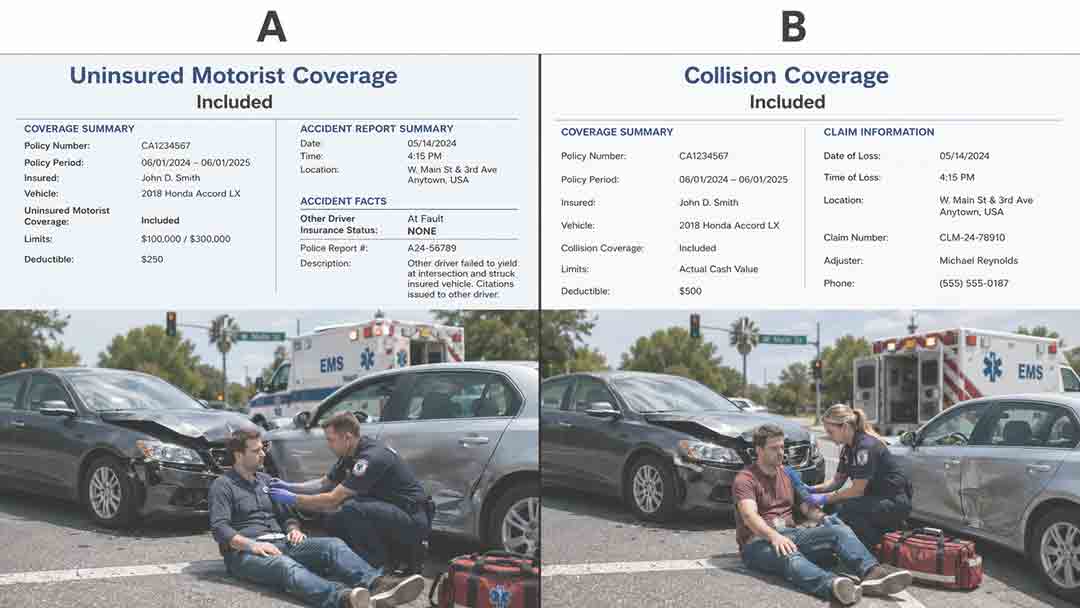
Direct Answer and Key Takeaways
Direct Answer
An uninsured motorist claim may provide compensation when a legally responsible driver has no applicable liability insurance. Underinsured motorist coverage may apply when the responsible driver has insurance but it is insufficient under the governing policy and state law. Coverage for injuries, property damage, hit-and-run accidents, claim procedures, offsets, and available compensation varies significantly by state and policy.
Key Takeaways
1. Uninsured motorist coverage and underinsured motorist coverage are different. UM generally addresses qualifying losses caused by an uninsured motorist, while UIM addresses qualifying losses involving a driver whose applicable liability coverage is insufficient under the governing policy and state rules.
2. No insurance card does not automatically mean the other driver is legally uninsured. The investigation should determine whether collectible or otherwise applicable liability insurance covered the driver, vehicle, and accident.
3. UM/UIM coverage does not guarantee payment. Fault, insured status, policy conditions, causation, documented damages, and state law may still need to be established.
4. Hit-and-run requirements vary by jurisdiction. Texas, for example, permits an actual-physical-contact requirement when the owner or operator of the vehicle is unknown in specified circumstances. That Texas rule is not a nationwide hit-and-run requirement.
5. A UM or UIM policy limit is an insurance boundary, not the automatic value of a claim or settlement.
This guide explains how uninsured and underinsured motorist coverage works, how UM/UIM differs from collision, PIP, MedPay, and property-damage protection, what evidence matters, what to consider before signing a liability release, and how injury compensation can be evaluated without relying on a universal settlement formula.
Legal Information Notice
This article provides general U.S. legal and insurance information and is not legal advice or individualized insurance coverage advice.
Uninsured and underinsured motorist laws vary substantially by state. Rules involving mandatory coverage, written rejection, stacking, offsets, exhaustion, settlement consent, notice, arbitration, hit-and-run claims, property-damage protection, filing deadlines, and available damages can differ.
The National Association of Insurance Commissioners explains that automobile insurance requirements vary among jurisdictions, making state-specific policy and legal review important.
How an Uninsured Motorist Claim Works
An uninsured motorist claim generally asks an applicable UM insurer to respond to covered damages caused by a legally responsible motorist who lacks applicable liability insurance.
The analysis usually follows a sequence:
Accident → Fault → Other Driver's Insurance Status → Applicable UM Policy → Coverage Requirements → Injury and Damage Evidence → Compensation Analysis → Claim Resolution
Each step answers a separate question.
First, determine what happened and who was legally responsible.
Second, determine whether collectible or otherwise applicable liability insurance covered the responsible driver or vehicle.
Third, review whether the injured person qualifies for UM protection under an applicable policy.
Finally, establish causation, covered damages, and compliance with policy and state-law requirements.
The other driver being uninsured does not automatically create a payable UM claim.
Fault ≠ insurance status.
Insurance status ≠ UM/UIM coverage.
UM/UIM coverage ≠ automatic payment.
Policy limit ≠ claim value.
UM vs. UIM Coverage
Uninsured motorist coverage generally applies to qualifying losses caused by a legally responsible driver who has no applicable liability insurance.
Underinsured motorist coverage generally applies when liability insurance exists but is insufficient under the UIM framework governing the claim.
The precise trigger is state-specific.
Texas, for example, defines and regulates uninsured and underinsured motorist coverage through Insurance Code Chapter 1952. Its statute provides for UM/UIM protection and addresses recovery under UIM coverage by reference to amounts the insured is legally entitled to recover, applicable policy limits, and amounts recovered or recoverable from the underinsured vehicle's insurer.
North Carolina uses a different structure. For new or renewed policies beginning July 1, 2025, UIM coverage is included, and the state changed how underinsured status, offsets, and coverage available from multiple policies are calculated. The North Carolina Department of Insurance specifically explains that the determination is now based on damages sustained rather than simply comparing liability limits and that most setoffs were removed except as provided by statute.
New York uses another framework. The New York State Department of Financial Services explains that auto policies include mandatory uninsured motorist bodily injury protection, while Supplementary Uninsured/Underinsured Motorists coverage, commonly called SUM, can provide additional protection subject to New York law and selected limits.
These examples demonstrate why one national UIM formula should not be applied to every claim.
UM ≠ UIM.
State law can materially change the result.
UM Bodily Injury, UIM, UMPD, Collision, PIP, and MedPay
These coverages may all become relevant after one accident, but they address different risks.
UM bodily injury generally concerns covered bodily injuries caused by a legally responsible uninsured motorist.
UIM generally addresses qualifying bodily injury when the responsible motorist has liability coverage but that coverage is insufficient under applicable state law and policy terms.
Uninsured motorist property damage, often abbreviated UMPD, can address covered property damage in jurisdictions and policies where that protection is available.
Collision coverage generally concerns physical damage to the insured vehicle caused by a collision, subject to policy terms and a deductible.
Medical payments coverage, commonly called MedPay, generally addresses qualifying medical expenses under the policy.
Personal injury protection, or PIP, is a separate form of first-party protection available or required under certain state systems and can address defined medical expenses and other specified losses.
These coverages should not be treated as interchangeable.
A person can have UM bodily injury coverage without necessarily having identical property-damage protection. Collision coverage may handle the damaged vehicle even while a UM bodily injury claim addresses physical injuries.
How to Confirm the Other Driver Was Actually Uninsured
No insurance card does not equal confirmed uninsured status.
The driver may be unable to produce proof at the scene while an applicable policy still exists.
The investigation may involve the police report, insurance information supplied by the driver, correspondence from an alleged liability insurer, confirmation of policy status, vehicle ownership, and other policies that may cover the driver or vehicle.
For example, someone may be driving a borrowed vehicle. An employee may be operating a business-owned vehicle. A vehicle owner's policy may require investigation even when the driver did not personally purchase coverage.
The practical question is not:
“Did the driver show an insurance card?”
It is:
“Was there collectible or otherwise applicable liability insurance covering the responsible driver, vehicle, and accident?”
That question should ordinarily be investigated before treating the loss as a confirmed uninsured motorist claim.
How an Underinsured Motorist Claim Begins
A UIM claim generally becomes relevant after the responsible driver's applicable liability insurance has been identified and the claimant's losses may exceed what that insurance can satisfy under the governing UIM rules.
The procedure before pursuing UIM benefits can be just as important as the amount of liability insurance available.
Depending on the state and policy, relevant requirements may involve notice, consent to settlement, exhaustion of underlying liability coverage, offsets, protection of recovery rights, or other conditions.
New York's Regulation 35-D governs SUM coverage, including prescribed policy provisions. DFS materials describe the SUM framework, including offsets, claims, and arbitration.
North Carolina applies its own UIM system, including the substantial rule changes effective July 1, 2025.
The practical recommendation is important:
Before signing a complete liability release, it may be prudent to review the UIM policy and applicable state requirements because the legal effect can vary by jurisdiction.
A settlement with the at-fault driver's insurer may appear to resolve one part of the accident while creating a separate coverage issue if a required UIM procedure is ignored.
New York SUM Coverage
New York distinguishes mandatory uninsured motorist bodily injury coverage from Supplementary Uninsured/Underinsured Motorists coverage.
The New York Department of Financial Services states that mandatory uninsured motorist protection must be included in auto policies at specified minimum bodily injury limits. SUM coverage provides additional uninsured and underinsured motorist protection and can be purchased up to applicable bodily injury liability limits under New York's framework.
Regulation 35-D, codified in 11 NYCRR Part 60-2, governs New York SUM coverage.
New York amended Regulation 35-D again in 2026. The consolidated amendment took effect June 17, 2026 and addressed SUM requirements involving peer-to-peer car-sharing group policies, among related conforming provisions.
This 2026 amendment should not be described as a nationwide UM/UIM change or as replacing the broader New York SUM framework.
Hit-and-Run Claims
A hit-and-run may qualify for uninsured motorist protection, but coverage is not automatic.
Useful evidence can include:
1. A prompt police report.
2. Photographs of the accident scene and vehicle damage.
3. Dashcam footage.
4. Nearby surveillance video.
5. Witness names and contact information.
6. Vehicle debris or paint transfer where relevant.
7. Records showing when the insurer was notified.
8. Medical documentation of injuries.
State requirements can differ significantly.
Texas provides a clear state-specific example. Texas Insurance Code Chapter 1952 permits UM coverage provisions requiring actual physical contact when the owner or operator of the motor vehicle causing bodily injury or property damage is unknown.
That rule applies to specified Texas unknown-driver circumstances.
Texas physical-contact rule ≠ nationwide hit-and-run rule.
Other states may use different statutory definitions, evidentiary requirements, policy language, or reporting conditions.
How to Build a UM/UIM Claim
Step One: Establish the Accident
Document when, where, and how the collision occurred.
Preserve photographs, video, witness information, police records, and vehicle damage evidence.
Step Two: Establish Fault
UM/UIM coverage generally does not eliminate the need to determine whether the uninsured or underinsured driver was legally responsible for the claimed damages.
Step Three: Verify Insurance Status
Determine whether the responsible driver and vehicle had applicable liability insurance.
For a potential UIM claim, identify available liability limits and any amounts paid.
Step Four: Identify Potentially Applicable Policies
Review the policy covering the involved vehicle and any other policy that may be relevant because of household status, occupancy, ownership, employment, or another legally significant relationship.
Do not assume there can be only one possible UM/UIM policy.
Step Five: Review Coverage Requirements
Identify UM bodily injury limits, UIM limits, UMPD where available, deductibles, notice provisions, settlement conditions, consent requirements, exhaustion provisions, hit-and-run conditions, arbitration provisions, and other policy terms.
Step Six: Document Injuries and Financial Losses
Preserve medical records, bills, wage documentation, repair estimates, total-loss records, and evidence supporting other claimed damages.
Step Seven: Review Other Available Benefits
Collision, PIP, MedPay, health insurance, workers' compensation, and liability insurance may affect how losses are paid or coordinated.
Step Eight: Evaluate Resolution
Only after fault, insurance status, policy coverage, and damages are reasonably understood should a potential resolution be evaluated.
This is an investigative framework, not a universal legal formula.
How Injury Compensation Is Evaluated
There is no universal UM/UIM compensation formula.
A useful first step is to document actual losses while keeping those amounts separate from the legal value of the claim.
Consider a hypothetical claimant with:
Medical expenses of $46,000.
Documented lost income of $14,000.
Other documented injury-related expenses of $5,000.
The arithmetic subtotal is $65,000.
$65,000 is not automatically the value of the uninsured motorist claim.
The subtotal does not establish liability.
It does not determine whether every expense is covered.
It does not establish noneconomic damages.
It does not account for comparative fault.
It does not resolve medical causation.
It does not determine offsets or how other insurance payments affect the claim.
Now consider a second part of the hypothetical.
Assume the responsible driver has $25,000 of available bodily injury liability insurance and the injured claimant has a UIM policy showing a $100,000 stated limit.
For simple arithmetic illustration:
$65,000 - $25,000 = $40,000.
$40,000 is not automatically the UIM payment.
Different states use different rules for determining underinsured status, calculating UIM benefits, applying offsets, combining policies, and coordinating liability recoveries.
North Carolina's July 1, 2025 reforms illustrate why simple subtraction can be misleading. North Carolina changed both the test for underinsured status and the treatment of most offsets and multiple UIM policies.
Likewise, Texas has its own statutory UIM recovery provisions.
There is no responsible universal settlement multiplier, UIM multiplier, or medical-bill multiplier.
A Practical UM/UIM Decision Framework
Question One: Who caused the accident?
If fault is disputed, investigate liability before assuming UM/UIM benefits will be available.
Question Two: Does the responsible motorist have applicable liability insurance?
If no, investigate UM coverage.
Question Three: If liability insurance exists, may it be insufficient under the governing UIM rules?
If potentially yes, review UIM coverage and state law.
Question Four: Which policy or policies may apply?
Review the involved vehicle's policy and other legally relevant insurance.
Question Five: What type of loss is involved?
Separate bodily injury from vehicle and other property damage.
Question Six: Which policy conditions must be satisfied?
Review notice, settlement, consent, exhaustion, hit-and-run, arbitration, and related requirements.
Question Seven: What damages can be documented?
Separate medical expenses, income loss, property damage, and other legally recognized losses.
Question Eight: How do other benefits affect the claim?
Review liability payments, collision coverage, PIP, MedPay, workers' compensation, health insurance, and other applicable benefits.
This framework prevents one fact, such as the other driver lacking insurance, from being treated as the entire coverage analysis.
Real-World-Style Example: Maria's Claim
Consider a hypothetical driver named Maria who is struck at an intersection by Driver B.
Evidence indicates Driver B failed to yield.
Maria suffers a shoulder injury and misses several weeks of work.
The crash report lists an insurance company for Driver B, but that insurer later states that Driver B's policy had expired before the collision.
Maria's own declarations page shows UM bodily injury coverage and collision coverage.
The investigation now requires several separate questions.
Was Driver B legally responsible?
Was another policy applicable to Driver B or the vehicle?
Does Maria qualify as an insured under the UM coverage?
Does the UM policy apply to the accident?
Which injuries and losses can Maria establish?
Should collision coverage address the vehicle damage?
Do deductibles or other policy provisions matter?
Which state-law claim procedures apply?
The existence of UM coverage is important.
It does not automatically answer liability, coverage, or compensation.
When Your Own Insurance Company Disputes the Claim
A UM/UIM claim can involve a genuine dispute even though the claimant is making the claim through the claimant's own insurance policy.
The insurer may dispute fault.
It may dispute whether the other vehicle qualifies as uninsured or underinsured.
The insurer may dispute whether the claimant is an insured.
A hit-and-run dispute may concern whether statutory or policy requirements were satisfied.
The parties may disagree about whether an injury resulted from the accident, how much compensation is supported, or how policy limits, offsets, notice, settlement conditions, or arbitration provisions operate.
New York's Regulation 35-D, for example, contains prescribed SUM provisions addressing claim and arbitration procedures.
A denial or reduced valuation should therefore be compared with the complete policy and governing law.
It should not automatically be assumed correct because it came from the claimant's insurer, nor should it automatically be assumed improper simply because the claimant disagrees with it.
Common Mistakes in Uninsured Motorist Claims
Mistake One: Assuming No Insurance Card Means No Insurance
Verify collectible or otherwise applicable liability insurance.
Mistake Two: Treating UM and UIM as the Same Coverage
They address different insurance situations and may use different legal triggers.
Mistake Three: Assuming UM Always Covers Vehicle Damage
UM bodily injury, UMPD, and collision coverage serve different functions.
Mistake Four: Signing a Complete Liability Release Before Checking UIM Requirements
Notice, consent, exhaustion, offset, or other state-specific requirements can matter.
Mistake Five: Assuming Every Hit-and-Run Uses the Same Rule
Texas permits an actual-physical-contact requirement in specified unknown-driver circumstances. That does not establish a nationwide physical-contact requirement.
Mistake Six: Treating the Policy Limit as the Claim Value
A $100,000 UIM limit does not mean the insurer automatically owes $100,000.
Mistake Seven: Applying a Medical-Bill or Settlement Multiplier
There is no universal multiplier that accurately calculates a UM/UIM claim.
Mistake Eight: Ignoring Other Insurance
Collision, PIP, MedPay, health insurance, workers' compensation, and other coverage may affect the overall payment analysis.
What Different Claimants Should Do Next
If the Other Driver Appears Uninsured
Verify insurance status before assuming that UM coverage applies. Preserve accident evidence and identify every potentially applicable policy.
If the Other Driver Has Limited Insurance
Review the UIM policy and governing state rules before signing a complete liability release.
If the Accident Was a Hit-and-Run
Report the collision promptly, preserve physical and video evidence, identify witnesses, and review the state's unidentified-motorist rules.
If Only the Vehicle Was Damaged
Determine whether collision coverage or UMPD may address the loss. Do not assume UM bodily injury coverage automatically applies to vehicle damage.
If Your Own Insurer Disputes the Claim
Obtain the insurer's position in writing, compare it with the complete policy, preserve relevant deadlines, and evaluate any state-specific dispute procedures.
Practical Conclusion
An uninsured motorist claim requires more than discovering that the responsible driver apparently lacked insurance.
The central distinctions remain:
Fault ≠ insurance status.
Insurance status ≠ UM/UIM coverage.
UM/UIM coverage ≠ automatic payment.
Policy limit ≠ claim value.
For an uninsured-driver accident, establish responsibility and verify whether applicable liability insurance actually exists.
For an underinsured-driver accident, identify available liability insurance and review the UIM policy and state rules before resolving the underlying claim.
For a hit-and-run, preserve evidence early because state-specific requirements can affect coverage.
For a disputed first-party claim, evaluate the insurer's position against the actual policy and governing law rather than assuming that dealing with your own insurer makes the claim automatic.
A well-supported UM/UIM claim is built from verified insurance status, liability evidence, applicable policy language, compliance with coverage requirements, and documented injuries and losses—not a promised settlement number.
Frequently Asked Questions
Does UM Coverage Automatically Pay If the Other Driver Has No Insurance?
No.
A claimant may still need to establish fault, applicable coverage, causation, damages, and compliance with relevant policy and state-law requirements.
Is UIM Coverage the Same as UM Coverage?
No.
UM generally addresses qualifying claims involving an uninsured motorist. UIM generally addresses qualifying losses involving a motorist whose available liability insurance is insufficient under the governing UIM rules.
Can UM Coverage Apply to a Hit-and-Run?
Potentially.
Hit-and-run protection exists under many UM frameworks, but requirements vary by jurisdiction. Texas, for example, permits an actual-physical-contact requirement when the responsible vehicle owner or operator is unknown in specified circumstances.
Can Collision Coverage Be Used Instead of UM Property Damage?
Potentially.
Collision coverage may address covered vehicle damage regardless of whether the responsible driver is insured, subject to policy terms and deductibles. Whether UMPD is available and how the two coverages interact depends on the applicable policy and state law.
Should I Automatically Accept the At-Fault Driver's Policy Limit Before Making a UIM Claim?
Not automatically.
The UIM policy and governing state law should be reviewed for notice, settlement, consent, exhaustion, offset, or related requirements before a complete liability release is signed.
Does a $100,000 UIM Limit Mean the Insurer Must Pay $100,000?
No.
The limit establishes a coverage boundary subject to the policy and applicable law. Actual payment depends on covered damages, fault, other insurance, offsets, policy requirements, and other case-specific factors.
Sources
National Association of Insurance Commissioners. Uninsured Motorists. Provides a national overview of uninsured motorists and explains that automobile liability insurance requirements vary by jurisdiction.
https://content.naic.org/insurance-topics/uninsured-motorists
Texas Department of Insurance. Uninsured Motorist Coverage. Provides consumer information regarding Texas UM/UIM coverage and related insurance options.
https://www.tdi.texas.gov/tips/uninsured-motorist-coverage.html
Texas Insurance Code Chapter 1952, Subchapter C. Contains Texas statutory UM/UIM provisions, including the physical-contact provision applicable when the responsible vehicle owner or operator is unknown in specified circumstances and statutory rules concerning UIM recovery.
https://statutes.capitol.texas.gov/GetStatute.aspx?Code=IN&Value=1952
North Carolina Department of Insurance. Changes to the Rating of Automobile Insurance Policies, Effective July 1, 2025. Explains North Carolina's July 1, 2025 UIM changes involving inclusion of UIM coverage, determination of underinsured status, offsets, and treatment of coverage under multiple policies.
https://www.ncdoi.gov/changes-rating-automobile-insurance-policies-effective-july-1-2025
New York State Department of Financial Services. How Much Auto Insurance Must I Carry? Explains New York's mandatory uninsured motorist bodily injury coverage and Supplementary Uninsured/Underinsured Motorists coverage.
https://www.dfs.ny.gov/faqs/consumer-auto/how-much-auto-insurance-must-i-carry
New York State Department of Financial Services. Regulation 35-D Supplementary Uninsured/Underinsured Motorists Coverage materials. Regulation 35-D governs New York's SUM framework, including prescribed claim and arbitration provisions.
https://www.dfs.ny.gov/industry_guidance/regulations/ins_regs_by_part_number
New York State Department of Financial Services. 2026 amendments to Regulation 35-D, effective June 17, 2026, addressing supplementary uninsured/underinsured motorist requirements involving peer-to-peer car-sharing group policies.
https://www.dfs.ny.gov/system/files/documents/2026/05/rf-ins-a12reg35d_0.pdf
Source Review Date: August 13, 2026