Direct Answer and Key Takeaways
Direct Answer
A commercial auto liability claim may provide a path to compensation when a truck driver, motor carrier, or another legally responsible insured party causes bodily injury or property damage. The available insurance depends on the policy, the parties involved, federal and state requirements, and the facts of the crash. Liability, insured status, insurance coverage, and compensation are related issues, but they are not the same issue.
Key Takeaways
First, commercial auto liability insurance generally addresses covered liability for injury or property damage caused to third parties. Cargo coverage, physical-damage insurance, and workers' compensation serve different purposes.
Second, federal motor-carrier rules establish minimum financial-responsibility levels for certain operations. Under current 49 CFR §387.9, applicable minimums include $750,000, $1 million, and $5 million depending on the type of carriage, vehicle, and cargo. A federal minimum is not automatically the actual policy limit.
Third, finding a commercial auto policy does not automatically establish that a particular driver, vehicle, company, accident, or loss is covered. The policy terms and applicable law still matter.
Fourth, the MCS-90 endorsement serves a specialized federal financial-responsibility function. It is not simply extra commercial auto insurance, does not automatically increase policy limits, does not establish negligence, and does not guarantee payment of every truck accident claim.
Fifth, a policy limit does not determine the value of a truck accident claim. Compensation depends on liability, causation, documented losses, coverage, defenses, and applicable law.
This guide explains how commercial auto liability insurance fits into a truck accident claim, how federal financial-responsibility requirements work, how the MCS-90 differs from ordinary policy coverage, what primary and excess insurance may mean, and how injuries and documented losses are evaluated.
Legal Information Notice
This article provides general U.S. legal and insurance information and is not legal advice or individualized insurance coverage advice.
Liability rules, insurance-policy interpretation, filing deadlines, comparative-fault rules, damages, direct-action rights, bad-faith standards, uninsured and underinsured motorist requirements, and claim procedures vary by jurisdiction.
Federal motor-carrier regulations also do not apply identically to every commercial vehicle or transportation operation. A qualified attorney or licensed insurance professional can evaluate the policies, facts, and law applicable to a particular claim.
How Commercial Auto Liability Insurance Fits Into a Truck Accident Claim
Commercial auto liability insurance can provide financial protection when an insured person or business becomes legally responsible for covered bodily injury or property damage arising from vehicle use.
For motor carriers subject to 49 CFR Part 387, federal law also imposes minimum financial-responsibility requirements. The regulation defines public liability to include bodily injury, property damage, and environmental restoration, and defines financial responsibility as financial reserves such as insurance or surety bonds sufficient to satisfy the required liability amounts.
Four separate questions should remain distinct.
Did a person or company become legally responsible for the crash?
Does that person or company qualify as an insured or otherwise relevant party under a financial-responsibility arrangement?
Does a policy, endorsement, bond, or other arrangement apply to the accident?
What legally recoverable damages can the claimant establish?
A yes to one question does not automatically answer the others.
The practical claim chain is:
Crash → Injury or Property Damage → Responsible Conduct → Legally Responsible Party → Insured Status → Coverage or Financial Responsibility → Documented Damages → Claim Resolution
This distinction can prevent a common mistake: treating the existence of insurance as proof of liability or treating a policy limit as the value of the claim.
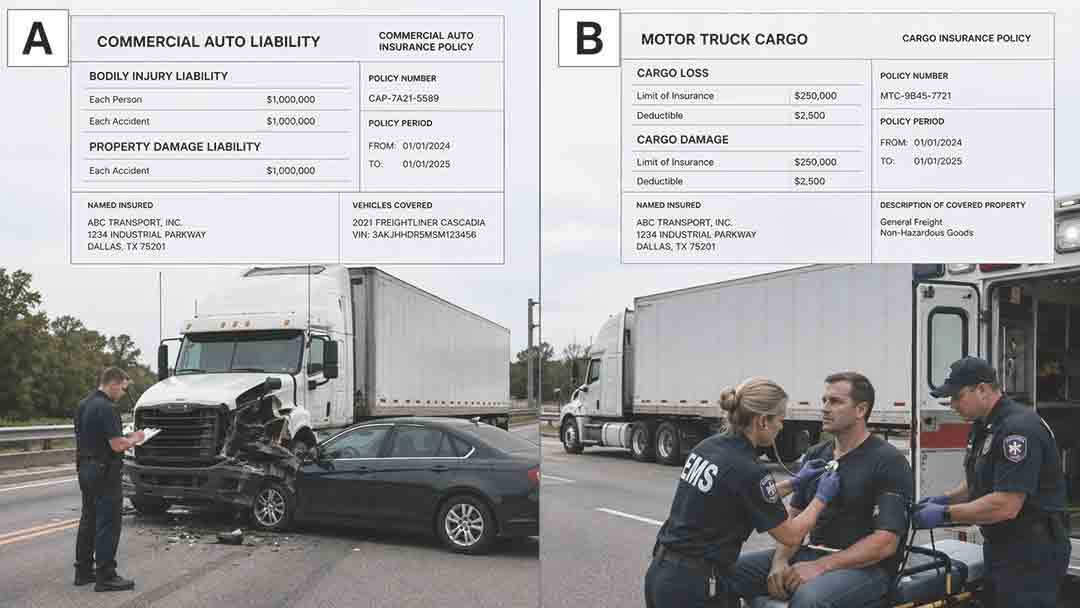
Commercial Auto Liability vs. Cargo, Physical Damage, and Workers' Compensation
Commercial auto insurance is a broad category of insurance associated with business vehicle operations.
Commercial auto liability insurance generally concerns covered liability to third parties for bodily injury or property damage.
Motor truck cargo coverage generally concerns property being transported as cargo.
Physical-damage coverage generally protects against covered damage to the insured commercial vehicle itself.
Workers' compensation generally addresses qualifying employee injuries through a separate statutory insurance system.
These coverages are designed for different risks and should not be treated as interchangeable.
The federal MCS-90 form illustrates the distinction. Its public-liability protection addresses bodily injury, property damage, and environmental restoration, while the form states that the relevant public-liability protection does not apply to property transported by the insured as cargo or to injury or death of the insured's employees while engaged in the course of employment.
For a motorist injured when a tractor-trailer collides with a passenger vehicle, commercial auto liability coverage is therefore generally more relevant to the third-party bodily injury claim than cargo or physical-damage insurance.
Federal Financial-Responsibility Requirements for Commercial Trucks
Federal requirements depend on the type of carrier, vehicle, cargo, and operation.
Current 49 CFR §387.9 establishes a $750,000 minimum for certain for-hire carriers operating vehicles with a gross vehicle weight rating of 10,001 pounds or more and transporting nonhazardous property in interstate or foreign commerce.
The same regulation establishes a $1 million minimum for specified transportation of oil, hazardous waste, hazardous materials, or hazardous substances that falls within the applicable regulatory category.
A $5 million minimum applies to specified higher-risk hazardous-material transportation categories described in the regulation.
These numbers are federal financial-responsibility minimums.
They are not universal policy limits for every commercial truck.
They do not predict the amount of compensation a claimant will receive.
They do not prove that a particular loss is insured.
They are not necessarily the maximum insurance available for a particular accident.
The actual insurance program may be larger or structured differently. A carrier may have primary insurance, excess coverage, other applicable policies, a surety arrangement, or authorized self-insurance.
Some operations also fall outside the specific federal requirement being discussed.
The better question is therefore not:
“Does every truck have at least $750,000 in coverage?”
The better question is:
“Which financial-responsibility rule applied to this carrier and operation, and what insurance or other financial-responsibility arrangements were actually in effect on the accident date?”
What Financial Responsibility Means for a Motor Carrier
Federal financial responsibility is not synonymous with one ordinary insurance policy.
Under 49 CFR §387.5, financial responsibility includes reserves such as insurance policies or surety bonds sufficient to satisfy the required public-liability amounts.
Under §387.7, proof of required financial responsibility for applicable property carriers can consist of an MCS-90 endorsement issued by an insurer, an MCS-82 motor-carrier surety bond, or written FMCSA authorization permitting the carrier to self-insure under the applicable regulatory framework.
These are different mechanisms.
MCS-90 involves an endorsement attached to a liability insurance policy.
MCS-82 is a surety-bond mechanism.
Authorized self-insurance involves FMCSA authorization rather than an ordinary third-party liability insurance policy satisfying the requirement in the same way.
A claimant should therefore not automatically conclude that no financial-responsibility protection exists merely because one conventional commercial auto policy cannot immediately be identified.
The carrier's legal name, operating authority, insurance filings, endorsements, bonds, and self-insurance status may all require investigation.
FMCSA also explains that financial-responsibility filing requirements depend on factors such as entity type, operating authority, cargo, and vehicle type.
Federal Minimum vs. Actual Policy Limit
No.
Federal minimum financial responsibility and actual insurance limits are different concepts.
Suppose a carrier is subject to the $750,000 federal minimum.
The carrier could maintain a $750,000 primary arrangement, but it could also maintain higher primary limits or additional excess insurance.
The federal minimum therefore does not establish the upper boundary of every potential claim.
The opposite point is equally important.
Finding a policy showing a large limit does not mean that the entire limit is automatically available to one claimant.
Coverage may depend on the identity of the insured, the covered vehicle, the accident, policy conditions, exclusions, applicable endorsements, other insurance, and governing law.
Multiple injured claimants arising from the same accident may also affect how available limits are relevant.
Federal minimum ≠ actual policy limit.
Actual policy limit ≠ settlement amount.
What the MCS-90 Endorsement Is
The MCS-90 is a federal motor-carrier public-liability endorsement used to satisfy applicable federal financial-responsibility requirements.
FMCSA states that the MCS-90 is required under 49 CFR §387.15 for covered motor carriers and that it is attached to the motor carrier's liability insurance policy rather than issued for an individual vehicle.
The current MCS-90 form provides that, within the limits stated in the endorsement, the insurer agrees to pay qualifying final judgments recovered against the insured for public liability resulting from negligence in the operation, maintenance, or use of motor vehicles subject to the federal financial-responsibility requirements.
However, several limitations are essential.
MCS-90 is not simply extra commercial auto insurance.
MCS-90 does not automatically increase the underlying policy limit.
MCS-90 does not automatically establish that a trucking company or driver was negligent.
MCS-90 does not guarantee payment of every truck accident claim.
MCS-90 does not automatically create an additional settlement fund on top of an ordinary commercial auto policy.
The form also states that the policy's terms remain binding between the insured and insurer and addresses reimbursement by the insured for certain payments the insurer would not otherwise have been obligated to make apart from the endorsement.
For claim analysis, MCS-90 should therefore be treated as a specialized federal financial-responsibility mechanism rather than a generic second insurance policy.
Insurance Documents That Matter After a Truck Accident
A declarations page can provide useful information, but it is not the entire insurance contract.
A complete investigation may require the commercial auto policy, declarations, endorsements, relevant vehicle schedules, MCS-90 documentation, FMCSA financial-responsibility filings, excess or umbrella policies, leasing agreements, owner-operator agreements, transportation agreements, ownership records, driver employment or contractor documents, and insurer correspondence.
BMC-91 and BMC-91X are among the forms used for proof of bodily injury and property-damage liability insurance filings with FMCSA where applicable. FMCSA also identifies the MCS-82 surety bond and MCS-90 endorsement among the relevant federal forms.
Different documents answer different questions.
A declarations page may identify limits and named insureds.
An endorsement may modify the policy.
A lease may help explain the relationship between the carrier and vehicle owner.
An FMCSA filing may help establish regulatory financial-responsibility information.
A coverage letter may identify an insurer's position on a particular claim.
These documents should be evaluated together rather than relying on one insurance card or certificate.
Who May Be Responsible for a Commercial Truck Accident
The driver and motor carrier are often central to the investigation, but responsibility depends on the facts and applicable law.
Other potentially relevant parties may include a vehicle owner, maintenance provider, equipment manufacturer, or another entity whose own conduct contributed to the collision.
The existence of a commercial relationship does not automatically establish liability.
For example, the fact that one business arranged transportation does not by itself establish that the company controlled the driver or is legally responsible for the driver's conduct.
Likewise, finding an insurance policy issued to one company does not automatically mean that every entity in the transportation chain is an insured.
A reliable investigation separates the questions.
First determine what happened.
Then determine which people or companies may be legally responsible.
Then determine what insurance or financial-responsibility arrangements apply to those parties.
How Evidence Can Support Truck Accident Liability
Insurance should follow the liability investigation rather than replace it.
Potential evidence may include police crash records, photographs, video, witness statements, ELD records, hours-of-service information, dispatch communications, GPS or telematics information, available vehicle electronic data, bills of lading, trip documents, driver records, maintenance information, vehicle ownership documents, leasing records, and insurance documentation.
Medical records help establish the injuries and treatment claimed to result from the crash.
No single piece of evidence automatically establishes liability in every case.
A truck accident attorney may compare multiple evidence sources to determine whether driver conduct, carrier practices, vehicle condition, maintenance, or another factor supports a claim under applicable law.
Insurance limits should not be used to reverse-engineer a theory of fault.
How Truck Accident Injuries Affect a Commercial Auto Liability Claim
The severity of an injury can affect damages, but a serious injury does not automatically establish liability.
A claimant generally needs evidence connecting the crash with the medical conditions for which compensation is sought.
Relevant documentation may include emergency treatment records, diagnostic imaging, hospital records, surgical documentation, specialist evaluations, therapy records, prescriptions, medical bills, work restrictions, and medically supported prognosis information.
The analysis should remain separated.
Injury evidence helps document physical harm.
Liability evidence addresses who is legally responsible.
Insurance analysis addresses whether coverage or financial responsibility responds.
Damages analysis addresses the losses recoverable under applicable law.
How Truck Accident Compensation Is Evaluated
There is no universal formula for calculating truck accident compensation.
Potentially recoverable damages depend on applicable law and the specific facts.
Common categories may include medical expenses, lost income, reduced earning capacity, property loss, and noneconomic damages where recognized by the governing jurisdiction.
A useful approach is to separate documented economic losses from overall legal claim value.
Consider a hypothetical claimant with:
Medical expenses of $72,000.
Lost wages of $24,000.
Vehicle and other property losses of $19,000.
The arithmetic subtotal is $115,000.
$115,000 is not automatically the value of the truck accident claim.
It is only the subtotal of three hypothetical documented economic-loss categories.
It does not establish liability.
It does not determine whether every medical charge is legally recoverable.
It does not establish noneconomic damages.
It does not account for comparative fault.
It does not establish available insurance.
It does not resolve disputes about medical causation.
There is no responsible universal truck accident settlement multiplier that can convert this subtotal into a predicted settlement.
Policy limit ≠ claim value.
Documented economic losses ≠ total claim value.
A Practical Liability-Coverage-Compensation Framework
A commercial auto liability investigation can be organized into eight stages.
Stage One: Establish the Crash
Determine where, when, and how the collision occurred.
Stage Two: Establish Injury and Property Damage
Document the physical injuries and property losses associated with the accident.
Stage Three: Identify Potentially Responsible Conduct
Investigate driving behavior, hours, maintenance, supervision, vehicle condition, and other relevant circumstances.
Stage Four: Identify Legally Responsible Parties
Determine which individuals or companies may bear responsibility under applicable law.
Stage Five: Identify Insurance and Financial Responsibility
Locate commercial auto insurance, MCS-90 documentation where relevant, federal filings, excess insurance, bonds, or authorized self-insurance.
Stage Six: Determine Insured Status and Coverage
Determine whether the responsible person or company qualifies under the relevant policy or arrangement and whether that coverage applies to the accident.
Stage Seven: Evaluate Damages
Document each potentially recoverable category of loss separately.
Stage Eight: Evaluate Resolution
Analyze the evidence, liability, defenses, available coverage, and damages before evaluating settlement or litigation options.
This is an investigative framework, not a legal scoring system.
Success at one stage does not guarantee success at the next stage.
Real-World-Style Example: One Crash, Several Insurance Questions
Consider a hypothetical tractor-trailer collision in which a truck changes lanes and strikes a passenger vehicle.
The passenger suffers substantial injuries.
The crash report identifies Driver A and Carrier B.
Carrier B maintains a commercial auto liability policy.
The tractor is owned by Leasing Company C.
The investigation also identifies an excess liability policy.
At first glance, someone may assume:
“The trucking company has insurance, so the claim is simple.”
The actual analysis involves separate questions.
Did Driver A cause or contribute to the collision?
Was Driver A acting for Carrier B?
Does Driver A qualify as an insured under the relevant policy?
Does the commercial auto policy apply to the vehicle and accident?
Does Leasing Company C have any independent legal responsibility?
What is the primary policy structure?
Does an excess policy apply?
What must occur before excess insurance attaches?
Are there multiple injured claimants?
What damages can the passenger support with evidence?
Has any insurer raised a coverage defense?
Is an MCS-90 endorsement relevant?
Each answer addresses a different part of the case.
Identifying an insurance company is therefore the beginning of the coverage investigation, not the end.
Primary and Excess Insurance
Commercial insurance programs can include multiple layers of coverage.
Primary commercial auto liability insurance generally responds according to its terms before an applicable excess policy.
Excess coverage typically becomes relevant only when its attachment requirements and other terms are satisfied.
The existence of an excess policy does not automatically mean that it must pay a claim.
The analysis can depend on the insured, the accident, the vehicle, the underlying insurance, policy exclusions, notice provisions, and the amount of covered liability.
A statement such as “the carrier has $5 million in insurance” may therefore be incomplete.
That amount could represent one policy, a primary policy combined with one or more excess layers, or another insurance structure.
The structure matters as much as the headline number.
Coverage Denials, MCS-90, and Evidence Preservation
A coverage denial does not automatically determine the underlying liability claim.
Liability and coverage are separate questions.
A denial may involve disputes about whether the person was insured, whether the vehicle was covered, whether the policy was in force, whether an exclusion applies, whether required conditions were satisfied, whether another insurer is primary, whether an excess policy applies, or whether a federal financial-responsibility mechanism is relevant.
A written coverage denial is an insurer's coverage position.
It is not automatically the final legal determination of either insurance coverage or the driver's or carrier's liability for the crash.
The policy, endorsements, facts, and applicable law should be reviewed before concluding that no potential recovery source exists.
How Can the MCS-90 Matter in a Coverage Dispute?
Potentially, but only when its requirements apply.
The MCS-90 exists within the federal motor-carrier financial-responsibility framework and contains an undertaking concerning qualifying final judgments for public liability within the endorsement's stated limits.
Its presence does not mean that every ordinary policy exclusion disappears for every purpose.
It does not automatically create coverage for every party.
It does not automatically add another layer to the policy limits.
It does not establish negligence.
It does not guarantee payment before its applicable requirements are satisfied.
Whether an MCS-90 affects a particular coverage dispute is a legal question requiring analysis of the endorsement, federal rules, underlying policy, insured motor carrier, facts, and applicable case law.
What Evidence Should Be Preserved for the Insurance Side of a Truck Accident Claim?
Crash evidence and insurance evidence should both be preserved.
Potentially useful insurance-related materials include the motor carrier's legal name, USDOT information, operating-authority information where applicable, commercial auto policy documents, declarations, endorsements, MCS-90 documentation, FMCSA financial-responsibility filings, excess and umbrella policies, vehicle ownership records, leasing agreements, driver employment or contractor records, claim correspondence, coverage letters, settlement communications, medical records, wage-loss documentation, and property-loss records.
Keep copies of insurer communications and record important dates.
Do not assume that a certificate of insurance or insurance card contains every legally relevant policy term.
Common Mistakes and Attorney Evaluation
Mistake One: Assuming Every Truck Has $750,000 of Coverage
The $750,000 figure applies to a defined federal category. Other operations may have different requirements or may not fall within that particular rule.
Mistake Two: Assuming the Federal Minimum Is the Actual Policy Limit
Federal minimum financial responsibility and the actual insurance program are different concepts.
Mistake Three: Assuming a Large Policy Means a Large Settlement
A policy limit establishes potential insurance capacity subject to coverage. It does not establish liability, damages, or settlement value.
Mistake Four: Treating Cargo Insurance as Bodily Injury Liability Insurance
Cargo and public-liability coverage address different risks.
Mistake Five: Treating MCS-90 as Extra Insurance
MCS-90 is a specialized federal endorsement, not a generic additional policy that should automatically be stacked on top of commercial auto insurance.
Mistake Six: Assuming Every Truck Has an MCS-90
Whether an MCS-90 is required or relevant depends on the carrier and applicable federal financial-responsibility framework.
Mistake Seven: Assuming Every Company in the Transportation Chain Is Liable
Participation in a commercial transportation transaction does not automatically establish civil responsibility for a crash.
Mistake Eight: Using a Settlement Multiplier
There is no universal multiplier that can responsibly convert medical bills, insurance limits, or federal minimum requirements into a predicted trucking accident settlement.
Questions That May Help When Comparing Truck Accident Attorneys
For a serious commercial vehicle case, useful questions focus on liability and insurance analysis rather than promises of a specific recovery.
Ask how the attorney will identify potentially responsible parties.
Ask how commercial auto policies will be obtained and reviewed.
Ask whether FMCSA financial-responsibility information will be investigated where relevant.
Ask whether excess or umbrella insurance will be examined.
Ask how vehicle ownership, leasing, and driver relationships will be analyzed.
Ask how electronic driving data, dispatch communications, maintenance information, and other crash evidence will be preserved.
Ask how medical expenses, lost income, property damage, and possible future losses will be documented.
Ask how attorney fees and litigation expenses are handled.
A truck accident lawyer or commercial truck accident lawyer should be able to explain why an insurance policy may be relevant without promising that the policy limit will be recovered.
No responsible personal injury attorney can guarantee a settlement or compensation amount before liability, coverage, damages, and applicable law have been evaluated.
General Considerations for Different Claim Situations
If the crash happened recently, preserve evidence and accurately identify the motor carrier and vehicle.
If an insurer has contacted you, preserve all correspondence and understand what releases or statements are being requested before signing documents that may affect legal rights.
If the carrier says it is self-insured, do not automatically assume there is no financial-responsibility arrangement. Federal regulations recognize authorized self-insurance as one method of satisfying applicable requirements.
If an insurer denies coverage, obtain and preserve the written coverage position. Coverage denial does not automatically eliminate the underlying liability claim.
If the accident involves serious injuries, multiple vehicles, leased equipment, several businesses, or layered insurance, analyze liability, insured status, coverage, and compensation as separate but connected issues.
Practical Conclusion
A commercial auto liability claim is not simply an insurance claim attached to a large policy limit.
A reliable analysis begins with the crash, identifies the responsible conduct and legally responsible parties, determines which insurance or financial-responsibility arrangements may apply, and then evaluates documented damages under applicable law.
The central distinctions should remain clear:
Liability ≠ insured status.
Insured status ≠ coverage.
Coverage ≠ compensation.
Federal minimum ≠ actual policy limit.
Policy limit ≠ settlement amount.
MCS-90 ≠ automatic additional insurance.
For someone injured in a commercial truck crash, practical priorities include preserving evidence, documenting medical treatment and financial losses, identifying the carrier and vehicle correctly, and determining the actual insurance structure.
The most useful question is not:
“How much insurance does a trucking company usually have?”
It is:
“Which person or company is legally responsible, which insurance or financial-responsibility arrangement applies to that party and accident, and which losses can be supported by evidence?”
Frequently Asked Questions, Conclusion, and Sources
Does Commercial Auto Liability Insurance Cover Injuries to Other Drivers?
Potentially.
Commercial auto liability insurance generally addresses covered liability for bodily injury and property damage to third parties. Whether a particular accident is covered depends on the policy, insured parties, vehicle, accident circumstances, exclusions, and applicable law.
Is the Federal $750,000 Minimum the Most a Truck Accident Claim Can Recover?
No.
The $750,000 figure is a federal minimum for a specified category of qualifying property carriers. Current §387.9 also contains $1 million and $5 million minimums for specified higher-risk cargo categories. Actual insurance may exceed the applicable federal minimum.
Does Every Commercial Truck Have an MCS-90?
No.
FMCSA describes the MCS-90 as an endorsement required for motor carriers subject to the applicable federal financial-responsibility rules. Whether it is required or relevant depends on the carrier and operation.
Does an MCS-90 Automatically Pay a Truck Accident Claim?
No.
The MCS-90 contains specific terms concerning qualifying final judgments for public liability. It does not automatically establish negligence, increase policy limits, or guarantee payment of every claim.
Can More Than One Insurance Policy Apply to a Truck Accident?
Potentially.
A claim may involve primary commercial auto insurance, excess or umbrella insurance, or insurance associated with another legally responsible party. Each policy must be evaluated separately under its terms and applicable law.
Does a Commercial Auto Policy Limit Determine Truck Accident Compensation?
No.
A policy limit defines an insurance boundary subject to the policy and applicable law. It does not establish liability or determine the amount of legally recoverable damages.
Sources
Electronic Code of Federal Regulations. 49 CFR Part 387, Minimum Levels of Financial Responsibility for Motor Carriers.
https://www.ecfr.gov/current/title-49/subtitle-B/chapter-III/subchapter-B/part-387
Electronic Code of Federal Regulations. 49 CFR §387.9, Financial Responsibility, Minimum Levels.
https://www.ecfr.gov/current/title-49/subtitle-B/chapter-III/subchapter-B/part-387/subpart-A/section-387.9
Federal Motor Carrier Safety Administration. Insurance Filing Requirements.
https://www.fmcsa.dot.gov/registration/insurance-filing-requirements
Federal Motor Carrier Safety Administration. Form MCS-90 — Endorsement for Motor Carrier Policies of Insurance for Public Liability.
https://www.fmcsa.dot.gov/registration/form-mcs-90-endorsement-motor-carrier-policies-insurance-public-liability-under
Federal Motor Carrier Safety Administration. Current MCS-90 Form.
https://www.fmcsa.dot.gov/sites/fmcsa.dot.gov/files/2024-08/MCS-90%20Form.pdf
Federal Motor Carrier Safety Administration. Insurance Forms FAQ.
https://www.fmcsa.dot.gov/faq/what-forms-are-required-insurance-and-where-can-i-find-them
Source Review Date: August 13, 2026