Key Takeaways
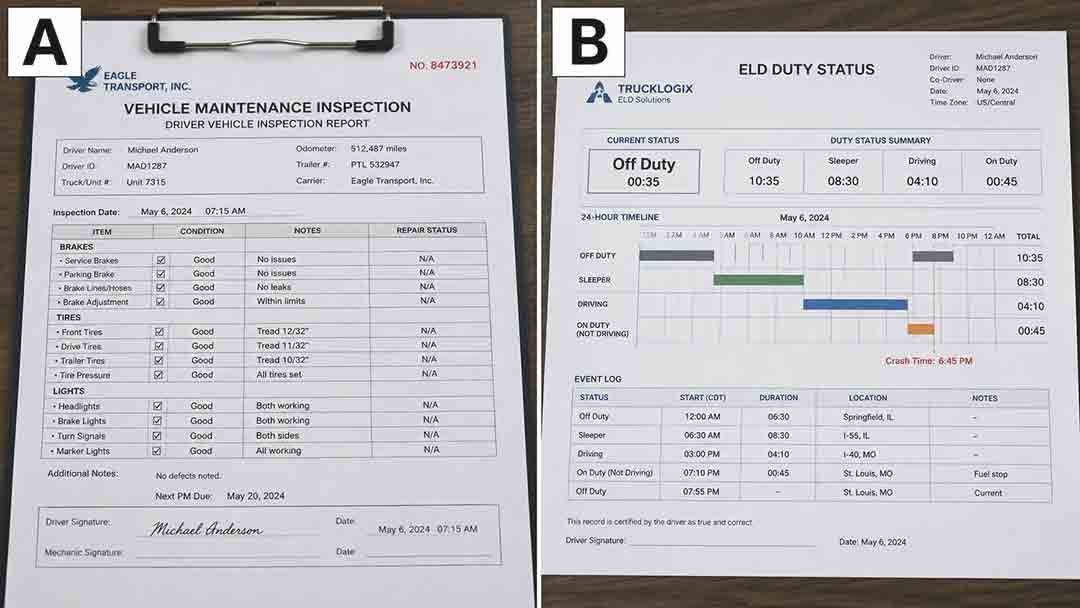
Electronic logging device records can be important evidence in a truck accident claim because they may show when a commercial driver was driving, on duty, resting, and operating the vehicle. When ELD data is compared with dispatch records, location information, receipts, and other records, it can help determine whether driver-hour rules were followed and whether fatigue or scheduling practices may have contributed to a crash.
Key Takeaways
- ELD records can help establish a driving and duty-status timeline, but an ELD does not directly measure whether a driver was fatigued. Federal rules require ELDs to record data such as date, time, commercial vehicle location, engine hours, vehicle miles, driver identification, vehicle identification, and motor-carrier identification.
See 49 CFR §395.26.
- For most property-carrying commercial drivers subject to the standard federal rules, the regulations include 10 consecutive hours off duty before driving, an 11-hour driving limit, a 14-hour driving window, a 30-minute interruption after more than eight cumulative hours of driving, 60/70-hour limits, and a possible 34-hour restart. Exceptions and special provisions can apply.
- A violation of an hours-of-service rule may support an investigation, but it does not automatically establish truck accident liability or prove that the violation caused the collision. The legal effect of a regulatory violation depends on applicable law and the facts.
- ELD logs are often more useful when compared with dispatch records, bills of lading, trip records, fleet communications, expense receipts, payroll records, settlement sheets, and other supporting evidence. Federal regulations identify several of these record categories as supporting documents for records of duty status.
- Federal rules generally require motor carriers to retain records of duty status and required supporting documents for at least six months. ELD records also require a separate backup for six months.
This guide explains what ELD logs can and cannot establish, how federal driver-hour limits work, which records should be compared with electronic logs, how carrier scheduling may become relevant, and how the resulting evidence may affect liability and compensation.
Legal Information Notice
This article provides general U.S. legal information and is not legal advice. Truck accident liability, negligence standards, evidence rules, statutes of limitation, comparative-fault rules, insurance coverage, available damages, and the legal significance of regulatory violations can vary by jurisdiction and individual case.
Federal hours-of-service rules also include exemptions and special provisions. A licensed attorney in the relevant jurisdiction can evaluate which federal and state rules may apply to a particular commercial vehicle, driver, carrier, route, and accident.
How ELD Logs Can Support a Truck Accident Claim
ELD records can help reconstruct what a commercial driver and vehicle were doing before a crash.
An electronic logging device, or ELD, is used to electronically record driver duty-status information when federal ELD requirements apply. Under 49 CFR §395.26, an ELD automatically records information including date, time, commercial motor vehicle location, engine hours, vehicle miles, driver identification, vehicle identification, and motor-carrier identification.
See the current eCFR text for 49 CFR §395.26.
Those records can help answer questions such as:
When did the driver begin the work period?
How much driving time had accumulated?
When were breaks recorded?
When was the truck moving?
How long had the driver been on duty?
Had the driver reached an applicable driving or on-duty limit?
Were duty-status records later corrected or annotated?
These questions can be relevant when a collision involves possible fatigue, excessive driving hours, inaccurate records, or carrier scheduling practices.
ELD evidence should not normally be viewed in isolation. Its greatest value often comes from comparison with independent business, trip, and vehicle records.
What an ELD Actually Records
An ELD records specific operational data. It does not directly measure a driver's fatigue.
Federal regulations require automatic recording of date, time, commercial vehicle location information, engine hours, vehicle miles, driver or authenticated-user identification, vehicle identification, and motor-carrier identification. The system also creates records at events such as changes in duty status, engine power-up or shutdown, and periodic intervals while the commercial vehicle is moving.
This creates an important distinction:
ELD evidence can establish or help reconstruct a timeline.
ELD evidence does not directly establish a driver's level of sleepiness, actual sleep duration, reaction time, mental alertness, distraction, or the cause of a collision.
A log showing compliance with the numeric HOS limits therefore does not automatically prove that a driver was alert or driving safely.
Federal law separately addresses fatigue. Under 49 CFR §392.3, a commercial driver may not operate, and a motor carrier may not require or permit operation, when the driver's ability or alertness is so impaired or likely to become impaired by fatigue, illness, or another cause that continued operation would be unsafe.
See 49 CFR §392.3.Federal Driver-Hour Rules That May Apply
For property-carrying commercial drivers subject to the standard federal hours-of-service rules, 49 CFR §395.3 establishes several important limits.
Federal HOS Rule Standard Property-Carrying Rule Why It Matters
Off-duty period before driving 10 consecutive hours off duty before driving Helps determine when a new driving period may begin
11-hour driving limit Up to 11 hours of driving during the applicable 14-hour period Additional driving may require investigation once the limit is reached
14-hour driving window Generally no driving after the 14th consecutive hour after coming on duty following 10 consecutive hours off Non-driving work can consume part of the window
30-minute interruption rule Driving is generally prohibited after more than 8 cumulative hours of driving without at least a consecutive 30-minute interruption in driving status Helps evaluate break timing
60/70-hour limits Generally no driving after 60 hours on duty in 7 days or 70 hours in 8 days, depending on carrier operations Requires review of multiple days
34-hour restart A period of at least 34 consecutive hours off duty can restart the applicable 7- or 8-day period Can change the cumulative-hours analysis
FMCSA's current summary confirms these basic standard property-carrying limits.
See FMCSA's Summary of Hours of Service Regulations.
Exceptions and Special Rules Can Change the Analysis
These standard limits should not be mechanically applied to every truck trip.
Part 395 contains exceptions and special provisions, including the short-haul exception, sleeper-berth rules, adverse-driving-condition provisions, and rules applicable to certain specialized operations. For example, qualifying short-haul drivers can be exempt from some record-of-duty-status requirements, while the adverse-driving-condition rule can alter certain driving limits when its requirements are met.
Passenger-carrying commercial operations also use different maximum-driving rules.
A reliable truck accident investigation therefore begins by identifying which federal rule actually governed the driver and trip.
Hours-of-Service Violations and Liability
No.
An HOS violation can be important evidence, but the legal analysis does not end with the violation.
A useful evidence chain is:
Crash → Driver Timeline → HOS Status → ELD / Supporting Records → Driver or Carrier Conduct → Causation → Liability → Damages
Each part answers a different question.
For example, evidence that a driver continued operating after an applicable driving limit may establish a regulatory compliance issue.
It does not automatically establish that excessive hours caused the collision.
The legal significance of a federal safety-rule violation can vary under applicable state law. The claimant may still need evidence connecting the relevant conduct to the crash and claimed injuries.
Conversely, a driver may remain within the numeric HOS limits yet still be too fatigued to drive safely. Federal §392.3 separately prohibits unsafe operation when alertness is impaired or likely to become impaired through fatigue or another cause.
Regulatory violation = evidence.
Causation = a separate issue.
Liability and damages = separate legal analyses.
Records to Compare With ELD Logs
ELD data becomes more informative when independent evidence confirms or contradicts the recorded timeline.
Under 49 CFR §395.11, federal supporting-document requirements identify categories including bills of lading, itineraries or schedules, dispatch and trip records, certain expense receipts, electronic fleet-management communications, payroll records, and settlement sheets. These records are used under the federal framework to help verify on-duty-not-driving time.
See 49 CFR §395.11.
Evidence What It May Show What to Compare With ELD Data
Dispatch records Assigned loads, trip instructions, scheduling Duty periods and driving timeline
Bills of lading Shipment origin, destination, and trip information Location and trip sequence
Fleet communications Instructions, delays, objections, or scheduling issues Log entries and vehicle movement
Expense or fuel receipts Time and location information Recorded duty status and geographic sequence
Payroll or settlement records Work or trip activity On-duty and driving periods
GPS or telematics Vehicle movement and location ELD driving events and location data
Engine or vehicle records Vehicle operation or event information ELD vehicle-motion records
Witness statements Driver behavior or crash circumstances Electronic timeline
Police crash records Collision time, location, and observations Final portion of the reconstructed trip
This is an investigative comparison framework, not a legal scoring system.
A discrepancy does not automatically prove falsification or liability. Differences may have legitimate explanations and should be investigated before conclusions are drawn.
ELD Edits, Corrections, and Annotations
Yes. Federal rules allow limited corrections and annotations designed to improve record accuracy.
Under 49 CFR §395.30, a driver must review the driver's records, correct inaccurate information, enter missing information, and certify the resulting record. Carrier personnel can propose certain edits after records are submitted, but the driver must confirm or reject the proposed change before it takes effect. Changes and additions must be annotated.
See 49 CFR §395.30.
FMCSA guidance also explains that the original ELD record remains available with the edits and that automatically recorded driving time generally cannot simply be shortened or converted to non-driving time, subject to limited technical exceptions specified in the ELD rules.
See FMCSA's ELD Editing and Annotations Guidance.
That means an investigation may ask:
Was a duty status changed?
Who proposed or made the edit?
Why was the change made?
Was an annotation entered?
Did the driver confirm or reject a carrier-proposed change?
How does the original record compare with the corrected record?
Do other trip records support the explanation?
An edit does not automatically mean wrongdoing.
Correcting inaccurate information is expressly contemplated by the federal ELD system. The relevant issue is whether the records accurately reflect what occurred.
Why Supporting Documents Matter
Supporting records help test whether the electronic log matches the driver's actual work activity.
Suppose an ELD shows an off-duty period. A fleet-management communication created during that period may show the driver receiving and responding to work instructions.
That discrepancy does not automatically establish an HOS violation, but it can justify further investigation into whether the duty-status classification accurately reflected the driver's activity.
Similarly, a receipt or shipment document may provide time and location information that can be compared against the electronic timeline.
Federal regulations specifically identify dispatch records, trip records, bills of lading, certain expense receipts, electronic fleet-management communications, payroll records, and settlement sheets among qualifying supporting-document categories.
The practical principle is simple:
ELD logs provide one layer of evidence.
Supporting records can corroborate or challenge that layer.
ELD Record Retention
Federal regulations generally require motor carriers to retain records of duty status and required supporting documents for at least six months.
The ELD regulations also require a motor carrier to keep a backup copy of ELD records on a separate device for six months.
See 49 CFR §395.22(i).
FMCSA provides the same explanation in its ELD retention guidance.
See FMCSA's ELD RODS Retention Guidance.
This does not mean all trucking records are deleted after six months.
Other company records, insurance records, vehicle data, communications, maintenance information, employment files, and litigation-related materials can be governed by different retention periods or preservation duties.
The federal six-month rule specifically makes timely attention to RODS and required supporting documents important after a serious collision.
Step-by-Step Driver-Hours Reconstruction
A useful reconstruction starts with the crash and works backward.
Step 1: Establish the Crash Time and Location
Start with the most reliable available evidence showing when and where the collision occurred.
Possible sources include police records, photographs, video, dispatch communications, electronic vehicle data, telematics, and witness information.
Step 2: Obtain the Driver's Duty Records
Review the driver's ELD or other legally permitted record of duty status for the crash date.
The investigation may also require previous days because the 60/70-hour limits measure cumulative on-duty time across seven or eight consecutive days.
Step 3: Identify the HOS Rule That Applied
Determine whether the trip was governed by the standard property-carrying rules, a short-haul exception, a sleeper-berth provision, an adverse-driving-condition provision, or another applicable rule.
Do not assume that the standard 11-hour and 14-hour limits resolve the analysis until exemptions and special provisions have been checked.
Step 4: Calculate Driving and On-Duty Time Separately
Driving time and on-duty time are different concepts.
Federal regulations define on-duty time broadly and can include activities such as waiting to be dispatched, inspecting or servicing a commercial vehicle, loading or unloading, and performing other work for a motor carrier.
A driver can therefore use part of the 14-hour window without the truck moving.
Step 5: Review Breaks and Off-Duty Periods
Determine whether the recorded interruptions and off-duty periods satisfy the rule that applies to the operation.
Then compare those periods with fleet communications, location information, receipts, and other independent evidence.
Step 6: Review the Prior Seven or Eight Days
The 60/70-hour rule cannot be evaluated from the crash-day log alone.
Review cumulative on-duty time and determine whether a valid restart or another applicable provision affected the calculation.
Step 7: Compare ELD Records With Independent Evidence
Identify meaningful inconsistencies.
A discrepancy is a question to investigate—not automatic proof of falsification, fatigue, negligence, or causation.
Practical Driver-Hours Example
Consider a hypothetical property-carrying driver subject to the standard federal HOS rules, with no special exception changing the calculation.
The driver completes the required off-duty period and comes on duty at 5:00 a.m.
The driver begins driving at 6:00 a.m. and drives for five hours.
After a qualifying 30-minute non-driving period, the driver resumes at 11:30 a.m. and drives another six hours.
The accumulated driving time is:
5 hours + 6 hours = 11 hours.
At 5:30 p.m., the driver has accumulated 11 hours of driving.
Under the standard property-carrying rule, additional driving would generally require investigation because §395.3 permits a total of 11 driving hours during the applicable period, unless another valid provision changes the analysis.
Suppose a collision occurs 20 minutes later while the driver is still operating the truck.
The first question is whether an exception or special rule applied. For example, qualifying adverse driving conditions can alter the standard maximum under specified circumstances.
If no applicable exception changes the calculation, the additional driving can become relevant evidence in an HOS investigation.
Now suppose dispatch communications also show that carrier personnel knew the driver was reaching the applicable limit but continued demanding immediate delivery.
Those messages could become relevant to the investigation of carrier conduct.
However:
The calculation alone does not prove fatigue.
The calculation alone does not prove causation.
The calculation alone does not establish civil liability or compensation.
The stronger analysis asks whether continued driving violated an applicable rule, whether the driver or carrier knew of the issue, whether fatigue was actually present, whether excessive hours contributed to the collision, and what other causes may have been involved.
Carrier Scheduling, Pressure, and Coercion
Potentially.
Federal regulations prohibit certain forms of coercion.
Under 49 CFR §390.6, a motor carrier, shipper, receiver, or transportation intermediary may not coerce a commercial driver to operate in violation of specified Federal Motor Carrier Safety Regulations.
See 49 CFR §390.6.
FMCSA issued updated coercion guidance effective April 28, 2026. Examples include pressuring a driver to exceed driving limits or ignore required breaks, pressuring a driver to falsify logs, and forcing a driver to operate while too fatigued or ill to drive safely. FMCSA expressly notes that this guidance explains existing rules and is not itself an independent legal basis for enforcement.
See FMCSA's 2026 Prohibited Coercion FAQs.
Potentially relevant evidence can include:
- dispatch messages;
- fleet-management communications;
- emails or texts;
- load assignments;
- delivery schedules;
- driver objections;
- scheduling changes;
- ELD edit requests;
- internal operational records.
Evidence of scheduling pressure does not automatically establish civil liability against a trucking company, shipper, broker, or other entity.
Its legal significance depends on the conduct, the entity's role, causation, and applicable law.
How ELD Evidence Can Affect Liability
ELD evidence can help establish facts relevant to liability, but the questions should remain separate.
A practical liability framework asks:
Question 1: Which HOS rule applied?
Question 2: What does the original ELD data show?
Question 3: Do supporting records corroborate the timeline?
Question 4: Was there an hours, fatigue, recordkeeping, or scheduling issue?
Question 5: Is there evidence connecting that issue to the collision?
Question 6: Which person or company may be legally responsible under applicable law?
This separation matters.
Regulatory violation = evidence.
Causation = separate issue.
Liability = separate legal determination.
Damages = separate analysis of the losses legally attributable to the accident.
Parties That May Require Investigation
The truck driver and motor carrier are often central to an HOS investigation, but responsibility should not be assumed before the evidence is reviewed.
The driver's conduct may involve:
- driving decisions;
- duty-status entries;
- compliance with HOS limits;
- response to fatigue;
- certification of records.
The motor carrier's conduct may involve:
- dispatching;
- scheduling;
- supervision;
- recordkeeping;
- ELD administration;
- proposed ELD edits;
- decisions to permit or require continued operation.
Under §395.3, both the driver and motor carrier are addressed by the standard property-carrying HOS restrictions. Federal fatigue rules likewise prohibit both unsafe operation by the driver and a carrier's requirement or permission for unsafe fatigued operation.
Other entities may sometimes require factual investigation, particularly if evidence suggests coercion or meaningful operational involvement.
Their civil liability depends on applicable law and the evidence. Participation in arranging transportation does not automatically make an entity liable for a collision.
How ELD Evidence Can Affect Compensation
ELD evidence may strengthen or weaken the factual basis for a claim, but it does not create a compensation formula.
Depending on applicable law and the facts, potentially recoverable losses in a personal injury matter may include categories such as medical expenses, lost income, reduced earning capacity, property damage, pain and suffering, or other damages recognized by the jurisdiction.
The analysis should separate:
What losses can be documented?
Who is legally responsible for those losses?
Consider a hypothetical claimant with:
$38,000 in medical expenses
$16,000 in documented lost wages
$6,000 in vehicle and property losses
The subtotal is:
$38,000 + $16,000 + $6,000 = $60,000.
$60,000 is not automatically the value of the truck accident claim.
It is only a hypothetical subtotal of three documented categories of loss.
Other damages, causation disputes, comparative-fault rules, insurance limits, defenses, and applicable state law may affect the eventual claim value, settlement, or judgment.
There is no valid universal “ELD violation compensation multiplier” or fixed settlement multiplier.
Evidence Preservation After a Serious Truck Crash
A practical evidence-preservation checklist may include:
- ELD records of duty status;
- original ELD event history;
- ELD edits and annotations;
- driver certifications;
- relevant unassigned or unidentified driving events;
- dispatch records;
- trip records;
- bills of lading;
- fleet-management communications;
- qualifying supporting receipts;
- driver payroll or settlement records;
- GPS or telematics information;
- available engine or vehicle electronic data;
- relevant driver qualification and employment records;
- schedules and load instructions;
- crash photographs and video;
- police and investigative records;
- medical documentation related to the claimed injuries.
Not every category will exist or be relevant in every case.
Federal regulations specifically impose retention requirements on RODS and required supporting documents, while other business and vehicle records may follow different rules.
Common Mistakes and Attorney Evaluation
Mistake 1: Assuming an ELD Measures Fatigue
It does not.
An ELD records operational and duty-status information. Fatigue requires a broader factual analysis.
Mistake 2: Reviewing Only the Crash Day
The 60/70-hour limits require a multi-day analysis.
The prior seven or eight days may materially change the HOS calculation.
Mistake 3: Treating Every Edit as Falsification
Federal rules permit legitimate corrections and annotations.
Carrier-proposed changes require driver confirmation or rejection, and the ELD system retains the original information together with the edit history.
An edit does not automatically mean wrongdoing.
Mistake 4: Ignoring Supporting Documents
Dispatch records, fleet communications, bills of lading, receipts, payroll information, and other records can add context to the electronic log.
Mistake 5: Assuming Every Commercial Driver Uses the Same HOS Rules
Exceptions and special operating rules exist.
The regulatory framework must be identified before calculating a violation.
Mistake 6: Assuming a Violation Automatically Determines Liability
A regulatory violation may be relevant evidence.
It does not automatically prove negligence, causation, truck accident liability, or entitlement to compensation.
Questions That May Help When Comparing Truck Accident Attorneys
A useful consultation should focus on evidence and legal analysis rather than promised results.
Questions may include:
How will the ELD data be preserved and obtained?
Will the original events and edit history be reviewed?
Which federal HOS rules appear to apply?
Will exemptions and special rules be checked?
Will the driver's preceding seven or eight days be analyzed?
Which supporting records will be compared with the ELD?
Will dispatch communications and scheduling be reviewed?
What other electronic vehicle or telematics data may exist?
Which parties actually require investigation?
How are legal fees and case expenses handled?
For a serious commercial vehicle collision, a commercial truck accident lawyer may also need to distinguish federal regulatory compliance issues from the separate state-law requirements governing causation, negligence, damages, and comparative fault.
A truck accident lawyer or personal injury attorney should not guarantee a settlement or compensation amount before the evidence, liability rules, insurance issues, and documented losses have been evaluated.
General Considerations for Different Claim Situations
If the Crash Happened Recently
Evidence preservation may deserve early attention because the federal RODS and supporting-document retention requirement is measured in months rather than indefinitely.
If Driver Fatigue Is Suspected
Do not focus only on the final hour before the crash.
Review the full duty timeline, prior days, off-duty periods, dispatch communications, and evidence of the driver's condition.
If the ELD Appears Fully Compliant
Do not assume compliance with numeric HOS limits eliminates every possible safety issue.
Other causes of the crash should still be investigated, and §392.3 separately addresses unsafe operation caused by fatigue or impaired alertness.
If the Log Conflicts With Other Records
Preserve both sources.
Investigate why location information, communications, receipts, or other records differ from the ELD rather than assuming one source must be fraudulent.
If Serious Injuries or Disputed Liability Are Involved
A qualified attorney can evaluate how the federal trucking evidence interacts with state negligence, causation, insurance, and damages rules.
Practical Conclusion
ELD logs can be valuable evidence because they create an electronic record of driver and vehicle activity. Their greatest value comes from comparison with other evidence.
A careful investigation asks which HOS rule actually applied, whether any exception changed the calculation, what the original ELD data shows, whether independent records support the timeline, whether the driver or carrier knew of a safety issue, and whether the evidence connects that issue to the collision.
The practical evidence chain is:
Crash → Driver Timeline → HOS Status → ELD / Supporting Records → Conduct → Causation → Liability → Damages
A strong truck accident claim should not begin with a guaranteed settlement figure or a presumed liability conclusion.
It should begin with determining what happened, which records can establish it, which legal rules apply, who may be responsible, and which losses can be documented.
Frequently Asked Questions, Conclusion, and Sources
Can ELD Logs Prove That a Truck Driver Was Fatigued?
Not by themselves.
ELD records can establish driving time, duty status, vehicle activity, and other operational information. They do not directly measure fatigue or alertness.
Fatigue analysis may require additional evidence, and 49 CFR §392.3 separately prohibits unsafe operation when fatigue or another condition impairs or is likely to impair safe driving.
How Far Back Should Driver Logs Be Reviewed?
It depends on the issue.
For standard property-carrying operations, the 60/70-hour rules require analysis of cumulative on-duty time across seven or eight consecutive days. Reviewing only the crash day can therefore miss a cumulative-hours problem.
Can a Trucking Company Change an ELD Log After a Crash?
Limited corrections are permitted under federal ELD rules.
Carrier-proposed changes require driver confirmation or rejection, edits require annotations, and the original ELD information is retained with the edit history. An edit does not automatically mean wrongdoing.
What If the Driver Was Within the 11-Hour Limit?
That does not automatically resolve the case.
The 14-hour window, 60/70-hour limits, applicable exceptions, fatigue rule, other safety regulations, and non-HOS causes may still require investigation.
How Long Must a Motor Carrier Keep ELD Records?
Federal rules generally require records of duty status and required supporting documents to be retained for at least six months. ELD records also require a separate backup copy for six months. Other company records may be governed by different retention requirements.
Does an Hours-of-Service Violation Automatically Increase a Truck Accident Settlement?
Not automatically.
An HOS violation may become relevant to liability when supported by evidence and connected to the collision, but compensation can also depend on causation, injuries, documented damages, comparative fault, insurance, defenses, and applicable state law.
There is no fixed compensation multiplier for an ELD or driver-hours violation.
Sources
Federal Motor Carrier Safety Administration — Summary of Hours of Service Regulations
Provides FMCSA's summary of standard property-carrying and passenger-carrying driver limits, including the 11-hour limit, 14-hour window, 30-minute driving interruption, 60/70-hour limits, 34-hour restart, and selected exceptions.
eCFR — 49 CFR §395.3, Maximum Driving Time for Property-Carrying Vehicles
Current federal regulatory text for standard property-carrying driver-hour limits. eCFR Title 49 was current through amendments dated August 7, 2026 when reviewed.
eCFR — 49 CFR Part 395, Hours of Service of Drivers
Contains definitions, scope provisions, exemptions, sleeper-berth provisions, short-haul rules, and other HOS requirements relevant to determining which rules apply.
eCFR — 49 CFR §395.8, Driver's Record of Duty Status
Includes RODS requirements and the requirement to retain records of duty status and supporting documents for at least six months.
eCFR — 49 CFR §395.11, Supporting Documents
Identifies qualifying supporting-document categories including dispatch records, bills of lading, certain receipts, fleet-management communications, payroll records, and settlement sheets.
eCFR — 49 CFR §395.22, Motor Carrier Responsibilities
Requires a six-month separate backup copy of ELD records and addresses ELD record security.
eCFR — 49 CFR §395.26, ELD Data Automatically Recorded
Specifies the date, time, location, engine-hours, mileage, driver, vehicle, and carrier information automatically recorded by an ELD.
eCFR — 49 CFR §395.30, ELD Record Submissions, Edits, Annotations, and Data Retention
Addresses record accuracy, driver certification, edits, annotations, and carrier-proposed changes.
FMCSA — ELD Editing and Annotations Guidance
Explains limited ELD edits, driver confirmation of carrier proposals, annotations, and preservation of original records.
FMCSA — ELD RODS Retention Guidance
Explains the six-month retention requirement for ELD RODS and supporting documents and the separate ELD backup requirement.
eCFR — 49 CFR §392.3, Ill or Fatigued Operator
Prohibits unsafe commercial vehicle operation when a driver's ability or alertness is impaired or likely to become impaired by fatigue, illness, or another cause.
eCFR — 49 CFR §390.6, Coercion Prohibited
Sets out the federal prohibition against specified forms of coercion involving CMV drivers.
FMCSA — FAQs: Prohibited Coercion of CMV Drivers
FMCSA guidance effective April 28, 2026, with examples involving excessive driving hours, required breaks, log falsification, and fatigue. The guidance states that it is explanatory and not independently legally binding.
Source Review Date: August 13, 2026