Can Chewing Ice Crack Your Teeth? Signs, Treatment Options & Repair Costs
Yes. Chewing hard ice can chip or crack a tooth, damage a filling, or worsen an already weakened tooth. Letting ice melt in a drink does not create the same biting force. If you notice a sharp edge, pain when biting, new temperature sensitivity, swelling, or a missing piece of tooth after chewing ice, stop chewing on that side and arrange a dental evaluation.
Key takeaways: chewing ice can damage teeth; a small chip and a deeper crack are not the same problem; pain does not always reflect the severity of a fracture; early evaluation may improve the chance of preserving a damaged tooth; and repair costs vary according to the diagnosis, procedure, location, and dental insurance coverage.
This guide explains why chewing hard ice is different from letting ice melt, how to recognize possible tooth damage, when emergency dental care may be appropriate, how dentists choose among chipped tooth repair and cracked tooth treatment options, and how to estimate repair costs without assuming that every fracture requires a crown or root canal.
Can Chewing Ice Really Crack or Chip a Tooth?
Yes. Regularly biting hard ice places concentrated mechanical force on teeth, fillings, crowns, and other restorations. The American Dental Association advises avoiding ice chewing because hard objects can chip or crack natural teeth and can also damage dental restorations.
The problem is mechanical rather than chemical. Ice is not harmful because it contains a damaging ingredient; the risk comes from applying strong biting force to an unusually hard object. A tooth that already has a large filling, previous fracture, structural weakness, or hidden crack may be more vulnerable to that force.
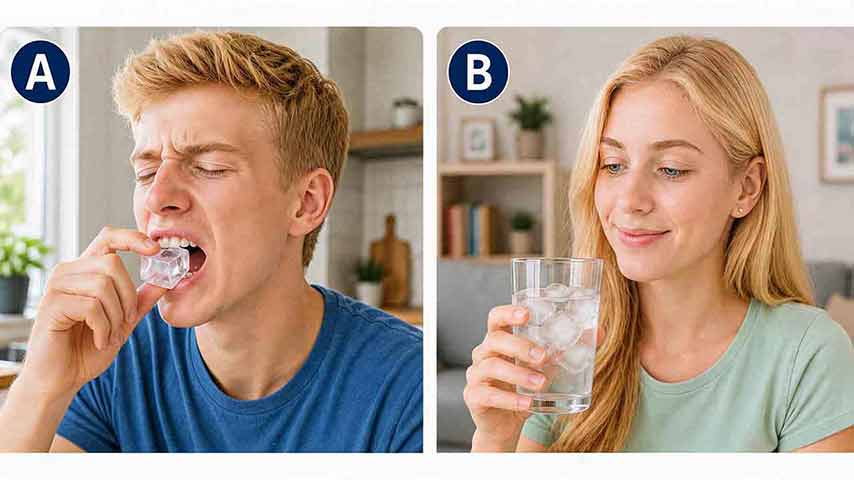
Chewing Hard Ice vs. Letting Ice Melt in Water
Chewing hard ice cubes creates high mechanical stress because the teeth must crush a rigid object. Crunching partially melted ice can still create substantial biting force, while letting ice melt in water avoids the fracture mechanism associated with hard-object chewing. Drinking chilled water does not create the same structural stress, although very cold liquids may trigger sensitivity in teeth that are already vulnerable.
For the quiz question, 'Which habit may chip or crack teeth?', the correct answer is A: chewing hard ice cubes. Letting ice melt in water is the safer option because it removes the need to crush a hard object with the teeth.
Why Can Ice Damage Teeth Even When It Seems Easy to Crunch?
A tooth can fail when biting force is concentrated on a hard object at an unfavorable angle or on an existing weak point. Healthy enamel is very strong, but teeth are not indestructible. Large restorations, previous decay, old fractures, and repeated clenching or grinding can reduce the amount of intact tooth structure available to absorb stress.
This does not mean a single ice cube will inevitably fracture a healthy tooth. It means chewing ice creates an avoidable mechanical risk with no dental benefit. The practical goal is not to predict which piece of ice will cause damage, but to remove an unnecessary source of stress.
Who Is More Vulnerable to Tooth Damage From Chewing Ice?
Anyone can chip a tooth, but the consequences may be greater when a tooth is already structurally compromised. Higher-risk situations include teeth with large fillings, previous chips or cracks, untreated decay, aging restorations, substantial restorative work, or a history of grinding and clenching.
A useful decision framework is to consider three factors: object hardness, tooth condition, and repetition. Hard objects create greater stress; weakened teeth tolerate less stress; and repeated exposure creates more opportunities for a vulnerable cusp, filling, or crack to fail.
What Are the Warning Signs of a Chipped or Cracked Tooth?
Possible warning signs include a rough or missing edge, sharp pain during chewing, pain when releasing a bite, new sensitivity to cold or heat, or unexplained intermittent discomfort. Cracked teeth can be difficult to recognize because symptoms may come and go, and some fractures cause little discomfort at first.
A small rough edge with no pain may indicate a minor chip. A visible missing piece may represent a larger chip or fractured cusp. Sharp biting pain, temperature sensitivity, swelling, or a tooth that appears split deserves faster professional assessment.
How Is a Chipped Tooth Different From a Cracked Tooth?
A chipped tooth usually means a piece of tooth structure has broken away. A cracked tooth contains a fracture line that may extend from the chewing surface toward the root without immediately separating the tooth into pieces. The depth and direction of the fracture often matter more than how dramatic the tooth looks in the mirror.
A minor enamel chip may only need smoothing or bonding. A fractured cusp may need a filling, onlay, or crown. A deeper crack can require a crown and, if the pulp is involved, root canal treatment. A split tooth or deep vertical root fracture may be much more difficult or impossible to restore.
What Should You Do Immediately After Chipping or Cracking a Tooth?
Stop chewing on the affected side and avoid testing the tooth with hard foods. Rinse the mouth gently with warm water to clear debris. If swelling is present, an external cold compress may help until professional care is available.
If you find a broken tooth fragment, keep it and bring it to the dental appointment because reattachment is occasionally possible depending on the injury. When you call the dental office, describe what you were chewing, whether a piece broke off, whether biting or temperature causes pain, and whether swelling or bleeding is present.
When Should You Call an Emergency Dentist?
A small painless chip is different from severe pain, swelling, major trauma, or a visibly unstable tooth. Contact a dentist promptly if a piece has broken off, biting causes sharp pain, a restoration has fractured, or new sensitivity develops.
Emergency dental care is more appropriate when pain is severe or rapidly worsening, swelling develops, the tooth is unstable, or several teeth are involved. Hospital emergency care may be necessary when the injury also includes uncontrolled bleeding, suspected jaw fracture, or significant facial trauma.
How Does a Dentist Diagnose a Cracked Tooth?
Cracked teeth can be difficult to diagnose because the fracture line may be tiny or hidden beneath a restoration. Dentists may combine symptom history, visual examination, bite testing, illumination, magnification, periodontal probing, and dental imaging to determine whether a crack is present and how serious it may be.
The key clinical question is not simply whether a line exists. The dentist needs to determine how far the fracture extends, whether the pulp remains healthy, and whether enough sound tooth structure remains for predictable restoration.
Which Cracked Tooth Treatment Might You Need?
Cracked tooth treatment ranges from very conservative repair to root canal therapy and a crown. The correct option depends on how much tooth structure is missing, the depth and location of the crack, the condition of the pulp, and whether the remaining tooth can be stabilized.
A tiny superficial chip may need smoothing or bonding. A larger chip may be repaired with composite resin, a filling, or a crown. A fractured cusp may require an onlay or crown. A crack that reaches the pulp may need root canal treatment followed by a crown, while a split or non-restorable tooth may require extraction.
What Does Chipped Tooth Repair Usually Involve?
Chipped tooth repair depends on the amount of missing structure and where the chip is located. Small chips may be polished or repaired with tooth-colored composite resin. Larger fractures may need a filling, veneer, onlay, or crown depending on how much strength must be restored.
The goal is not only to make the tooth look normal. A repair must also restore a comfortable bite, protect exposed dentin or pulp, and preserve enough tooth structure to function under normal chewing forces.
When Are a Dental Crown or Root Canal Needed?
A dental crown may be recommended when a crack or fracture has substantially weakened the visible portion of a tooth. The crown surrounds the remaining structure and can help reduce movement of vulnerable cusps during chewing.
A root canal is not automatically required for every crack. It becomes relevant when the pulp is irreversibly inflamed, injured, or infected. In those cases, root canal treatment may be followed by a crown to restore and protect the tooth.
Does a Cracked Tooth Always Need to Be Extracted?
No. Many cracked teeth can be preserved when the fracture is diagnosed early enough and enough stable tooth structure remains. Extraction is generally reserved for teeth that cannot be predictably restored, such as certain split teeth or fractures extending too deeply into the root.
A diagnosis of a cracked tooth should therefore not be treated as an automatic extraction decision. The location, depth, pulp condition, periodontal support, and restorative options all need to be evaluated before deciding whether the tooth can be saved.
How Much Does Chipped or Cracked Tooth Repair Cost?
There is no single national price for repairing an ice-damaged tooth. Cost depends on the diagnosis, procedure, material, geographic location, dentist, network status, and dental insurance coverage. A small repair may cost far less than a case involving an examination, imaging, root canal treatment, buildup, and crown.
Illustrative U.S. consumer cost examples published by dental insurers commonly place examinations in the tens to low hundreds of dollars, fillings in the low hundreds, root canal treatment in the high hundreds or more, and crowns from several hundred to well over one thousand dollars. These are broad examples rather than guaranteed fees.
What Determines Dental Crown Cost?
Dental crown cost varies according to material, tooth location, clinical complexity, geographic area, and whether other procedures are needed first. Porcelain, ceramic, zirconia, and porcelain-fused-to-metal crowns may have different fees, and the final bill can rise if the tooth also needs a buildup or root canal treatment.
A useful way to estimate the real expense is to separate the procedure fee from insurance benefits and additional care. The patient cost is influenced by the negotiated fee, insurer payment, deductible, coinsurance, annual maximum, and any noncovered services.
Does Dental Insurance Cover a Cracked or Chipped Tooth?
Dental insurance coverage often depends on why the procedure is needed, how the plan classifies the treatment, whether the dentist is in-network, the deductible, annual maximum, waiting periods, and whether a service is considered restorative or primarily cosmetic.
Before major treatment, ask for the diagnosis, procedure codes, treatment alternatives, total estimated fee, expected insurance payment, estimated patient responsibility, and whether the insurer can provide a pre-treatment estimate or predetermination of benefits.
Restorative Dentistry vs. Cosmetic Dentistry Services
Restorative dentistry primarily aims to restore damaged tooth structure, function, and stability. Cosmetic dentistry services primarily focus on appearance, although the same procedure can sometimes serve both purposes.
A crown on a cracked molar may be mainly restorative because it protects weakened structure. Composite bonding on a chipped front tooth may restore both function and appearance. Veneers may sometimes be discussed for visible damage, but they are not automatically appropriate for every chip or crack.
Real-World Example: You Hear a Crack While Chewing Ice
Imagine someone who routinely chews the remaining ice after finishing a drink. One evening, a small crack is heard while biting down. There is no severe pain, but the tongue detects a rough edge on a lower molar.
A poor response would be to keep chewing normally because the tooth does not hurt much. A better response is to stop chewing ice, avoid hard foods on that side, rinse gently, and arrange a dental evaluation before the area is exposed to more force.
Can a Cracked Tooth Heal on Its Own?
No. A structural crack in a tooth does not biologically fuse back together the way a fractured bone can. Dental treatment may stabilize and protect the tooth, reduce symptoms, or remove damaged pulp, but it does not make the crack disappear.
This is why waiting for a crack to heal itself is not a useful strategy. Some cracks remain stable after treatment, while others continue to progress depending on their location, depth, and mechanical stresses.
What Common Mistakes Should You Avoid After a Tooth Cracks?
Do not repeatedly test the tooth by biting down on hard foods. Do not ignore intermittent pain simply because it disappears temporarily. Do not assume every crack needs a root canal, and do not assume every crack requires extraction.
Another mistake is shopping only by price. The most useful comparison is the diagnosis, prognosis, treatment options, expected longevity, insurance benefits, and total cost of care rather than the initial quoted fee alone.
How Can You Stop the Ice-Chewing Habit and Protect Your Teeth?
The simplest prevention strategy is to remove the opportunity to crunch hard ice. Choose chilled water without ice, let ice melt completely, use a straw if it reduces the temptation to chew, and avoid using teeth to crush other hard objects such as hard candy, popcorn kernels, or pens.
If you grind or clench your teeth, mention it to your dentist because repetitive mechanical stress may increase the importance of protecting vulnerable teeth. If the urge to chew ice is persistent or unusually strong, mention the behavior to a healthcare professional rather than focusing only on dental repair.
Practical Conclusion: What Should You Do?
Chewing hard ice can chip or crack teeth, while letting ice melt in water avoids the hard-object biting force responsible for that risk. If you have no symptoms, stop chewing ice and use water as the safer alternative.
If you notice only a tiny rough edge, arrange a dental evaluation. If biting or cold causes pain, seek prompt assessment. If a large piece breaks off, contact a dentist and save the fragment if possible. Severe pain, swelling, unstable teeth, or major facial trauma may require emergency dental care or emergency medical care depending on the injury.
If cost is a concern, ask for the diagnosis, treatment alternatives, written estimate, insurance predetermination, and estimated out-of-pocket expense before major restorative treatment whenever the situation allows.
FAQ: Can Chewing One Ice Cube Crack a Tooth?
It is possible, but there is no reliable way to predict whether one particular ice cube will fracture one particular tooth. The risk depends on tooth condition, bite angle, existing restorations, hidden cracks, and the amount of force applied. Avoiding ice chewing removes this unnecessary mechanical risk.
FAQ: Why Does My Tooth Hurt Only When I Bite After Chewing Ice?
Pain during chewing can occur with a cracked tooth because movement along a fracture may irritate the pulp and supporting tissues. Symptoms can be intermittent, so a tooth that hurts only occasionally still deserves professional evaluation.
FAQ: Does a Painless Chipped Tooth Still Need a Dentist?
Yes. A painless chip may be minor, but only an examination can determine how much structure was lost and whether the tooth needs smoothing, bonding, a filling, or another restoration. Early evaluation also helps identify hidden damage.
FAQ: Will I Definitely Need a Crown If I Crack a Tooth?
No. Treatment depends on the location and depth of the crack, the amount of remaining tooth structure, and whether the pulp is involved. Some injuries can be managed conservatively, while deeper cracks may need a crown or root canal treatment followed by a crown.
FAQ: How Much Does a Crown for a Cracked Tooth Cost?
There is no universal crown fee. U.S. prices vary widely by material, geographic location, dentist, additional procedures, and insurance benefits. A local written treatment estimate or insurer cost estimator is more meaningful than a national average.
FAQ: Does Dental Insurance Pay for a Cracked Tooth?
It may. Coverage depends on the plan, diagnosis, procedure, deductible, coinsurance, waiting periods, annual maximum, network status, and whether the treatment meets the policy's coverage requirements. For expensive care, ask whether a pre-treatment estimate is available.
Sources and Professional References
Primary professional references for this guide include American Dental Association MouthHealthy guidance on habits that harm teeth and dental emergencies; American Association of Endodontists patient resources on cracked teeth, traumatic dental injuries, and root canal treatment; FAIR Health dental coverage guidance; Delta Dental cost-estimator resources; and Guardian consumer information on dental crown and cracked-tooth costs. Cost figures should always be treated as estimates rather than guaranteed fees.