Quick Answer and Key Takeaways
Quick Answer
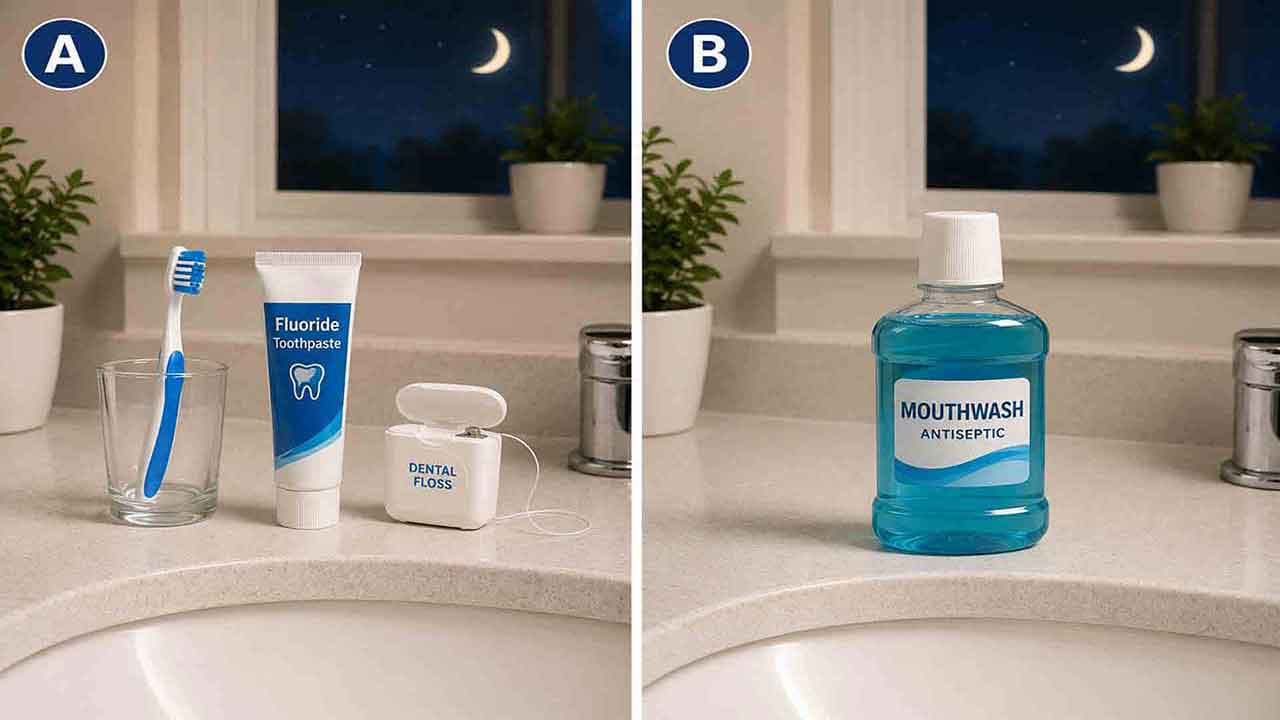
A complete dental care routine starts with brushing twice daily for about two minutes using fluoride toothpaste and cleaning between the teeth once a day. Mouthwash can add benefits for specific needs but does not replace brushing or interdental cleaning. Limiting frequent added-sugar exposure, monitoring gum changes, and receiving appropriate professional dental care help complete a practical routine for protecting teeth and gums.
Key Takeaways
Brush twice a day for about two minutes with fluoride toothpaste and a soft-bristled toothbrush.
Clean between the teeth once daily because toothbrush bristles cannot effectively reach every tight interdental surface.
Mouthwash is optional for many people. Therapeutic rinses can address specific concerns such as plaque, gingivitis, tooth decay, or bad breath, but they do not replace brushing and flossing.
Persistent bleeding, swelling, recession, loose teeth, or painful chewing deserve professional evaluation because periodontitis involves tissues supporting the teeth and cannot be managed by home cleaning alone.
A simple routine performed consistently is generally more useful than collecting many dental products without a clear purpose.
This guide explains what to do in the morning and evening, how to brush and clean between teeth effectively, when mouthwash makes sense, how to recognize early gum problems, and how to adjust the routine for braces, dry mouth, limited dexterity, or higher dental risk.
It also explains the boundary between preventive dentistry and professional treatment so routine cleaning is not confused with treatment for established periodontal disease.
This guide is based on authoritative dental guidance and practical selection criteria rather than hands-on product testing.
How Should a Complete Dental Care Routine Be Structured?
A complete dental care routine should perform several different jobs rather than relying on one product to do everything.
The first job is mechanically removing dental plaque from accessible tooth surfaces with a toothbrush.
The second is cleaning between neighboring teeth, where a toothbrush may not reach effectively.
The third is maintaining appropriate fluoride exposure to help protect against tooth decay.
The fourth is recognizing changes that require professional evaluation rather than simply adding more products or brushing harder.
The American Dental Association recommends brushing twice daily for about two minutes with fluoride toothpaste and cleaning between the teeth daily. These two habits form the core of home oral care.
Mouthwash should be viewed differently. Therapeutic mouthrinses can help address selected problems, but they are an addition to brushing and interdental cleaning rather than a replacement.
This creates a useful priority order.
First, make brushing reliable.
Second, establish daily interdental cleaning.
Third, add a therapeutic rinse or specialized product only when it solves a specific problem.
Finally, maintain professional dental care appropriate to your oral-health needs.
What Should Your Morning Dental Routine Include?
For most adults, an effective morning routine can remain simple.
Brush thoroughly with fluoride toothpaste for about two minutes.
Clean between your teeth in the morning if that is the time you are most likely to remember the habit. Daily consistency matters more than forcing every person to clean between their teeth at the same time of day.
If you use a therapeutic mouthrinse, follow its product directions or personalized dental instructions rather than assuming every rinse must be used immediately after brushing.
A complete routine does not require several different rinses, toothpastes, powders, or gadgets.
The purpose is consistent plaque control and cavity prevention, not maximizing the number of products used.
How Should You Brush Your Teeth Correctly?
Effective brushing depends on time, coverage, fluoride, gentle pressure, and consistency.
A practical routine uses a soft-bristled toothbrush and fluoride toothpaste for about two minutes twice a day. Either a manual or powered toothbrush can work when used correctly.
Choose the Right Toothbrush
Use a soft-bristled toothbrush with a head that can comfortably reach your molars and inner tooth surfaces.
Replace the toothbrush when the bristles become visibly frayed or worn. For many people, this is approximately every three to four months, although wear can occur sooner.
A large brush head is not automatically more effective.
If a large head makes the back of the mouth difficult to reach, a smaller one may be more practical.
Use Fluoride Toothpaste
Fluoride toothpaste should be the default choice for most people seeking routine cavity prevention.
Fluoride helps make enamel more resistant to acid-related mineral loss and supports remineralization of early enamel changes.
For most adults, an ordinary fluoride toothpaste is sufficient for everyday care.
People at higher risk of tooth decay may sometimes receive individualized recommendations for additional fluoride based on a dentist's assessment.
Clean Every Tooth Surface
Do not spend most of the brushing time on the front teeth simply because they are easiest to see.
Position the brush toward the gumline and use gentle, short movements.
Clean the outer surfaces facing the cheeks, the inner surfaces facing the tongue, and the chewing surfaces of the back teeth.
The inside surfaces of the front teeth can be easier to reach by holding the toothbrush more vertically and using short up-and-down movements.
A systematic pattern helps prevent missed areas.
For example, start with the upper right teeth, move across the upper arch, and then clean the lower teeth using the same pattern.
This makes it less likely that the same molars or inner surfaces will be skipped every day.
Avoid Excessive Pressure
Plaque does not require aggressive scrubbing.
Gentle technique with soft bristles is sufficient when every tooth surface receives appropriate attention.
If toothbrush bristles quickly spread outward, reconsider how much force you are using.
Brushing harder is not a substitute for brushing more completely.
Manual Toothbrush or Electric Toothbrush: Which Is Better?
Both can support good oral hygiene.
Manual and powered toothbrushes can both remove plaque effectively when used with appropriate technique and adequate coverage.
A powered toothbrush can be particularly useful for someone with limited dexterity, difficulty maintaining consistent hand movements, or a tendency to stop brushing too soon.
The decision is therefore less about finding a universal winner and more about solving a practical problem.
If you routinely brush for less than the intended time, a built-in timer may help.
If excessive pressure is a recurring problem, a pressure indicator may provide useful feedback.
If you already clean thoroughly and consistently with a manual toothbrush, switching technology is not automatically necessary.
Why Should You Clean Between Your Teeth Every Day?
Interdental cleaning removes plaque and debris from surfaces toothbrush bristles cannot effectively clean.
Even excellent brushing cannot completely reach every contact area between neighboring teeth.
Daily flossing or another appropriate interdental method helps disrupt plaque in these spaces and along areas of the gumline.
Plaque is a sticky bacterial film.
When plaque remains long enough, some of it can harden into tartar, also called calculus.
Once tartar has formed, ordinary brushing and flossing cannot reliably remove it. Professional removal is usually required.
This distinction is important.
Daily interdental cleaning is preventive plaque control.
It is not a home substitute for professional scaling.
Flossing, Interdental Tools, and Cleaning Order
How Should You Floss Correctly?
Good flossing cleans the surfaces of neighboring teeth rather than simply pulling a strand through the contact point.
Guide the floss gently between two teeth.
Avoid snapping it sharply into the gum tissue.
Once the floss has passed the contact, curve it around one tooth and move it gently along the tooth surface.
Then reposition the floss against the neighboring tooth and repeat.
One space contains two tooth surfaces to clean.
Continue around the mouth, including the rear surface of the final molar in each row.
If conventional string floss is difficult to use, another interdental method may be more practical.
The objective is consistent cleaning between teeth, not loyalty to one particular product.
Which Interdental Tool Should You Choose?
Use the anatomy of the space as the starting point.
For tight contacts between natural teeth, string floss or dental tape may work well.
For wider spaces, an appropriately sized interdental brush may make better contact with neighboring tooth surfaces.
For fixed bridges or braces, specialty floss, a floss threader, interdental brush, or water flosser may improve access.
For arthritis or limited hand control, a floss holder or powered device may be easier to use consistently.
The best interdental tool is usually the one that fits the space safely and can be used correctly every day.
One mouth may even benefit from more than one method.
For example, tight front contacts may work well with string floss while larger spaces farther back may be easier to clean with an interdental brush.
Should You Floss Before or After Brushing?
Either order can work.
Some people prefer cleaning between the teeth first and then brushing with fluoride toothpaste.
Others find it easier to brush first and floss afterward.
The key requirement is that both steps are completed thoroughly and consistently.
This is a good example of where routine matters more than searching for a theoretically perfect sequence.
Choose an order that makes it difficult for you to forget the second step.
Mouthwash: When and Why to Use It
Do You Need Mouthwash Every Day?
No. Mouthwash is not essential for every person.
Mouthrinses can broadly be divided into cosmetic and therapeutic products.
Cosmetic rinses mainly provide temporary benefits such as fresher breath.
Therapeutic mouthrinses contain active ingredients intended to help address concerns such as plaque, gingivitis, tooth decay, or persistent bad breath.
A therapeutic rinse can therefore be useful when it addresses a clearly defined need.
However, mouthwash does not mechanically clean the contact surfaces between neighboring teeth.
It should be viewed as an addition to the routine rather than a substitute for brushing and flossing.
Which Mouthwash Fits Different Needs?
The correct product depends on the goal.
A fluoride mouthrinse can provide additional fluoride exposure for selected people, particularly when individual cavity risk is higher.
Some antimicrobial rinses can help reduce plaque or gingivitis when used alongside mechanical cleaning.
People with dry mouth may prefer products specifically intended for moisture relief or formulations without ingredients they find uncomfortable or drying.
Young children should use mouthrinse only when they can reliably avoid swallowing it and when the product is appropriate for their age.
Rather than buying mouthwash because the bottle promises a more complete routine, ask one question first.
What specific problem am I trying to solve?
If there is no clear answer, adding another product may not improve the routine.
Gum Disease Prevention and Warning Signs
How Does Daily Dental Care Help Prevent Gum Disease?
Daily plaque control is central to protecting the gums.
Gingivitis is inflammation limited to the gum tissues and commonly involves redness, swelling, or bleeding.
Gingivitis can often improve when plaque control is improved and appropriate professional care is provided.
Periodontitis is more advanced because it affects the tissues supporting the teeth and can involve bone loss.
Professional treatment is required to manage established periodontitis.
Home prevention therefore focuses on reducing plaque accumulation before deeper disease develops.
Brush twice daily.
Clean between the teeth once daily.
Avoid tobacco.
Maintain professional dental care appropriate to your individual risk.
Overall health also matters. Conditions such as diabetes can influence periodontal risk, which is another reason oral hygiene should be considered part of broader health maintenance rather than an isolated cosmetic routine.
What Gum Changes Should You Pay Attention To?
Persistent gum changes deserve evaluation rather than increasingly aggressive home cleaning.
Warning signs can include red or swollen gums, repeated bleeding, gum recession, loose or sensitive teeth, pain when chewing, and changes in how teeth fit together.
Occasional bleeding does not by itself prove that someone has periodontitis.
However, repeatedly bleeding gums should not simply be dismissed as proof that flossing is working.
If bleeding persists despite gentle daily plaque control, a dental professional can evaluate whether gingivitis, tartar, periodontal disease, a restoration, or another local problem is involved.
Professional Dental Care and Deep Cleaning
When Is Professional Dental Care Needed?
Professional dental care becomes important when deposits cannot be removed at home, symptoms persist, or disease extends beyond routine plaque control.
A professional dental cleaning removes tartar and other deposits that ordinary brushing and flossing cannot reliably eliminate.
Preventive dentistry combines this professional monitoring with daily self-care.
Regular examinations can also identify early tooth decay, periodontal changes, damaged restorations, and areas where home cleaning is ineffective.
Professional cleaning does not replace home care because new plaque continues to form.
Likewise, good brushing and flossing do not make professional evaluation unnecessary when symptoms or hardened deposits are present.
This boundary is important.
Home care is designed mainly to prevent problems and control daily plaque.
Professional care becomes necessary when diagnosis, hardened-deposit removal, or disease treatment is required.
What Is the Difference Between Routine Cleaning and Deep Cleaning?
Routine cleaning and deep teeth cleaning have different clinical purposes.
Routine professional cleaning is primarily associated with prevention and maintenance. It removes plaque, tartar, and deposits that remain despite normal home care.
The term deep teeth cleaning commonly refers to scaling and root planing.
Scaling and root planing is used for specific periodontal conditions when deposits and affected root surfaces below the gumline require treatment.
This makes deep cleaning different from simply receiving a more thorough version of routine preventive cleaning.
It is not an upgrade that everyone should choose.
The appropriate procedure depends on the findings of a dental and periodontal examination.
More complex periodontal disease may sometimes require referral to a periodontist for additional evaluation or treatment.
The essential distinction is simple.
Routine cleaning supports prevention and maintenance.
Scaling and root planing is used when periodontal disease requires treatment below the gumline.
A Practical Morning and Evening Dental Routine
A strong routine can be built without making oral hygiene complicated.
Morning Routine
Brush for about two minutes using fluoride toothpaste.
Make sure the inner, outer, and chewing surfaces receive attention.
Clean between the teeth if morning is the time when you are most likely to maintain the daily habit.
Use a therapeutic mouthrinse only when it serves a specific purpose and follow the product directions or personalized dental guidance.
Evening Routine
Brush again for about two minutes using fluoride toothpaste.
If you did not perform interdental cleaning earlier, clean between the teeth now.
Pay attention to any area that repeatedly bleeds, traps food, hurts, or catches floss.
Do not attempt to scrape away hard deposits with household tools.
This structure provides the important daily functions without turning oral care into a long multi-product ritual.
A Simple Decision Framework for Dental Products
Before adding a new product, use three questions.
Question 1: What problem am I solving?
If the answer is unclear, another product may not be necessary.
For example, buying another antimicrobial rinse simply because several mouthwashes are available does not automatically improve plaque control.
Question 2: Does the product supplement or replace something?
Most specialized products supplement core oral hygiene.
Mouthwash does not replace brushing and flossing.
A water flosser may replace another interdental method for some people, but it does not replace toothbrushing.
A powered toothbrush may replace a manual toothbrush, but it does not eliminate the need to clean between teeth.
Question 3: Will I actually use it correctly?
Consistency matters.
A straightforward toothbrush and interdental-cleaning routine performed every day can be more useful than an elaborate system that becomes difficult to maintain.
Real-World Example: Building a Routine Around Actual Needs
Consider an adult who brushes twice every day but rarely flosses because string floss is difficult to control.
The person also uses a strong mouthwash because it creates a very clean sensation after brushing.
However, food repeatedly collects between several lower teeth, and the gums in that area occasionally bleed.
The missing part of this routine is not another mouthwash.
A more useful change is to preserve twice-daily fluoride brushing and replace the difficult flossing method with an interdental tool that is easier to use, such as an appropriately sized interdental brush or water flosser.
If bleeding continues despite consistent and gentle cleaning, professional evaluation becomes the next step.
This illustrates an important rule for building a complete dental care routine.
Solve the missing function instead of adding products that duplicate something you already do well.
Common Dental Care Mistakes
Brushing Harder Instead of More Thoroughly
Aggressive force is not a substitute for complete coverage.
Use soft bristles, gentle movements, and enough time to clean every region.
Skipping Between-the-Teeth Cleaning
Teeth can look clean from the front while plaque remains at contact surfaces.
Daily interdental cleaning exists specifically because a toothbrush cannot reach every surface effectively.
Using Mouthwash as a Shortcut
A fresh taste does not prove that plaque has been removed.
Therapeutic mouthwash can support oral care, but it does not replace mechanical cleaning.
Ignoring Bleeding Gums
Repeated gum bleeding can be associated with gingival inflammation or periodontal disease.
Persistent symptoms deserve evaluation rather than stronger brushing.
Trying to Remove Tartar at Home
Once plaque has hardened into tartar, normal brushing and flossing cannot reliably remove it.
Professional instruments are designed for this purpose.
Changing Products Every Few Days
Frequent product switching can make it difficult to determine whether the actual problem is product selection or inconsistent technique.
Build a reliable core routine first.
Assuming More Products Mean Better Dental Care
A longer bathroom shelf does not automatically produce cleaner teeth.
Every product should perform a useful function.
If brushing, interdental cleaning, fluoride exposure, and appropriate professional care are already covered, additional products may add little value.
Troubleshooting Common Dental Care Problems
If floss repeatedly shreds in the same location, try another type of floss. If the problem continues at one particular tooth, professional evaluation may help identify a rough restoration or another local issue.
If your gums bleed when cleaning between teeth, use gentle technique and maintain regular plaque removal. If bleeding persists, arrange an evaluation.
If you cannot reach back molars comfortably, consider whether a smaller toothbrush head or powered brush would improve access.
If limited dexterity makes string floss difficult, consider another interdental device such as a floss holder, interdental brush, or water flosser.
If mouthwash causes uncomfortable dryness, reconsider whether the product is necessary and whether another formulation better matches the intended purpose.
If you continue developing cavities despite consistent brushing and interdental cleaning, ask a dentist to assess individual risk factors. Additional fluoride or other preventive measures may be appropriate for some people.
If hard buildup remains near the gumline despite brushing, do not increase pressure. The material may be tartar that requires professional removal.
If one particular space repeatedly traps food, bleeds, or catches floss, mention that location during a dental evaluation. A recurring local problem may involve more than cleaning technique.
How Should the Routine Change for Different People?
For Someone With Generally Healthy Teeth and Gums
Keep the routine simple.
Brush twice daily with fluoride toothpaste, clean between teeth once daily, limit frequent added-sugar exposure, and maintain professional dental care.
You do not need multiple specialized products simply because they are available.
For Someone With Braces or Fixed Dental Work
Access becomes the main challenge.
Brackets, wires, bridges, and connected restorations can make conventional floss more difficult to use.
Interdental brushes, floss threaders, specialty floss, or water flossers may make cleaning more practical.
The important goal is reaching areas where plaque tends to collect.
For Someone With Dry Mouth
Saliva helps clear food, buffer acids, and support enamel remineralization.
Persistent dry mouth can therefore increase oral-health concerns.
Water, sugar-free gum when appropriate, and individualized fluoride recommendations may be useful.
Persistent dry mouth deserves professional discussion because medication, health conditions, and other factors may contribute.
For Someone With Limited Hand Mobility
Choose tools that reduce the physical difficulty of the routine.
A powered toothbrush may be easier than a manual brush.
A floss holder, interdental brush, or water flosser may also be easier than manipulating traditional string floss.
The correct adaptation is the one that makes effective daily cleaning possible.
For Someone With a History of Gum Disease
Home care remains essential, but the professional maintenance plan may differ from that of someone with consistently healthy gums.
Continue brushing and interdental cleaning according to individualized instructions.
Do not assume that successful professional treatment removes the need for daily plaque control.
Complete Dental Care Checklist
Brush twice every day.
Brush for about two minutes each time.
Use fluoride toothpaste.
Use a soft-bristled toothbrush.
Clean the outer, inner, and chewing surfaces of the teeth.
Clean between the teeth once daily.
Choose interdental tools according to the spaces and dental work in your mouth.
Use mouthwash only when it provides a defined benefit.
Limit frequent sugary foods and drinks.
Pay attention to repeated bleeding, swelling, gum recession, pain, or loose teeth.
Do not attempt to scrape away tartar with improvised tools.
Maintain professional dental care appropriate to your oral-health needs.
Review the routine when your dental needs change.
A complete routine is built from a few effective behaviors performed consistently, not from the largest possible collection of oral-care products.
The Practical Bottom Line
A complete dental care routine does not need to be complicated.
For most people, the foundation is brushing twice daily for about two minutes with fluoride toothpaste and cleaning between the teeth once every day.
If your teeth and gums are generally healthy, build consistency around those habits before adding extra products.
If string floss is difficult, change the interdental tool rather than abandoning between-the-teeth cleaning.
If you have higher cavity risk or persistent dry mouth, ask whether additional fluoride or other individualized preventive measures are appropriate.
If gums repeatedly bleed, swell, recede, or become tender, professional evaluation is more useful than brushing harder or adding stronger mouthwash.
Professional dental care becomes important when tartar cannot be removed at home or when symptoms suggest that disease extends beyond routine plaque control.
Deep cleaning procedures such as scaling and root planing are used for specific periodontal conditions rather than as routine upgrades to ordinary preventive cleaning.
The best routine is therefore the one that reliably performs every necessary job: removing plaque from accessible surfaces, cleaning between teeth, maintaining appropriate fluoride protection, supporting healthy gums, and recognizing when professional care is needed.
Sources
American Dental Association. Home Oral Care. Guidance on twice-daily brushing with fluoride toothpaste, daily interdental cleaning, powered toothbrushes, and personalized preventive care.
American Dental Association. Dental Floss and Interdental Cleaners. Guidance on daily interdental cleaning, flossing sequence, tartar, water flossers, and interdental brushes.
American Dental Association. Toothbrushes. Guidance on soft bristles, brushing technique, manual and powered toothbrushes, and toothbrush replacement.
American Dental Association. Mouthrinse and Mouthwash. Guidance on cosmetic and therapeutic mouthrinses and their role as an addition to brushing and flossing.
Centers for Disease Control and Prevention. Oral Health Tips for Adults. Guidance on fluoride toothpaste, daily oral hygiene, diet, dry mouth, and professional dental care.
Centers for Disease Control and Prevention. Periodontal Disease. Guidance on gingivitis, periodontitis, warning signs, prevention, and professional treatment.
National Institute of Dental and Craniofacial Research. Periodontal Gum Disease. Guidance on plaque, tartar, gum disease symptoms, diagnosis, professional care, and periodontal treatment.
National Institute of Dental and Craniofacial Research. Oral Hygiene. Guidance on brushing, interdental cleaning, professional cleaning, fluoride, and individualized preventive care.
American Academy of Periodontology. Non-Surgical Periodontal Treatments. Information on scaling and root planing and periodontal maintenance.
Educational Note
This article provides general oral-health information. It does not diagnose cavities, gingivitis, periodontitis, or other dental conditions and does not replace individualized advice, diagnosis, or treatment from a dentist or periodontal specialist.