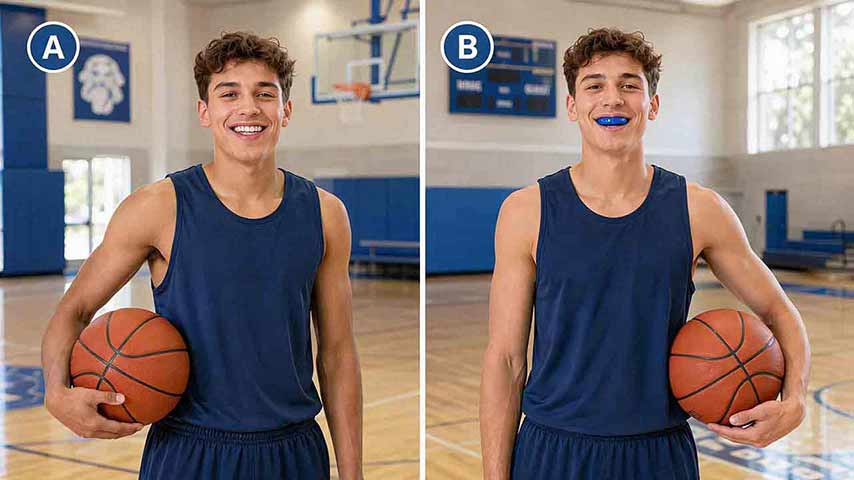
Best Sports Mouthguard for Dental Protection: Dentist Guidelines, Injury Prevention, Emergency Dental Care, and Costs
For most athletes exposed to meaningful risk of facial or dental impact, the best sports mouthguard is one that fits securely, stays comfortably in place, provides appropriate impact protection, and is worn consistently during both practice and competition. A custom mouthguard offers the highest level of individual adaptation, but a properly fitted boil-and-bite mouthguard can also be a practical option for many athletes.
Evidence and scope note: This guide is based on authoritative professional guidance and practical selection criteria rather than hands-on product testing. It does not rank commercial mouthguard brands or claim that one product can prevent every dental injury.
Medical information notice: This article provides general educational information. It does not replace diagnosis, treatment, or individualized advice from a dentist, orthodontist, physician, or other qualified healthcare professional.
Key Takeaways
• The American Dental Association recommends a properly fitted Sports Mouthguard for activities with a meaningful risk of dental trauma or orofacial injury.
• Custom-made, boil-and-bite, and stock mouthguards differ in retention, adaptability, comfort, convenience, and cost.
• A Custom Mouthguard offers individualized fitting, but higher price does not automatically make it the best choice for every athlete. Properly prepared alternatives can also provide useful protection.
• Mouthguards have a clearer role in Dental Injury Prevention than in concussion prevention; current evidence about concussion reduction is mixed.
• Athletes should know how to respond to a knocked-out permanent tooth before an injury happens because rapid Emergency Dental Care may improve the chance of saving the tooth.
This guide helps athletes, parents, and coaches choose among mouthguard types, judge fit, decide when professional fitting makes sense, compare Dental Care Costs, ask the right Dental Insurance questions, and prepare for sports-related dental emergencies.
Why Does a Sports Mouthguard Matter?
A properly fitted mouthguard helps reduce the incidence and severity of sports-related dental and oral injuries. Professional dental guidance recommends mouthguards for sporting and recreational activities that create significant risk of dental trauma or other orofacial injury. The recommendation is not limited to professional or elite athletes.
Risk exists in obvious contact and collision sports, including football, boxing, hockey, lacrosse, martial arts, rugby, soccer, and wrestling. Dental injuries can also occur in activities such as basketball, baseball, gymnastics, skateboarding, skiing, bicycling, volleyball, and skating.
That leads to a more useful question than simply asking whether a sport is officially labeled contact: Can a fall, collision, ball, stick, elbow, opponent, or piece of equipment realistically strike the athlete's teeth, lips, mouth, or jaw? If yes, appropriate mouth protection deserves consideration.
What Should a Good Sports Mouthguard Actually Do?
A useful mouthguard should fit the athlete's mouth, stay securely in position, provide a resilient protective surface, and remain practical enough to wear consistently. An ideal mouthguard should be properly adapted to the athlete's oral structures, made of resilient material, securely retained, relatively easy to clean, and capable of absorbing impact energy.
For consumers, that can be simplified into four requirements: Fit + Retention + Protection + Consistent Use.
A mouthguard with impressive packaging provides little real-world value if the athlete repeatedly removes it because it falls out or feels intolerable. Likewise, an inexpensive mouthguard can become poor value if it does not stay in position during actual play.
Five Practical Fit Questions: 1. Does it remain securely in place? 2. Can the athlete tolerate wearing it throughout practice or competition? 3. Does it avoid sharp or irritating edges? 4. Has it maintained its shape? 5. Will the athlete actually use it consistently?
Which Type of Sports Mouthguard Should You Choose?
Most athletes are choosing among three broad categories: custom-made, mouth-formed or boil-and-bite, and stock mouthguards.
Comparison:
• Custom-made → highest personalization; high retention potential; requires professional fitting; highest relative cost; individually adapted fit.
• Boil-and-bite → moderate personalization; retention varies with fitting; easy to obtain; moderate relative cost; user-molded fit.
• Stock → low personalization; usually lowest retention; easiest to obtain; lowest relative cost; generic fit.
The comparison should not be read as expensive always wins. The real question is whether the selected guard provides adequate protection and is fitted well enough to stay in the athlete's mouth during use.
How Does a Custom Mouthguard Work?
A Custom Mouthguard is individually fabricated using the athlete's dental anatomy and is generally the most adaptable option. Custom guards can be fabricated from individualized dental records or impressions using professional forming techniques and can be tailored to the user's anatomy and preferences.
Advantages of a Custom Mouthguard include individualized adaptation, strong retention potential, professional fitting, accommodation for individual anatomy, and potentially better comfort and wearability for some athletes.
Limitations include higher cost, required dental appointments, non-instant fabrication, and the possibility that changing teeth or orthodontic treatment will eventually require refitting.
A custom mouthguard is especially attractive when fit problems, frequent sport participation, dental complexity, or athlete preference justify professional customization. It should not be marketed as mandatory for every person who plays a sport.
Is a Boil-and-Bite Mouthguard Good Enough?
A properly fitted boil-and-bite mouthguard can be a reasonable protective option for many athletes. Mouth-formed guards are softened and molded around the user's teeth according to the manufacturer's instructions. Unlike generic stock guards, they provide some adaptation to the individual dental arch.
A boil-and-bite guard may be especially practical when the athlete has uncomplicated dental anatomy, professional customization is not necessary, budget matters, the guard can be molded securely, and the athlete finds the result comfortable enough for regular use.
The major limitation is that fitting quality partly depends on preparation. A poorly molded mouthguard may have less secure retention than the same product fitted correctly.
Why Are Stock Mouthguards Usually the Weakest Option?
Stock mouthguards are convenient and inexpensive, but their generic sizing can limit fit and retention. Stock guards are prefabricated devices available in a limited range of sizes. Because they are not adapted to the individual mouth, the athlete may need to keep the mouth closed to hold the guard in place.
That creates a practical tradeoff. The lowest purchase price may not represent the best value if the mouthguard is difficult to retain or uncomfortable enough that the athlete avoids wearing it.
The Sport–Dental–Fit–Budget Decision Matrix
Instead of asking, “Which mouthguard is best?”, use four decisions in sequence.
Step 1: Evaluate Sport Risk. Higher impact exposure strengthens the need for dependable mouth protection. Factors include player-to-player contact, high-speed balls or pucks, sticks or equipment near the face, frequent falls, combat or collision activity, and previous facial impacts.
Step 2: Evaluate Dental Complexity. Ask whether the athlete has braces, major restorative dental work, unusual dental alignment, a previous dental injury, teeth that are actively changing position, or repeated difficulty fitting OTC mouthguards. Greater complexity increases the value of individualized Dentist Guidelines.
Step 3: Evaluate Fit Requirement. Can a mouth-formed OTC guard stay securely in place and remain comfortable? If yes, a properly fitted boil-and-bite option may be reasonable. If no, professional fitting becomes more attractive.
Step 4: Evaluate Budget. Compare not only purchase price but also expected replacement needs. The goal is to choose the least complicated option that still provides appropriate fit, protection, and consistent use for that athlete.
Quick Mouthguard Selection Matrix
Athlete Situation → Practical Starting Point:
• Recreational athlete, uncomplicated teeth, good OTC fit → properly fitted boil-and-bite.
• Frequent competitive contact sport → consider custom fitting.
• OTC mouthguard repeatedly falls out → consider professional evaluation.
• Athlete with braces → seek dentist or orthodontic guidance.
• Previous significant dental trauma → consider individualized dental assessment.
• Young athlete with changing dentition → reassess fit regularly.
• Athlete unwilling to wear current guard → solve comfort and retention problem.
• Tight budget but significant injury risk → prioritize fit over premium branding.
This is a decision aid, not an individualized dental prescription.
Which Athletes Should Consider Professional Dentist Guidelines?
Professional guidance becomes more valuable when dental anatomy or the sport makes fit difficult or especially important. Consider dental guidance when an OTC guard repeatedly comes loose, the athlete has orthodontic appliances, dental restorations complicate fit, a previous tooth injury has occurred, the athlete experiences persistent irritation, teeth are changing position, mouthguards repeatedly become damaged, or the athlete competes frequently in high-impact activities.
The advantage of professional evaluation is not simply access to a more expensive product. It is the ability to evaluate the athlete's actual mouth.
What Should Athletes With Braces Do?
Athletes with braces need a mouthguard that protects the mouth without interfering with orthodontic appliances or normal tooth movement. Because orthodontic treatment intentionally changes tooth positions, a guard that fits correctly at one point in treatment may not remain appropriate indefinitely.
Do not force a mouthguard over braces or teeth when the fit has clearly changed. A dentist or orthodontic professional can help determine whether the appliance provides adequate clearance and protection.
Can a Sports Mouthguard Prevent a Concussion?
A mouthguard should not be presented as a guaranteed concussion-prevention device. Evidence for concussion reduction is less consistent than the evidence supporting reduction of dental and orofacial injury. Some studies have reported possible associations, while others have not shown a clear effect.
This distinction strengthens rather than weakens the case for mouthguards. Their established purpose is Dental Injury Prevention. Athletes should continue using all other sport-specific safety measures, including helmets, face protection, coaching protocols, and appropriate medical concussion assessment where relevant.
How Much Should You Spend on a Sports Mouthguard?
There is no medically correct universal price because cost varies by mouthguard type, professional fees, location, replacement frequency, and individual dental needs. Rather than focusing on one market price, calculate annual protection cost.
Annual mouthguard cost = price per guard × replacements per year.
Hypothetical Example: Suppose Athlete A buys a mouth-formed guard for $30 and replaces it twice during the year. Annual cost: $30 × 2 = $60. Athlete B obtains a hypothetical custom guard costing $180 and replaces it once. Annual cost: $180 × 1 = $180.
These figures are examples only. They are not current average retail or dental-office prices. The comparison becomes useful only after adding fit and usage.
How Do Mouthguard Costs Fit Into Dental Care Costs?
Separate predictable prevention expenses from unpredictable injury-treatment expenses.
Cost Category → Example → Predictability:
• Protective equipment → Sports Mouthguard → high.
• Professional customization → Custom Mouthguard → high after a quote.
• Routine prevention → dental checkups → moderate.
• Emergency Dental Care → trauma evaluation → low.
• Restorative dental care → treatment of damaged teeth → depends on injury.
• Specialist follow-up → endodontic or other care → depends on diagnosis.
This is the responsible way to discuss Dental Care Costs. A mouthguard should never be marketed with a claim such as “Buy this and you will avoid expensive dental treatment.” No mouthguard guarantees that an injury will not occur.
Does Dental Insurance Cover a Custom Mouthguard?
Coverage varies by insurance plan, employer benefit design, age restrictions, procedure coding, and individual policy terms. An industry or professional policy position does not mean every Dental Insurance contract pays for sports mouthguards.
Before ordering a custom mouthguard, ask the dental office and insurer: 1. Is an athletic mouthguard covered? 2. Does the plan cover custom fabrication? 3. Is there an age limitation? 4. Is preauthorization required? 5. Does an annual maximum apply? 6. Is the dentist in network? 7. How often can a replacement be covered? 8. What amount is expected out of pocket?
Do not interpret “dental insurance included” as “this mouthguard will be free.” Benefits should be verified against the actual plan.
How Can You Tell Whether a Mouthguard Fits Correctly?
A suitable guard should remain in place securely and should not require constant biting or repositioning to prevent it from falling out.
Fit Checklist:
• The mouthguard stays in position.
• It avoids repeated slipping.
• It has no sharp or jagged edges.
• It remains structurally intact.
• It is comfortable enough for regular wear.
• It fits the athlete's current teeth.
• It avoids obvious interference with dental appliances.
A poor-fitting mouthguard should not be treated as good enough simply because it has already been purchased.
When Should You Replace a Sports Mouthguard?
Replace or reassess a mouthguard when its fit, structure, or retention is no longer appropriate. There is no single replacement interval that fits every athlete.
Mouthguard life can be affected by chewing, training frequency, impact exposure, material wear, distortion, growth, orthodontic movement, and dental changes.
For that reason, use a simple rule: Condition + Fit + Dental Change. Replace or reassess the mouthguard when one of these changes substantially. This is especially important for growing children and teenagers because dental anatomy may change during development or orthodontic treatment.
What Should You Do if a Permanent Tooth Is Knocked Out During Sports?
Treat a knocked-out permanent tooth as an urgent dental problem and seek professional care immediately. Handle the tooth by the crown rather than touching the root. When appropriate and possible, the permanent tooth can be gently repositioned in the socket. If it cannot be replaced, keep it moist and go to a dentist immediately.
Simple Emergency Sequence:
1. Find the tooth.
2. Hold it by the crown, not the root.
3. If dirty, gently rinse it without scrubbing.
4. If appropriate and feasible, reposition it in the socket.
5. Otherwise, keep it moist using an appropriate preservation method such as milk or a tooth-preservation product.
6. Seek professional dental treatment immediately.
This guidance is for a knocked-out permanent tooth. Dental injuries involving primary teeth should be managed according to professional pediatric dental advice.
What Should You Do for a Cracked Tooth?
Rinse the mouth gently, reduce external swelling with a cold compress when needed, and arrange prompt dental evaluation. A cracked tooth may look minor but still involve deeper structures.
Do not use visible appearance alone to determine severity.
When Is an Emergency Dentist More Important Than the Mouthguard?
Once a significant injury has occurred, the priority changes from prevention to diagnosis and treatment.
Seek prompt professional assessment for a knocked-out permanent tooth, a significantly displaced tooth, a major fracture, severe dental pain after trauma, persistent oral bleeding, significant swelling, suspected jaw injury, or other concerning facial trauma.
Potentially life-threatening emergencies should be directed to emergency medical services or a hospital emergency department. A new mouthguard cannot diagnose or repair an existing injury.
Build an Emergency Dental Care Plan Before the Season
Athletes, parents, coaches, and teams should know their dental-emergency pathway before a game-day injury happens.
A practical plan includes: 1. Save the regular dentist's contact information. 2. Know the office's after-hours procedure. 3. Identify an appropriate Emergency Dentist pathway. 4. Keep dental first-aid instructions available. 5. Know how to handle a knocked-out permanent tooth. 6. Keep relevant Dental Insurance information accessible. 7. Replace a damaged mouthguard before returning to high-risk activity.
This planning costs little but removes uncertainty during an emergency.
Real-World Selection Examples
Athlete A: Recreational Basketball. Alex plays recreational basketball twice a week, has no braces, and can obtain a secure fit with a properly prepared boil-and-bite mouthguard. Practical choice: a quality mouth-formed mouthguard may be a sensible starting point because the athlete has uncomplicated dental needs and does not require professional customization simply because custom options exist.
Athlete B: Competitive Martial Arts. Morgan trains several times per week and competes regularly. The athlete has previously struggled with OTC mouthguards moving during activity. Practical choice: a professionally fitted Custom Mouthguard becomes more attractive because secure retention and frequent use justify greater customization.
Athlete C: Teenager With Braces. Taylor participates in a sport with meaningful facial-contact risk while undergoing orthodontic treatment. Practical choice: obtain dentist or orthodontic guidance rather than forcing a generic close-fitting guard over changing appliances.
Athlete D: Young Player Still Growing. Jordan's mouthguard fitted well at the start of the season but begins feeling tight several months later. Practical choice: reassess fit rather than assuming the original guard should last for a predetermined number of years.
These scenarios demonstrate the central rule: Risk determines the need for protection; dental complexity and fit determine the best form of protection.
What Are the Most Common Sports Mouthguard Mistakes?
Mistake 1: Buying Only by Price. The least expensive mouthguard is not a bargain if it will not stay in place. The highest-priced mouthguard is also unnecessary when a simpler option already fits securely and meets the athlete's needs.
Mistake 2: Assuming Custom Automatically Means Necessary. Custom mouthguards provide excellent adaptability, but other properly fabricated and consistently worn mouthguards can also be effective.
Mistake 3: Wearing the Guard Only During Competition. Sports injuries can occur during practice.
Mistake 4: Ignoring Changing Fit. Growing athletes and orthodontic patients can outgrow a mouthguard even when the material itself remains intact.
Mistake 5: Promoting Mouthguards as Concussion-Proof Equipment. The evidence does not justify that claim.
Mistake 6: Treating a Dental Injury as an Equipment Problem. A cracked, displaced, or knocked-out tooth requires professional evaluation. Buying a different mouthguard afterward does not replace treatment.
Troubleshooting Common Mouthguard Problems
“My Mouthguard Keeps Falling Out.” Likely issue: inadequate retention or poor fit. Recheck fitting instructions if the product supports remolding. If the guard remains unstable, try a more suitable mouth-formed product or consider professional fitting.
“I Have to Bite Down Constantly to Keep It In.” Likely issue: inadequate retention. A guard that requires continuous clenching may not be appropriately adapted to the athlete's mouth.
“The Guard Hurts My Gums.” Likely issue: poor adaptation, rough edges, damage, or an unsuitable design. Stop using a guard that causes persistent injury or irritation and seek appropriate dental guidance when needed.
“The Guard Used to Fit but Now Feels Tight.” Likely issue: tooth movement, growth, orthodontic change, or distortion. Reassess the fit rather than continuing to force the appliance into place.
“My Child Refuses to Wear the Mouthguard.” Likely issue: comfort, retention, communication, or habit. Find out what specifically makes the guard difficult to wear. Repeatedly telling an athlete to just wear it does not correct a genuine fitting problem.
The 60-Second Mouthguard Decision Tree
Does the activity create realistic dental-impact risk? No → review sport-specific requirements and individual circumstances. Yes → use appropriate mouth protection.
Does the athlete have braces, significant dental work, previous trauma, or unusual fit problems? Yes → seek individualized dental guidance. No → continue to fit assessment.
Can a properly prepared boil-and-bite mouthguard remain securely in place? Yes → it may be a practical choice. No → consider professional fitting.
Is the mouthguard comfortable enough to be worn consistently? No → correct the fit or select another option. Yes → continue.
Has it become damaged, distorted, loose, or too tight? Yes → replace or reassess it. No → continue regular use and inspection.
This decision tree intentionally avoids using price as the first decision. Protection begins with risk and fit—not with the product's price tag.
Sports Mouthguard Buying Checklist
Before buying or ordering a mouthguard, ask:
• Is my sport associated with meaningful dental-impact risk?
• Does my sport or league have a mouthguard requirement?
• Does the guard fit securely?
• Can I wear it throughout practices and games?
• Does it avoid sharp edges and persistent irritation?
• Do braces or dental restorations complicate the fit?
• Am I paying extra for customization I actually need?
• Can I afford replacement when the fit changes?
• If buying a Custom Mouthguard, have I checked Dental Insurance benefits?
• Do I know where to obtain Emergency Dental Care?
• Does my family or team know what to do with a knocked-out permanent tooth?
A useful mouthguard purchase solves a real protection problem instead of simply adding another piece of sports equipment.
Conclusion: Choose Protection by Risk, Fit, and Actual Use
For athletes exposed to meaningful dental-trauma risk, a properly fitted Sports Mouthguard is an evidence-supported part of Dental Injury Prevention.
If you are a recreational athlete with uncomplicated dental anatomy and can obtain a secure OTC fit, a properly prepared boil-and-bite mouthguard may be a practical option.
If you compete frequently, have difficulty keeping OTC guards in place, or place a high priority on individualized fit, a professionally fabricated Custom Mouthguard may justify the additional cost.
If you have braces, significant dental restorations, prior trauma, or changing dental anatomy, individualized Dentist Guidelines are more valuable than guessing from a product package.
If cost matters, compare total Dental Care Costs rather than simply choosing the cheapest guard. For professional mouthguards, verify Dental Insurance benefits before assuming any portion of the expense will be covered.
If an injury has already occurred, stop treating the problem as a mouthguard-shopping decision. A knocked-out permanent tooth, serious fracture, substantial displacement, uncontrolled bleeding, or other significant trauma may require immediate Emergency Dental Care from a dentist, endodontist, Emergency Dentist, or emergency medical service depending on severity.
The most useful mouthguard is ultimately not the cheapest, most expensive, or most heavily marketed option. It is the appropriate guard for the athlete's risk, dental anatomy, fit requirements, budget, and willingness to wear it consistently.
FAQ: Is a Custom Mouthguard Always Better Than a Boil-and-Bite Mouthguard?
Not necessarily for every athlete. A custom mouthguard provides individualized professional adaptation and may improve fit or wearability, but other mouthguards can also be effective when they are properly fabricated and consistently worn.
FAQ: Which Sports Should Use Mouthguards?
Mouthguards are particularly relevant to collision, contact, and high-velocity activities, but dental trauma can also occur in sports that are not traditionally described as high-contact. Properly fitted mouth protection is most relevant when the activity carries significant risk of dental or orofacial injury.
FAQ: Can a Sports Mouthguard Prevent Concussions?
Do not rely on a mouthguard as a guaranteed concussion-prevention device. Evidence regarding concussion reduction remains mixed and less consistent than evidence supporting protection against dental and orofacial injury.
FAQ: What Should I Do if a Permanent Tooth Is Knocked Out?
Handle the tooth by the crown rather than the root, keep it moist, and obtain professional dental treatment immediately. If appropriate, the tooth may be repositioned in its socket; otherwise, a suitable preservation method such as milk or a tooth-preservation product can be used while seeking care.
FAQ: Does Dental Insurance Cover Custom Sports Mouthguards?
It depends on the specific plan. Individual dental plans can have different covered benefits, exclusions, maximums, deductibles, network rules, and cost-sharing provisions. Verify the actual benefit before treatment.
FAQ: When Should a Sports Mouthguard Be Replaced?
Replace or reassess a mouthguard when it becomes damaged, distorted, loose, uncomfortable, or no longer fits the athlete's current dental anatomy. Young athletes and orthodontic patients may require more frequent fit reassessment because their teeth and oral structures can change.