How to Choose the Best Fluoride Toothpaste for Cavity Prevention: Dentist Guidelines, Key Ingredients, Preventive Dental Care, and Costs
For most people, the best toothpaste for cavity prevention is a fluoride toothpaste that clearly lists an anticavity fluoride compound as an active ingredient, is comfortable enough to use twice daily, and addresses any additional need—such as sensitivity or gingivitis—without replacing the core fluoride benefit. Mint flavor, whitening language, premium packaging, or a high price does not by itself mean better cavity protection.
Medical information notice: This article provides general educational information. It does not diagnose dental disease or replace individualized advice, diagnosis, or treatment from a licensed dental professional.
Key Takeaways
• Fluoride is the key toothpaste ingredient for cavity prevention. Toothpastes making evidence-based cavity-protection claims typically rely on fluoride as the anticavity active ingredient.
• Common anticavity fluoride compounds include sodium fluoride, stannous fluoride, and sodium monofluorophosphate.
• A toothpaste can offer additional benefits for sensitivity, gingivitis, tartar, whitening, or breath, but those benefits should be considered separately from cavity protection.
• The right toothpaste depends on your risk factors. People with dry mouth, recurring cavities, exposed roots, or other higher-risk conditions may need individualized Dentist Guidelines rather than simply switching brands.
• Toothpaste is only one part of Preventive Dental Care. Twice-daily brushing, interdental cleaning, appropriate Dental Checkups, and dietary habits remain important parts of Oral Health Care.
This guide will help you read a toothpaste label, identify useful Toothpaste Ingredients, compare common fluoride formulas, avoid misleading buying shortcuts, estimate toothpaste costs, and decide when professional dental advice is more useful than buying another product.
How Should You Choose a Fluoride Toothpaste?
Start with the active ingredient, then match additional features to a real oral-health need. A simple five-step process works better than choosing toothpaste based on package color, flavor, whitening claims, or price.
Step 1: Confirm That the Toothpaste Contains Fluoride. Look at the Drug Facts or active-ingredient section rather than relying only on the front of the package. Sodium fluoride, stannous fluoride, and sodium monofluorophosphate are common fluoride compounds used as anticaries agents in toothpaste.
Step 2: Identify Your Main Goal. Ask what you actually need the toothpaste to do: prevent cavities, reduce sensitivity, support gingivitis control, help remove surface stains, improve breath, or meet a dentist-recommended higher-fluoride need. Cavity prevention should remain the foundation unless a dental professional has advised otherwise.
Step 3: Check for a Relevant Evidence-Based Claim. A toothpaste marketed for sensitivity should contain ingredients intended for sensitivity. A whitening toothpaste may focus mainly on stain removal. A “fresh mint” label describes flavor or sensory experience—it does not identify the anticavity active ingredient.
Step 4: Consider Whether You Will Use It Consistently. An effective toothpaste that tastes unpleasant or causes irritation may not be practical for daily use. The best choice is one you can use correctly and consistently as part of a twice-daily brushing routine.
Step 5: Ask a Dentist When Your Risk Is Higher Than Average. Recurring cavities, persistent dry mouth, exposed roots, extensive restorations, orthodontic appliances, or other risk factors can justify individualized preventive recommendations.
Why Is Fluoride Toothpaste Important for Cavity Prevention?
Fluoride helps strengthen enamel and supports remineralization, the process by which minerals are returned to areas of early enamel damage. Tooth decay develops when acids produced during bacterial metabolism contribute to mineral loss from the tooth surface. When mineral loss repeatedly exceeds repair, enamel can eventually break down and form a cavity.
Fluoride shifts that balance in a more favorable direction. It can support remineralization and make enamel more resistant to acid-related decay. This distinction matters because toothpaste is not merely a cleaning paste. Brushing provides mechanical plaque removal, while fluoride adds an important anticavity effect.
Which Toothpaste Ingredients Actually Help Prevent Cavities?
In the United States, the most important ingredient category to identify for ordinary anticavity toothpaste is fluoride.
Common Active Ingredients and Main Roles:
• Sodium fluoride — cavity prevention and enamel remineralization; a common fluoride source.
• Stannous fluoride — cavity prevention; some formulations may also target sensitivity or gingivitis.
• Sodium monofluorophosphate — cavity prevention; another established fluoride source.
These ingredients are different chemical forms, but all can serve as fluoride-based anticavity agents when appropriately formulated. For a typical shopper, the practical question is not “Which fluoride name sounds strongest?” It is “Does the toothpaste provide an accepted fluoride anticavity ingredient, and does the rest of the formula match my needs?”
Is Sodium Fluoride Better Than Stannous Fluoride?
Neither ingredient should automatically be considered the best choice for every person. Both can provide anticavity fluoride when used in appropriately formulated toothpaste.
The main difference for consumers is that some stannous fluoride formulations are designed to provide additional benefits beyond cavity prevention, including formulas aimed at sensitivity or gingivitis. That can make stannous fluoride attractive for someone who wants cavity protection plus another targeted benefit.
However, a person who simply wants reliable cavity prevention does not need to reject a sodium fluoride or sodium monofluorophosphate toothpaste. Choose based on the complete product claim and your actual needs rather than assuming one chemical name is universally superior.
What Does the ADA Seal of Acceptance Tell You?
For cavity-protection toothpaste, the ADA Seal provides an additional evidence-based screening tool. Toothpastes making an accepted anticavity claim under the ADA Seal must meet defined safety and efficacy requirements, and fluoride is central to accepted cavity-protection formulas.
That does not mean a toothpaste without the Seal is automatically ineffective. It means the Seal can simplify shopping for consumers who want an additional independent evaluation of specific product claims.
Package Feature → What It Tells You:
• “Fresh Mint” → flavor or sensory positioning.
• “Whitening” → usually a stain-removal or cosmetic claim.
• “Sensitive” → may indicate a sensitivity-focused formula.
• “Anticavity” → check the active ingredients for fluoride.
• ADA Seal for cavity protection → the product met ADA requirements for that accepted claim.
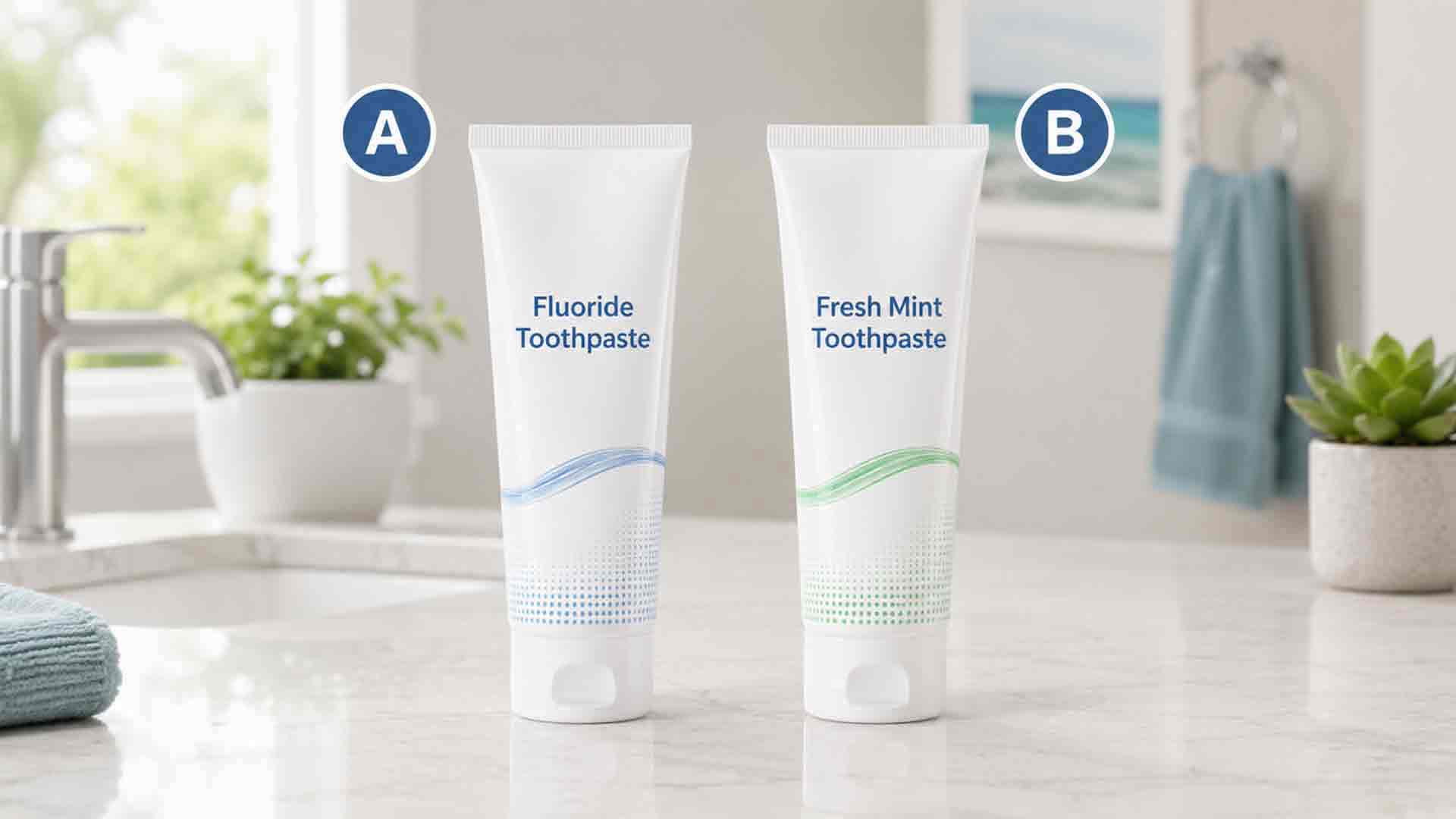
The original quiz comparison illustrates this well: Fluoride Toothpaste is the more relevant label for cavity prevention than Fresh Mint Toothpaste. Mint can make toothpaste pleasant to use, but mint flavor itself is not the anticavity drug.
Does Fresh Mint Toothpaste Prevent Cavities?
Mint flavor alone does not tell you whether a toothpaste provides anticavity protection. A mint-flavored toothpaste can absolutely contain fluoride and provide cavity protection, but the word mint is not the reason.
The correct buying habit is: ignore the flavor for a moment, check the active ingredients, and confirm fluoride. Flavor can still matter because a toothpaste that tastes acceptable may be easier to use consistently. It simply belongs in a different category from active cavity-prevention ingredients.
Is Whitening Toothpaste Good for Cavity Prevention?
Whitening and cavity prevention are separate product functions. Some fluoride toothpastes also contain ingredients or abrasives intended to reduce surface staining, which can be convenient if someone wants both benefits.
However, “whitening” on the front of the box does not replace the need to confirm a fluoride anticavity ingredient. When choosing between two whitening toothpastes, use this order: confirm fluoride, confirm that the product is appropriate for daily use, consider the whitening feature, then consider price and comfort. This prevents cosmetic marketing from outranking the core oral-health purpose of the toothpaste.
How Should You Choose Toothpaste for Sensitive Teeth?
Choose a fluoride toothpaste that also contains an ingredient intended to address sensitivity when sensitivity is your main additional concern. Toothpaste formulas may contain sensitivity-focused ingredients such as stannous compounds, potassium compounds, or arginine-based systems in addition to fluoride.
The key word is additional. A sensitivity toothpaste should still fit into an overall cavity-prevention routine. Persistent or severe sensitivity should not be managed indefinitely by trying different toothpaste brands without professional evaluation because sensitivity can have multiple causes.
What If You Have Dry Mouth or Frequent Cavities?
People with persistent dry mouth or recurring decay may need more than a standard over-the-counter toothpaste decision. Saliva helps wash food particles away and supplies minerals involved in maintaining tooth structure, so persistent dry mouth can increase cavity risk.
For people at higher cavity risk, dental professionals may recommend additional fluoride approaches. Prescription-strength fluoride toothpaste can have a role in selected high-risk situations, but this is not a reason for the average shopper to automatically seek the highest fluoride concentration available. It is an example of why Dentist Guidelines become more important as cavity risk rises.
Does More Fluoride Always Mean Better Toothpaste?
No. More is not automatically better for every person. Standard over-the-counter fluoride toothpaste is appropriate for many users. Higher-strength fluoride products may be used when a clinician identifies increased cavity risk and determines that additional fluoride exposure is appropriate.
This leads to a useful principle: Normal risk → choose a suitable OTC fluoride toothpaste. Higher risk → ask a dental professional whether targeted additional fluoride is appropriate. Do not turn ingredient strength into a competition.
How Should Parents Choose Fluoride Toothpaste for Children?
Children can benefit from fluoride toothpaste, but the amount used should be age-appropriate and supervised. For very young children, caregivers should use only a small smear of fluoride toothpaste; as children grow, a pea-sized amount is commonly recommended for the preschool years. Caregivers should supervise brushing and encourage children to spit rather than swallow toothpaste.
Young children are not simply smaller adults. The amount of toothpaste matters because developing teeth can be affected by excessive fluoride ingestion. Parents should therefore follow pediatric dental guidance rather than applying adult toothpaste habits automatically.
The Fluoride Toothpaste Decision Framework
Use this Core–Need–Value Framework when standing in the toothpaste aisle.
Core: Does It Provide Cavity Protection? Check for fluoride. If fluoride anticavity protection is missing, the product should not be your first choice when cavity prevention is the goal.
Need: Do You Have an Additional Problem? Examples include sensitivity, gingivitis, staining, dry mouth, high cavity risk, and exposed roots. Choose additional features only when they solve a real problem.
Value: Is the Extra Cost Justified? Ask whether the more expensive toothpaste actually adds a feature you need. If two products both meet your cavity-prevention needs and one has premium packaging but no useful additional benefit for you, the higher price may provide little practical value.
This framework separates clinical function from marketing value.
Toothpaste Selection by User Type
User Type → Core Priority → Possible Additional Consideration:
• Healthy adult with average cavity risk → Fluoride toothpaste → flavor and price.
• Frequent cavities → Fluoride plus dental risk assessment → dentist-directed additional fluoride.
• Sensitive teeth → Fluoride → sensitivity-focused active ingredients.
• Gingivitis concerns → Fluoride → appropriate plaque/gingivitis formulation.
• Dry mouth → Fluoride → professional cavity-risk assessment.
• Wants whiter teeth → Fluoride → whitening feature after core protection.
• Child → Fluoride → correct age-based amount and supervision.
• Exposed roots or older adult → Fluoride → individualized preventive advice.
This table is a practical selection framework, not a diagnostic tool.
How Much Should Fluoride Toothpaste Cost?
There is no medically correct price for fluoride toothpaste. Price varies by brand, package size, formulation, retailer, specialty benefits, and promotion. A more useful comparison is cost per unit rather than package price alone.
Hypothetical Example: Toothpaste A costs $4 for 4 ounces, while Toothpaste B costs $8 for 3 ounces. The approximate unit costs would be $1.00 per ounce for A and $2.67 per ounce for B. These are hypothetical numbers used only to demonstrate comparison.
If both products provide appropriate fluoride cavity protection, Toothpaste B needs to offer a feature you actually value—such as a suitable sensitivity benefit—to justify the higher price for your situation.
How Do Toothpaste Expenses Fit Into Dental Care Costs?
Toothpaste is a predictable home-care expense, while professional dental costs are more variable.
Dental Care Costs Framework:
• Daily Oral Health Care → toothpaste, toothbrush, floss → relatively predictable.
• Specialized home care → sensitivity products, electric brush heads → moderately predictable.
• Preventive Dental Care → dental checkups, professional cleaning → depends on schedule and coverage.
• Restorative care → fillings and other treatment → depends on diagnosis.
• Unexpected dental care → urgent treatment → difficult to predict.
The goal is not to claim that purchasing premium toothpaste will prevent all future dental bills. No toothpaste can guarantee that outcome. Instead, choose an effective, affordable product you can use consistently while maintaining the rest of your preventive routine.
Is Expensive Toothpaste Better?
Price alone is a poor indicator of cavity-prevention quality. A higher-priced toothpaste may include legitimate additional features, but it can also cost more because of branding, packaging, specialty positioning, or retail strategy.
Use this order of priorities: 1. Fluoride anticavity ingredient. 2. Relevant additional benefit. 3. Comfort and usability. 4. Cost. 5. Cosmetic preferences. This order keeps health function ahead of marketing.
How Does Toothpaste Fit Into Preventive Dental Care?
Fluoride toothpaste is important, but it cannot perform every preventive task. A complete Preventive Dental Care system usually includes fluoride toothpaste, appropriate brushing technique, twice-daily brushing, interdental cleaning, sensible food and drink habits, replacing worn toothbrushes, and professional Dental Checkups.
Think of toothpaste as one component of the system, not the entire system. Even excellent fluoride toothpaste cannot compensate for consistently poor brushing coverage or skipped interdental cleaning.
Why Are Dental Checkups Still Important If You Use Fluoride Toothpaste?
Because toothpaste cannot diagnose tooth decay or determine your individual risk. Early tooth decay may not cause obvious symptoms, and regular dental evaluation can identify problems that home care cannot.
Dental Checkups can also help determine whether ordinary over-the-counter toothpaste is sufficient or whether more targeted preventive care is appropriate. Fluoride toothpaste supports prevention, but it does not replace professional examination.
Real-World Example: Choosing Between Three Toothpastes
Imagine three hypothetical products.
Toothpaste A: Fresh Mint. The package emphasizes fresh breath and mint flavor. You inspect the label and find a recognized fluoride anticavity ingredient. Result: It may be a perfectly reasonable cavity-prevention choice. The important feature is the fluoride, not the mint name.
Toothpaste B: Premium Whitening. It also contains fluoride, but costs considerably more. You want mild stain removal and are comfortable paying the difference. Result: The premium may make sense for your personal preference, but the higher price does not automatically mean stronger cavity prevention.
Toothpaste C: Fluoride + Sensitivity Benefit. It provides fluoride and an additional sensitivity-focused ingredient. You experience persistent sensitivity. Result: The extra feature may be relevant, although persistent sensitivity should still be professionally evaluated.
The lesson is simple: choose by function first, branding second.
Fluoride Toothpaste Buying Checklist
Before putting a toothpaste in your cart, check:
• Does the active-ingredient section list fluoride?
• Does the product make an anticavity claim?
• Does it address an additional need I actually have?
• Is the product appropriate for the user's age?
• Can I tolerate the flavor and texture twice every day?
• Is the price sustainable for routine use?
• Am I paying extra for a meaningful feature or mainly for marketing?
• If cavity risk is high, have I discussed fluoride needs with a dentist?
• If symptoms persist, am I seeking professional evaluation rather than repeatedly changing toothpaste?
A good toothpaste purchase should survive all nine questions.
What Are the Most Common Toothpaste Buying Mistakes?
Choosing Flavor Instead of Active Ingredients: “Fresh mint” describes experience. It does not identify the anticavity ingredient.
Assuming Whitening Means Better Oral Health: Whitening is primarily a cosmetic goal. Always verify cavity protection separately.
Buying the Highest-Priced Option Automatically: Premium price does not prove superior fluoride performance.
Looking for the “Strongest” Fluoride Without Considering Risk: Higher-strength products can have legitimate clinical roles, but they are not automatically better for average-risk users.
Switching Toothpaste Instead of Investigating Symptoms: Persistent pain, sensitivity, dry mouth, bleeding gums, or recurring cavities deserve professional assessment.
Ignoring the Rest of the Routine: Even excellent fluoride toothpaste cannot compensate for consistently poor brushing coverage or skipped interdental cleaning.
Troubleshooting Your Toothpaste Choice
“I Use Fluoride Toothpaste but Still Get Cavities.” Fluoride toothpaste reduces risk; it does not guarantee zero cavities. Review brushing frequency and technique, interdental cleaning, added-sugar exposure, dry mouth, fluoride exposure, and individual cavity risk with a dental professional.
“My Toothpaste Makes My Mouth Uncomfortable.” Stop assuming discomfort is necessary for effectiveness. Formulations contain different flavors, detergents, abrasives, and other inactive ingredients. If irritation persists, discuss suitable alternatives with a dentist or healthcare professional.
“I Want Whitening and Cavity Protection.” Look for both functions. Start by confirming fluoride, then evaluate the whitening feature.
“I Have Dry Mouth.” Do not rely on stronger toothpaste marketing alone. Persistent dry mouth can increase cavity risk and deserves evaluation of its cause and preventive needs.
“My Teeth Are Very Sensitive.” A sensitivity-focused fluoride toothpaste may be useful, but persistent or worsening sensitivity should be evaluated because toothpaste cannot identify the cause.
Conclusion: Choose Fluoride First, Then Personalize
For most people, selecting toothpaste does not need to be complicated. Start with a fluoride toothpaste designed for cavity prevention. Then add other benefits—such as sensitivity support, gingivitis control, or whitening—only when they match a real need.
If you are a generally healthy adult with average cavity risk, an affordable fluoride toothpaste you enjoy using consistently is usually a sensible starting point. If you have sensitive teeth, choose a fluoride formula with an appropriate sensitivity benefit and arrange professional evaluation if symptoms persist.
If you frequently develop cavities, have exposed roots, experience persistent dry mouth, or have other significant risk factors, ask a dentist whether your Preventive Dental Care plan needs additional fluoride or other adjustments. If you are choosing toothpaste for a young child, follow age-appropriate fluoride toothpaste amounts and supervise brushing.
If you are primarily comparing prices, calculate unit cost and ask whether the more expensive product offers a benefit you actually need. The best toothpaste is not the tube with the boldest claims. It is one that provides evidence-based cavity protection, matches your individual needs, fits your budget, and supports a dental routine you can maintain every day.
FAQ: Is Fluoride Toothpaste Better Than Fresh Mint Toothpaste?
These labels describe different things. Fluoride identifies an active ingredient category associated with cavity prevention, while fresh mint mainly describes flavor. A toothpaste can be both mint-flavored and fluoride-containing. For cavity prevention, check the active ingredient rather than relying on flavor wording.
FAQ: Which Fluoride Ingredient Is Best?
Sodium fluoride, stannous fluoride, and sodium monofluorophosphate are all used as anticavity fluoride compounds. The best choice depends on the entire formulation and whether you need additional benefits such as sensitivity or gingivitis support.
FAQ: Does Fluoride Toothpaste Reverse Cavities?
Fluoride can support remineralization and help stop or reverse very early mineral loss before a permanent cavity forms. Once enamel has broken down into a true cavity, professional dental treatment may be required.
FAQ: Should Everyone Use Prescription-Strength Fluoride Toothpaste?
No. Prescription-strength fluoride toothpaste is intended for situations in which a dental or healthcare professional determines that additional fluoride is appropriate. Standard over-the-counter fluoride toothpaste is suitable for many people.
FAQ: Is Expensive Toothpaste Better for Preventing Cavities?
Not necessarily. Price does not determine whether a toothpaste contains an appropriate fluoride anticavity ingredient. Compare the active ingredients and additional benefits before deciding whether a higher price provides useful value.
FAQ: How Often Should I Visit a Dentist if I Use Fluoride Toothpaste?
Fluoride toothpaste does not replace professional dental care. The appropriate visit schedule depends on individual oral-health risk, symptoms, treatment history, and professional guidance. Regular Dental Checkups remain part of Preventive Dental Care even when a person uses fluoride toothpaste consistently.