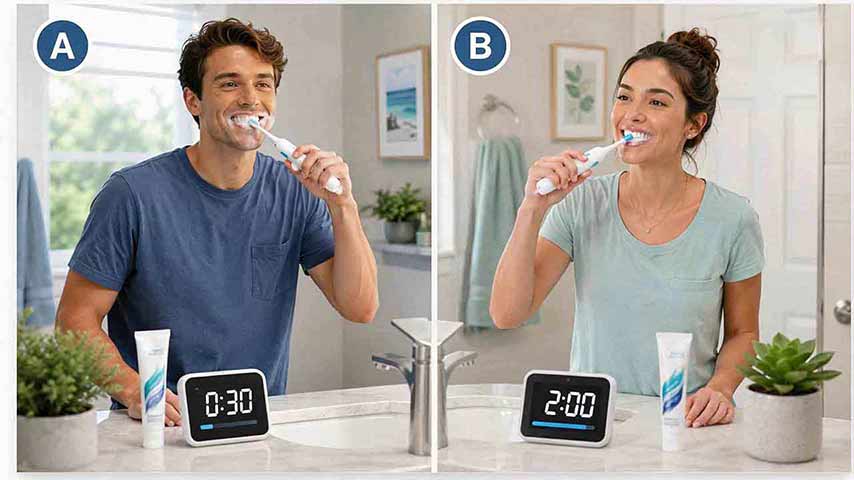
Who Brushes for the Recommended Time? Why Two Minutes Is the Better Answer
The correct quiz answer is B: the person brushing for 2 minutes. The source article states that the American Dental Association recommends brushing twice daily for two minutes. A 30-second session is usually too short to give the outer, inner, and chewing surfaces of every tooth enough attention.
Key Takeaways:
The correct quiz answer is B: 2 minutes.
Brush twice a day for about two minutes with fluoride toothpaste.
Use the full two minutes to clean all tooth surfaces, not only the visible front teeth.
Gentle and systematic brushing is better than rushing or scrubbing hard.
A timer can make the two-minute target easier to follow.
This article explains why two minutes is the recommended brushing target, why 30 seconds is usually too short, and how to build a simple two-minute routine.
Medical information notice: This article provides general educational information and does not replace individualized examination, diagnosis, or treatment from a licensed dental professional.
Quiz Answer: 30 Seconds or 2 Minutes?
The better answer is the person brushing for 2 minutes. Thirty seconds may feel like a complete brushing session when someone is in a hurry, but it gives much less time to reach the back teeth, inner surfaces, chewing surfaces, and areas near the gumline.
The quiz is testing a simple daily-care principle: a recommended brushing session lasts about two minutes, not a quick 30-second pass.
Why Is Two Minutes Recommended for Brushing?
Two minutes gives a person a practical amount of time to move around the entire mouth instead of repeatedly cleaning only the easiest areas. A complete brushing session should include the outer, inner, and chewing surfaces of the teeth.
The two-minute target is useful because it supports complete coverage. It gives enough time to follow a consistent route around the mouth without rushing.
Why Is 30 Seconds Usually Too Short?
A 30-second brushing session can easily become a quick sweep across the visible front teeth while other areas receive little attention. The problem is not that nothing happens during 30 seconds. The problem is that complete coverage becomes much less likely.
When brushing is rushed, people may skip the inside surfaces, back molars, chewing grooves, or areas near the gumline. That is why the quiz contrasts 30 seconds with 2 minutes.
How Can You Divide a Two-Minute Brushing Session?
A simple approach is to divide the mouth into four sections and spend about 30 seconds on each one. For example, clean the upper right, upper left, lower right, and lower left areas in sequence.
Within each section, remember three groups of surfaces: the outer surfaces facing the cheeks, the inner surfaces facing the tongue, and the chewing surfaces. Four 30-second sections together create the full two-minute routine.
How Should You Use the Two-Minute Rule in the Morning?
In the morning, brush with fluoride toothpaste for about two minutes. Use a soft-bristled toothbrush and gentle pressure. Start in one area and follow the same route each day so the back teeth and inner surfaces are not forgotten.
A repeatable pattern makes the two-minute goal easier because you do not need to decide where to brush next while the timer is running.
How Should You Use the Two-Minute Rule at Night?
At night, clean between the teeth with floss or another suitable interdental cleaner and brush again for about two minutes with fluoride toothpaste. The evening brushing session should still cover all accessible tooth surfaces, not just the areas where food feels stuck.
The exact order of flossing and brushing is less important than completing both tasks consistently and thoroughly.
Does Two Minutes Matter If Your Brushing Technique Is Poor?
Time alone is not enough. A person can brush for two minutes and still miss important surfaces if the technique is inconsistent. Use gentle, controlled movements and make sure the brush reaches the outer, inner, and chewing surfaces of every tooth.
The goal is complete coverage with gentle pressure. Brushing harder does not compensate for missed areas or rushed technique.
Should You Brush Harder to Clean Faster?
No. Brushing harder is not a useful shortcut for a shorter brushing session. A soft-bristled toothbrush and gentle pressure are more appropriate for routine cleaning.
Trying to turn a two-minute routine into 30 seconds by scrubbing aggressively does not create a better brushing method. The better approach is to use the recommended time and clean systematically.
Can a Timer Help You Brush for the Full Two Minutes?
Yes. A timer removes guesswork. People can easily underestimate or overestimate brushing time, especially when they are rushing in the morning or before bed.
You can use a phone timer, bathroom timer, or a powered toothbrush with a built-in timer. The purpose is simple: make sure a 30-second routine does not feel like a two-minute routine.
Do Manual and Electric Toothbrushes Follow the Same Two-Minute Goal?
Yes. Both manual and powered toothbrushes can support an effective routine when used correctly, and the two-minute brushing target remains useful with either type.
A powered toothbrush may make timing easier because many models include built-in timers or interval signals. A manual toothbrush can work just as well when paired with a simple timer and a consistent brushing pattern.
Which Tooth Surfaces Need Attention During Two Minutes?
A complete brushing session should include outer surfaces, inner surfaces, and chewing surfaces. The visible front teeth should not receive most of the brushing time simply because they are easiest to see.
Pay particular attention to the inner surfaces of the teeth, the back molars, and the gumline. These areas are easy to neglect when brushing is rushed.
Why Use Fluoride Toothpaste During the Two-Minute Routine?
The source article recommends brushing twice daily for about two minutes with fluoride toothpaste. The toothbrush provides mechanical cleaning, while fluoride toothpaste adds an important anticavity benefit.
The two-minute recommendation should therefore be understood as part of a broader routine that also includes fluoride toothpaste and consistent daily care.
Does Brushing for Two Minutes Replace Flossing?
No. Even a full two-minute brushing session does not replace cleaning between the teeth. Toothbrush bristles may not clean interdental spaces effectively, so floss or another suitable interdental cleaner remains useful.
The quiz focuses on brushing duration, but a complete oral-care routine includes both brushing and interdental cleaning.
Can Mouthwash Replace a Two-Minute Brushing Session?
No. Mouthwash may provide cosmetic or therapeutic benefits depending on the product, but it does not replace brushing for about two minutes.
Fresh breath after a rinse should not be confused with complete mechanical cleaning. Brushing remains the essential step for physically cleaning accessible tooth surfaces.
What Are the Most Common Two-Minute Brushing Mistakes?
Common mistakes include stopping after about 30 seconds, spending most of the time on the visible front teeth, skipping the inner surfaces and back molars, brushing too hard, and relying on mouthwash instead of brushing.
Another common mistake is assuming that more pressure can compensate for less time. It cannot. Complete coverage, gentle pressure, and consistency matter more than speed.
Real-World Example: 30 Seconds vs. 2 Minutes
Person A brushes for 30 seconds. Most of the time is spent on the visible front teeth, and the inner surfaces and back molars receive little attention.
Person B brushes for two minutes. The mouth is divided into four sections, and each section receives about 30 seconds of attention. Person B cleans the outer, inner, and chewing surfaces using gentle pressure.
For the quiz, Person B is the better answer because the routine matches the recommended brushing time and supports more complete coverage.
How Can Busy People Make Two-Minute Brushing Easier?
Attach brushing to an existing routine, such as after breakfast and before bed. Use a timer so you do not have to estimate the duration.
Keep the routine simple: fluoride toothpaste, a soft-bristled toothbrush, a consistent route around the mouth, and about two minutes of brushing. The easier the routine is to repeat, the more likely it is to become automatic.
How Can Children Learn the Two-Minute Brushing Habit?
Children can benefit from a visible or audible timer and supervision appropriate to their age and brushing ability. The goal is to help them understand what a full brushing session feels like and to avoid rushing through only the front teeth.
Parents can divide the mouth into four sections and guide the child through each area until the routine becomes familiar.
Troubleshooting: I Always Finish Brushing in Less Than One Minute
Use a timer for several days and follow a fixed route around the mouth. Divide the mouth into four sections and spend about 30 seconds on each one.
If you still finish quickly, check whether you are skipping the inner surfaces, back teeth, chewing surfaces, or gumline.
Two-Minute Brushing Checklist
Before you finish brushing, ask yourself: Did I brush for about two minutes? Did I clean the outer surfaces? Did I clean the inner surfaces? Did I clean the chewing surfaces? Did I reach the back teeth? Did I use gentle pressure? Did I use fluoride toothpaste? Did I avoid rushing through only the front teeth?
If several answers are no, the routine may need more structure rather than more force.
When Should You See a Dentist Instead of Only Adjusting Brushing Time?
A two-minute brushing routine supports preventive care, but it cannot diagnose or treat existing dental problems. Seek professional advice for persistent tooth pain, swelling, bleeding gums, loose adult teeth, repeated cavities, ongoing sensitivity, broken teeth, or other concerning changes.
Improving brushing time should not delay needed professional evaluation.
Conclusion: Two Minutes Is the Better Quiz Answer and the Better Daily Target
For the quiz question, the correct answer is B: the person brushing for 2 minutes. The source article states that the American Dental Association recommends brushing twice daily for two minutes.
The practical reason is simple: two minutes gives you enough time to clean the mouth systematically rather than rushing through only the easiest surfaces. Use gentle pressure, fluoride toothpaste, and a consistent route around the teeth. Think of 30 seconds as one part of a full brushing routine, not the entire session.
FAQ: Is 30 Seconds of Brushing Enough?
Thirty seconds is shorter than the recommended brushing duration. For most people, about two minutes is a better target because it provides more time to clean all tooth surfaces systematically.
FAQ: How Many Times a Day Should I Brush for Two Minutes?
The source article recommends brushing twice daily for about two minutes with fluoride toothpaste. A common routine is once in the morning and once at night.
FAQ: Does an Electric Toothbrush Make Two Minutes Unnecessary?
No. A powered toothbrush can make timing and technique easier, but it does not remove the need for adequate brushing time and complete coverage. Many powered brushes include timers specifically to support a full brushing session.
FAQ: What If I Brush for Two Minutes but Still Miss Areas?
Use a fixed brushing route and divide the mouth into four sections. Spend about 30 seconds on each section and clean the outer, inner, and chewing surfaces before moving on.
FAQ: Is Brushing Longer Than Two Minutes Always Better?
Not necessarily. The goal is thorough, gentle brushing, not maximum time or force. About two minutes is a practical target for complete coverage. Longer brushing does not compensate for aggressive pressure or poor technique.