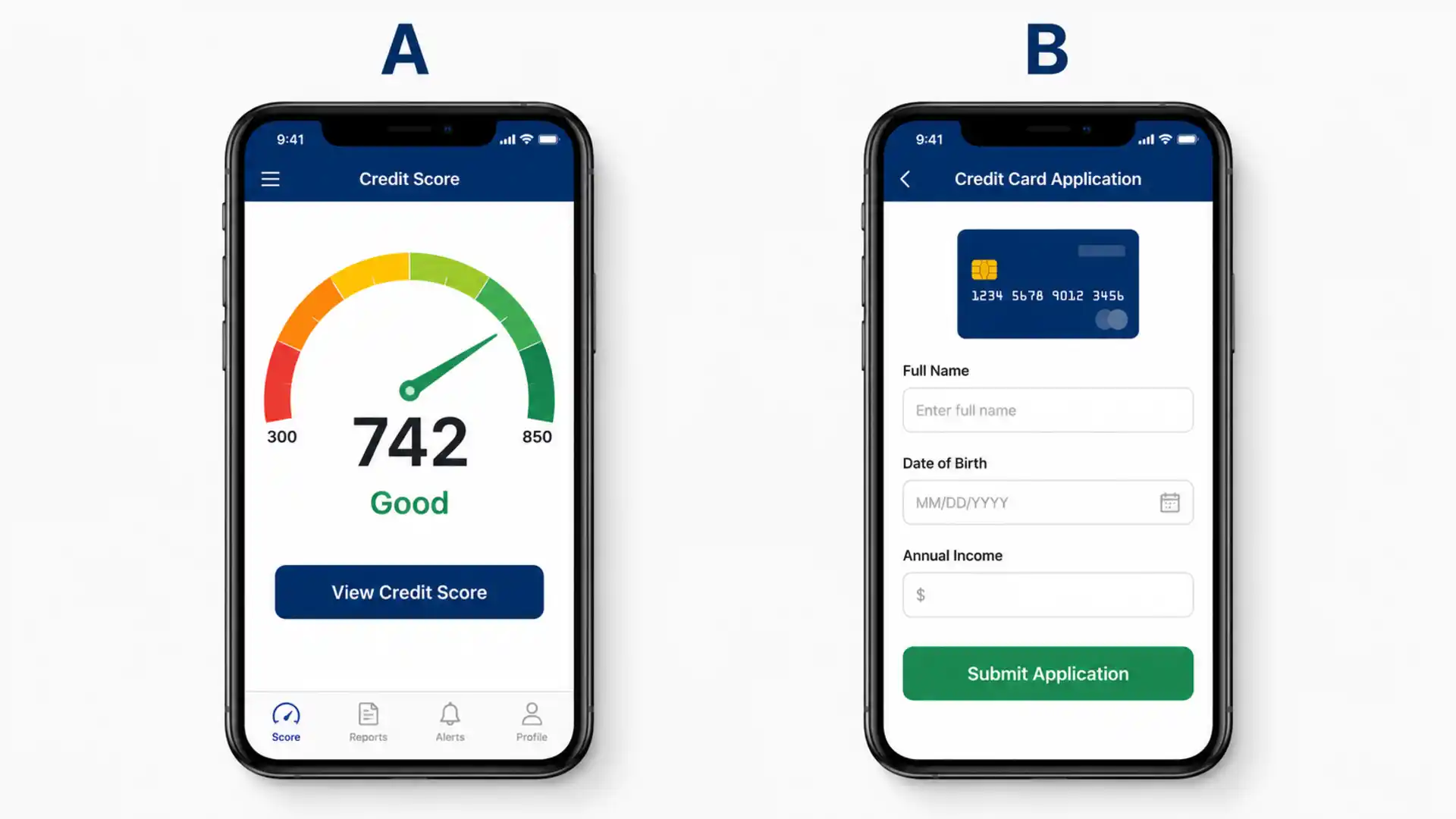
Does Checking Your Credit Score Lower It?
The short answer is:
Usually, no. Checking your own credit score does not lower it.
The confusion usually comes from mixing together several different activities.
Checking your own credit score.
Reviewing your own credit report.
Using a credit monitoring service.
Applying for credit cards.
Applying for personal loans or other new credit.
These activities are not the same.
Checking your own credit information is generally different from authorizing a lender to review your credit as part of a new application.
That distinction matters because checking your own credit information generally does not involve the same kind of application-related hard inquiry that may occur when you apply for new credit.
A lot of consumers still avoid looking at their credit score because they worry that simply viewing the number will cause it to fall.
That is usually the wrong conclusion.
Regularly reviewing your credit score, credit report, and credit monitoring alerts can instead help you understand what is being reported, notice unfamiliar activity, identify possible errors, and prepare before applying for credit cards, personal loans, auto financing, or other forms of credit.
The most useful principle to remember is simple:
Checking your own credit information is generally not the same thing as applying for new credit.
Key Takeaways
Checking your own credit score usually does not lower it.
Requesting your own credit report generally does not hurt your credit score.
Credit monitoring can help you track account changes, inquiries, balances, and unusual activity, but credit monitoring itself does not directly improve or lower a credit score.
Applying for credit cards, personal loans, auto loans, mortgages, or other new credit may result in a hard inquiry.
A hard inquiry may affect a credit score, but one inquiry should not automatically be treated as serious credit damage.
If you see an inquiry you do not recognize, review your credit report and investigate the activity rather than assuming every inquiry means fraud.
Why You Can Trust This Guide
This guide is based on public consumer-credit guidance and primary scoring resources, including the Consumer Financial Protection Bureau, AnnualCreditReport.com, IdentityTheft.gov, and myFICO.
It is designed to explain the difference between checking your own credit information and allowing a lender to review your credit during an application.
Consumer Financial Protection Bureau guidance on requesting your own credit report
https://www.consumerfinance.gov/ask-cfpb/does-requesting-my-credit-report-hurt-my-credit-score-en-1229/
Consumer Financial Protection Bureau explanation of credit inquiries
https://www.consumerfinance.gov/ask-cfpb/what-is-a-credit-inquiry-en-1317/
AnnualCreditReport.com
https://www.annualcreditreport.com/
myFICO information about checking credit and inquiries
https://www.myfico.com/credit-education/credit-reports/does-checking-credit-score-lower-it
https://www.myfico.com/credit-education/credit-reports/manage-credit-inquiries
This article provides general educational information and is not individualized financial, lending, legal, or tax advice.
The Answer Most People Need First
Checking your own credit score usually does not lower it.
Requesting your own credit report also does not normally hurt your score.
The Consumer Financial Protection Bureau explains that requesting your own credit report does not hurt your credit score.
https://www.consumerfinance.gov/ask-cfpb/does-requesting-my-credit-report-hurt-my-credit-score-en-1229/
This distinction is important because people often use the terms credit score and credit report as though they mean the same thing.
They do not.
A credit report contains information about your credit accounts and credit history.
A credit score is a numerical result generated by a scoring model using information from a credit file.
Credit monitoring is another separate concept.
A credit monitoring service may help you observe changes in reported information, new inquiries, account activity, or score movement depending on the service.
None of those activities should automatically be confused with applying for a new credit card or personal loan.
The Idea That Explains the Topic: Soft Inquiries and Hard Inquiries
The easiest way to understand whether checking credit can affect a credit score is to separate inquiries into two broad categories.
Soft Inquiries
Soft inquiries generally do not affect a credit score.
Common situations can include checking your own credit report, viewing your own credit score through a bank or credit monitoring service, certain prequalification processes, and account reviews performed by an existing creditor.
For example, you might open your bank's app and view the credit score it provides.
You might review your credit report through AnnualCreditReport.com.
You might receive a credit monitoring alert about a balance change.
An existing credit card issuer might review your credit as part of managing an account you already have.
Those activities are different from submitting a new application for credit.
Hard Inquiries
Hard inquiries are commonly associated with applications for new credit and may affect a credit score.
Examples can include applying for a new credit card, applying for personal loans, seeking auto financing, or applying for a mortgage.
The exact process can vary by lender and product.
The important distinction is that a lender is evaluating whether to extend new credit.
That is fundamentally different from you reviewing your own information.
Consumer Financial Protection Bureau credit inquiry guidance
https://www.consumerfinance.gov/ask-cfpb/what-is-a-credit-inquiry-en-1317/
Does Checking Your Own Credit Score Lower It?
Usually, no.
Checking your own credit score is generally treated differently from a lender reviewing your credit in connection with a new application.
That means checking the score provided through your bank, a credit monitoring platform, or another consumer-facing service generally should not be treated like applying for credit cards or personal loans.
myFICO explains the distinction between soft inquiries and hard inquiries and notes that soft inquiries do not affect FICO Scores.
https://www.myfico.com/credit-education/credit-reports/does-checking-credit-score-lower-it
https://www.myfico.com/credit-education/credit-reports/manage-credit-inquiries
This matters because avoiding your own credit score out of fear can make it harder to understand your financial situation.
Reviewing your own information may help you notice changes before you submit an important credit application.
Does Checking Your Credit Report Lower Your Credit Score?
No.
Requesting your own credit report does not hurt your credit score according to the CFPB.
https://www.consumerfinance.gov/ask-cfpb/does-requesting-my-credit-report-hurt-my-credit-score-en-1229/
This makes credit report review an important part of routine credit management.
Your report may contain account information, reported balances, payment history, inquiries, and other information that can help explain why a credit score changed.
Reviewing a credit report can also help identify information that appears inaccurate, incomplete, or unfamiliar.
Official credit reports are available through AnnualCreditReport.com.
https://www.annualcreditreport.com/
Credit Score, Credit Report, and Credit Monitoring Are Different
These three concepts are closely related, but they serve different purposes.
A credit report contains the underlying reported credit information.
A credit score is a numerical result produced by a scoring model using information from a credit file.
Credit monitoring is a service that can help you observe changes in credit-related information.
For example, credit monitoring may alert you when a new inquiry appears, when an account balance changes, or when unfamiliar activity is detected, depending on the service.
Credit monitoring itself does not directly improve a credit score.
It also does not create a hard inquiry simply because you check your own information.
Its primary value is tracking, organization, reporting awareness, and unusual activity monitoring.
A credit monitoring service also may not display the same score model used by a particular lender.
That is why a consumer-facing credit score should not automatically be interpreted as a prediction that an application for personal loans or credit cards will be approved.
When Can a Credit Check Affect Your Credit Score?
A credit check becomes more relevant to scoring when it is connected to an application for new credit.
For example, suppose you submit an application for a new credit card.
The issuer may review your credit report as part of evaluating the application.
That review may create a hard inquiry.
The same general issue can arise when applying for personal loans, auto loans, mortgages, or other credit products.
The CFPB explains that hard inquiries are often associated with applications for credit and can affect a credit score because scoring models may consider recent credit-seeking activity.
https://www.consumerfinance.gov/ask-cfpb/what-is-a-credit-inquiry-en-1317/
This does not mean every application produces the same score effect.
It also does not mean one hard inquiry automatically causes major credit damage.
The exact effect depends on the scoring model and the broader credit file.
Why Applying for Personal Loans Is Different From Checking Your Own Score
Suppose you are considering personal loans because you want to consolidate expenses or finance a large purchase.
First, you check your own credit score.
Then you review your credit report.
You may also use credit monitoring to make sure you recognize recent account activity.
Those self-review activities are different from submitting an application to a lender.
Once you formally apply for a personal loan, the lender may conduct a credit review that creates a hard inquiry.
That is why a consumer can safely research their credit situation without treating every review as though it were a new loan application.
The same distinction applies to credit cards.
Viewing your own score before applying for a credit card is not the same event as submitting the credit card application itself.
Why Applying for Credit Cards Can Create a Hard Inquiry
When you apply for a new credit card, the issuer may review your credit as part of the approval process.
That application-related review can create a hard inquiry.
By contrast, an existing credit card issuer may sometimes review your account for account-management purposes without creating the same kind of inquiry.
The CFPB explains that an existing credit card company may review a customer's credit report for account-management purposes and that such a review can be a soft inquiry.
https://www.consumerfinance.gov/ask-cfpb/when-can-a-credit-card-company-look-at-my-credit-reports-en-3/
This is why seeing the name of a credit card issuer on your credit information does not automatically mean you submitted a new application.
The context matters.
One Hard Inquiry Does Not Automatically Mean Serious Credit Damage
Consumers sometimes see one hard inquiry and assume their credit score is about to collapse.
That is usually too broad a conclusion.
A hard inquiry may affect a credit score, but its exact effect varies.
A single inquiry should not automatically be treated as major credit damage.
The CFPB has explained that a single lender inquiry generally has relatively little impact compared with more significant credit factors.
https://www.consumerfinance.gov/ask-cfpb/what-kind-of-credit-inquiry-has-no-effect-on-my-credit-score-en-321/
What can deserve more attention is repeated unnecessary application activity.
For example, submitting applications for several unrelated credit cards and personal loans over a short period may add multiple hard inquiries and new-credit activity to the file.
That does not mean all applications are harmful.
It means repeatedly applying for credit without a clear purpose can create additional information that scoring models may consider.
Why Your Credit Score May Drop After You Check It
Sometimes a consumer checks a credit score and notices that the number is lower than before.
It is easy to assume the act of checking caused the decline.
That conclusion may be wrong.
Credit scores can change because the underlying information changed.
A higher credit card balance may have been reported.
A late payment may have appeared.
A new account may have been added.
An application for a credit card or personal loan may have created a hard inquiry.
An account may have been closed.
Other information in the credit report may have changed.
The fact that you noticed the lower score immediately after checking it does not mean the act of checking caused the score movement.
This is one reason reviewing the credit report behind the score can be useful.
The report may provide more context than the score alone.
Can Your Current Credit Card Issuer Review Your Credit?
Yes.
An existing credit card issuer may review your credit information for account-management purposes.
That type of review is generally different from submitting an application for a new credit card.
CFPB guidance
https://www.consumerfinance.gov/ask-cfpb/when-can-a-credit-card-company-look-at-my-credit-reports-en-3/
This distinction can help prevent unnecessary concern when an existing lender appears in your credit information.
Not every creditor review is a new-credit application.
What Should You Do If You See an Inquiry You Do Not Recognize?
An unfamiliar inquiry deserves attention, but it does not automatically prove identity theft.
Start by identifying the company that made the inquiry.
Think about whether you recently applied for a credit card, personal loan, auto financing, mortgage, retail financing, or another credit product connected to that company.
Review your credit reports for unfamiliar accounts or additional activity.
If something appears inaccurate or incomplete, review the appropriate dispute process.
CFPB dispute guidance
https://www.consumerfinance.gov/ask-cfpb/how-do-i-dispute-an-error-on-my-credit-report-en-314/
If you suspect identity theft, IdentityTheft.gov provides federal recovery resources.
https://www.identitytheft.gov/
Credit monitoring may also help you notice future unfamiliar activity, but monitoring does not replace reviewing the underlying credit report.
What Should You Do Before Applying for New Credit?
Checking your own information before applying can be useful.
Review your credit report.
Check the credit score available to you if one is provided.
Look for information that appears inaccurate, incomplete, or unfamiliar.
Review recent inquiries.
Check whether credit card balances have increased significantly.
Think about whether the new application is necessary.
If you are considering personal loans, review the broader financial purpose of the loan rather than focusing only on whether you may qualify.
If you are considering credit cards, think about whether another revolving account fits your financial needs.
This type of self-review generally should not be avoided simply because you are worried about hurting your credit score.
The lender application is the event more likely to create a hard inquiry.
Credit Monitoring Before an Application
Credit monitoring can be useful before applying for important credit.
It can help you notice account changes, reported balances, new inquiries, or unusual activity depending on the service.
But credit monitoring should be treated as an information tool.
It does not guarantee approval for personal loans.
It does not guarantee approval for credit cards.
It does not tell you every factor a specific lender will consider.
It does not directly improve your credit score.
A lender may use a different score model, additional underwriting information, income information, debt obligations, or other criteria.
That is why monitoring can help you prepare, but it cannot predict every lending decision.
What Usually Matters More Than Checking Your Own Credit Score?
If your goal is maintaining a healthier credit profile, worrying about soft inquiries is usually less useful than understanding the underlying account behavior.
Payment history can matter.
Revolving balances on credit cards can matter.
Credit utilization can matter.
New applications and hard inquiries can matter.
The accuracy of your credit report can matter.
Repeatedly applying for credit you do not need can add unnecessary activity.
Credit monitoring can help you observe some of those changes.
But avoiding your own credit score is not a substitute for managing the underlying credit profile.
Official Resources
AnnualCreditReport.com
https://www.annualcreditreport.com/
CFPB guidance on requesting your own credit report
https://www.consumerfinance.gov/ask-cfpb/does-requesting-my-credit-report-hurt-my-credit-score-en-1229/
CFPB explanation of credit inquiries
https://www.consumerfinance.gov/ask-cfpb/what-is-a-credit-inquiry-en-1317/
CFPB guidance on credit card issuer account reviews
https://www.consumerfinance.gov/ask-cfpb/when-can-a-credit-card-company-look-at-my-credit-reports-en-3/
CFPB credit reports and scores resources
https://www.consumerfinance.gov/consumer-tools/credit-reports-and-scores/
IdentityTheft.gov
https://www.identitytheft.gov/
myFICO information about credit inquiries
https://www.myfico.com/credit-education/credit-reports/does-checking-credit-score-lower-it
https://www.myfico.com/credit-education/credit-reports/manage-credit-inquiries
FAQ
Does Checking My Credit Score Lower It?
Usually, no.
Checking your own credit score generally does not involve a hard inquiry and usually does not lower your score.
That is different from applying for new credit and allowing a lender to review your credit as part of the application.
Does Checking My Credit Report Lower My Credit Score?
No.
The CFPB explains that requesting your own credit report does not hurt your credit score.
https://www.consumerfinance.gov/ask-cfpb/does-requesting-my-credit-report-hurt-my-credit-score-en-1229/
Does Credit Monitoring Lower My Credit Score?
Generally, no.
Using credit monitoring to review your own credit information is not the same as applying for new credit.
Credit monitoring can help with tracking, organization, reporting awareness, and unusual activity monitoring.
It does not directly improve or lower your credit score simply because you use the service.
Can Applying for Personal Loans Affect My Credit Score?
It can.
A formal application for personal loans may involve a lender credit check that creates a hard inquiry.
A hard inquiry may affect a credit score, but the exact effect depends on the scoring model and the broader credit file.
Checking your own credit score before comparing personal loans is a different activity.
Can Applying for Credit Cards Affect My Credit Score?
It can.
Applying for a new credit card may create a hard inquiry.
Opening a new account can also change other information in the credit file.
The exact score effect varies and should not be predicted from the inquiry alone.
Can My Existing Credit Card Issuer Check My Credit Without Lowering My Score?
Yes, in some account-management situations.
An existing issuer may review a customer's credit information for account-management purposes without creating the same kind of inquiry associated with a new-credit application.
https://www.consumerfinance.gov/ask-cfpb/when-can-a-credit-card-company-look-at-my-credit-reports-en-3/
Does One Hard Inquiry Ruin My Credit Score?
Usually, no.
A hard inquiry may affect a credit score, but one inquiry should not automatically be treated as major credit damage.
The exact effect depends on the scoring model and the broader credit profile.
Should I Avoid Checking My Credit Before Applying for a Loan?
Generally, no.
Reviewing your own credit score and credit report can help you understand your credit profile before submitting an application.
You can also use credit monitoring to check for unusual activity or recent changes.
The self-review itself is generally different from the lender's application-related credit review.
The Bottom Line
Checking your own credit score usually does not lower it.
Reviewing your own credit report also does not normally hurt your score.
Credit monitoring can help you track balances, inquiries, account changes, and unusual activity without functioning like a new-credit application.
The distinction becomes important when you apply for credit cards, personal loans, auto loans, mortgages, or other new credit.
Those applications may result in hard inquiries, and hard inquiries may affect a credit score.
That does not mean every hard inquiry causes serious credit damage.
It also does not mean checking your own information should be avoided.
The more useful approach is to understand what type of credit check occurred.
Use your credit report to understand the underlying information.
Use your credit score as one indicator rather than the entire financial picture.
Use credit monitoring for tracking and awareness.
And distinguish those activities from actually applying for personal loans, credit cards, or other new credit.
That distinction makes the topic much simpler:
Checking your own credit information is generally not the problem.
Applying for new credit is the activity more likely to create the kind of inquiry that can matter.