7 Common Mistakes That Can Lower Your Credit Score (And How to Address Them)
A lot of people think a credit score falls only when something dramatic happens.
A bankruptcy.
A charge-off.
A collection account.
A major financial setback.
Those events can matter.
But many credit score problems come from much more ordinary mistakes.
Not dramatic ones.
Repeated ones.
That is why this topic matters.
Your credit score does not react only to major financial events. It can also reflect patterns that make your credit profile look more stretched, inconsistent, or risky.
That means some credit problems come from behavior people do not recognize as harmful in the moment.
For example, someone may carry credit card debt too close to available limits for too long.
They may apply for several new accounts in a short period.
They may miss one payment and then assume the situation is already hopeless.
They may close an older credit card without understanding how that decision affects available credit.
They may ignore inaccurate information on a credit report because the dispute process feels intimidating.
They may watch a credit monitoring app while never reviewing the underlying reports.
Or they may assume one large payment or one good month solves the entire problem.
These are not always financial emergencies.
They are often credit-profile mistakes.
And credit scoring models can react to the information those patterns create.
This article explains seven common mistakes that can lower a credit score, why they matter, and how to think about credit repair and credit rebuilding without relying on shortcuts or guaranteed outcomes.
The most useful idea to remember from the start is this:
Many credit score problems come from patterns that make the file look more risky than it did before.
Key Takeaways
A lower credit score can result from repeated or misunderstood mistakes, not only major financial disasters.
Missed payments, high credit utilization, elevated credit card debt, unnecessary applications, poorly timed account closures, and inaccurate credit report information can all affect the way a credit profile looks.
A decision that feels financially responsible in everyday life can still have an unintended credit effect if it changes the information used by a scoring model.
Credit monitoring can help with awareness and organization, but monitoring a score is not the same as understanding the credit report behind it.
Credit repair is usually more useful when it begins with identifying the biggest current problem, correcting inaccurate information where appropriate, stopping fresh damage, and building cleaner patterns over time.
Why You Can Trust This Guide
This guide is based on public consumer-credit guidance and primary scoring resources, including the Consumer Financial Protection Bureau, AnnualCreditReport.com, IdentityTheft.gov, and myFICO.
It is written for ordinary readers trying to understand what common habits can lower a credit score in practice rather than simply memorizing score myths.
The goal is to help readers distinguish between active problems, structural issues, credit report errors, and behaviors that can be improved over time.
This article provides general educational information and is not individualized financial, lending, legal, or tax advice.
Official Resources to Review First
Who This Article Is For
This guide may be useful if your credit score dropped and you are not sure why.
It may help if your score feels stuck even though you are trying to make responsible financial decisions.
It may also help if you want to understand common mistakes before applying for new credit or if you are trying to decide what part of your credit profile deserves attention first.
The article is designed as a practical action guide rather than a promise that one strategy will produce a particular score increase.
Who This Article Is Not For
This article may not be enough on its own if you are dealing with active identity theft, fraudulent accounts, legal disputes around debts or collections, highly specific mortgage underwriting questions, business-credit scoring issues, or major derogatory events that require account-by-account analysis.
In those situations, this framework can still help you understand the basics, but more specific assistance may be necessary.
Our Editorial Review Standard
This guide follows a simple editorial standard.
Does it explain common credit score mistakes in practical terms?
Does it distinguish between a financial decision and the credit-risk signal that decision may create?
Does it avoid exaggerated credit repair or credit hack language?
Does it distinguish credit monitoring from actual changes to the underlying credit file?
Does it point readers toward authoritative public resources when discussing credit reports, disputes, utilization, and scoring factors?
This matters because content about sudden credit score drops can become either too vague or unnecessarily alarming.
A Simple Starting Framework
If your credit score dropped suddenly, first look for a recent trigger.
That could include a reported late payment, a higher revolving balance, a new inquiry, a new account, an account closure, or updated information on a credit report.
If balances are high but there are no recent late payments, revolving utilization and credit card debt may deserve the first look.
If there is a recent missed payment, stopping additional payment damage becomes more important.
If the score seems unexpectedly low, review the underlying credit report for inaccurate or incomplete information before assuming the score itself is the problem.
If the score is not falling sharply but seems stuck, look for repeated weak patterns rather than searching for one dramatic event.
Mistake 1: Missing a Payment, Even Once
Payment history is one of the most important parts of major credit scoring systems.
That is one reason reported late payments can matter so much.
A lot of people misunderstand how late payments work.
Some assume that being a few days late automatically destroys a credit score.
Others assume one missed due date does not matter if they eventually catch up.
Some focus mainly on the late fee and overlook the credit reporting issue.
The important question is whether the creditor reports the account as delinquent.
A reported delinquency can create a significant negative signal, especially on a previously clean credit report.
Why This Mistake Matters
A late payment can indicate that repayment reliability has weakened.
The exact credit score effect varies according to the scoring model and the rest of the credit profile.
That is why one person may see a different result from another person after a similar event.
Better Response
Get the account current as soon as practical.
Try to prevent another missed payment.
Consider reminders or automatic payments if those tools make payment management easier.
Review your other accounts so one missed payment does not become a broader pattern.
One reported late payment can matter.
Repeated missed payments can create a more serious pattern.
For credit repair, preventing fresh negative payment information is often more useful than searching for a quick score trick.
Mistake 2: Letting Credit Card Debt and Utilization Get Too High
This is one of the most important areas to review when a credit score changes even though there has not been a missed payment.
Credit utilization refers to how much available revolving credit is being used.
Credit card debt refers to the actual amount owed.
The two concepts are related but not identical.
A borrower can carry substantial credit card debt while still having moderate utilization if available limits are very high.
Another borrower can owe a smaller dollar amount but have very high utilization because available limits are low.
Why High Utilization Can Matter
If reported balances are high compared with available limits, the credit profile may look more stressed.
The CFPB explains that scoring models look at how close a consumer is to being maxed out and notes that experts advise keeping credit use at no more than 30 percent of total available credit.
https://www.consumerfinance.gov/ask-cfpb/how-do-i-get-and-keep-a-good-credit-score-en-318/
That does not mean 30 percent is a guaranteed scoring threshold.
A credit score does not suddenly become good or bad at one exact utilization percentage.
The broader point is that high revolving balances can make a credit profile look riskier.
Example
Suppose your overall utilization looks reasonable, but one individual card is almost maxed out.
That single account can still show significant revolving stress.
If one card is near its limit, reviewing that account may be more useful than looking only at total utilization.
If balances are high across several cards, the overall credit card debt load may deserve more attention.
If the score changed after a statement balance was reported, reporting timing may also be relevant.
If the score changed after a credit card was closed, reduced available credit may have changed the utilization calculation.
What Utilization Does Not Mean
High utilization is not a morality test.
It is not automatically permanent damage.
It is not necessarily solved by closing credit cards.
It is also not determined only by whether a payment was made before the due date.
Better Response
If cash is limited, identify which card is carrying the highest balance relative to its limit.
Work on reducing overall revolving balances over time where financially practical.
Pay attention to the balances that are actually being reported, not only the payment due date.
Before closing an account, consider how removing its credit limit could affect total available credit.
For some consumers, reducing credit card debt may also reduce utilization once lower balances are reported.
The exact credit score outcome still depends on the scoring model and the broader credit file.
Mistake 3: Applying for Too Much Credit in a Short Period
This often happens when someone feels urgency.
A person gets denied once or feels short on available credit and then begins applying in several places.
That reaction can create more activity on an already stressed credit profile.
Why This Can Matter
Repeated applications can create additional hard inquiries.
New accounts can also add new-credit activity to the file.
A burst of applications may make the profile look more actively credit-seeking.
A single inquiry does not automatically create major credit damage.
But repeatedly applying for new credit without understanding the underlying problem may make the file noisier.
Better Response
Pause before submitting another application.
Review your credit report and current profile first.
Ask whether the application is necessary or simply a reaction to a previous denial.
If you use credit monitoring, treat it as an awareness tool rather than an approval predictor.
A score shown in a credit monitoring service does not necessarily tell you whether a specific lender will approve an application.
Credit repair is usually more effective when new unnecessary problems stop accumulating.
Mistake 4: Closing Old Accounts Without Understanding the Tradeoff
A lot of people close old credit cards because they want to simplify their finances.
Sometimes that is reasonable.
But closing an account can also reduce total available credit.
If credit card debt remains on other accounts, the same balances may then represent a larger percentage of available revolving credit.
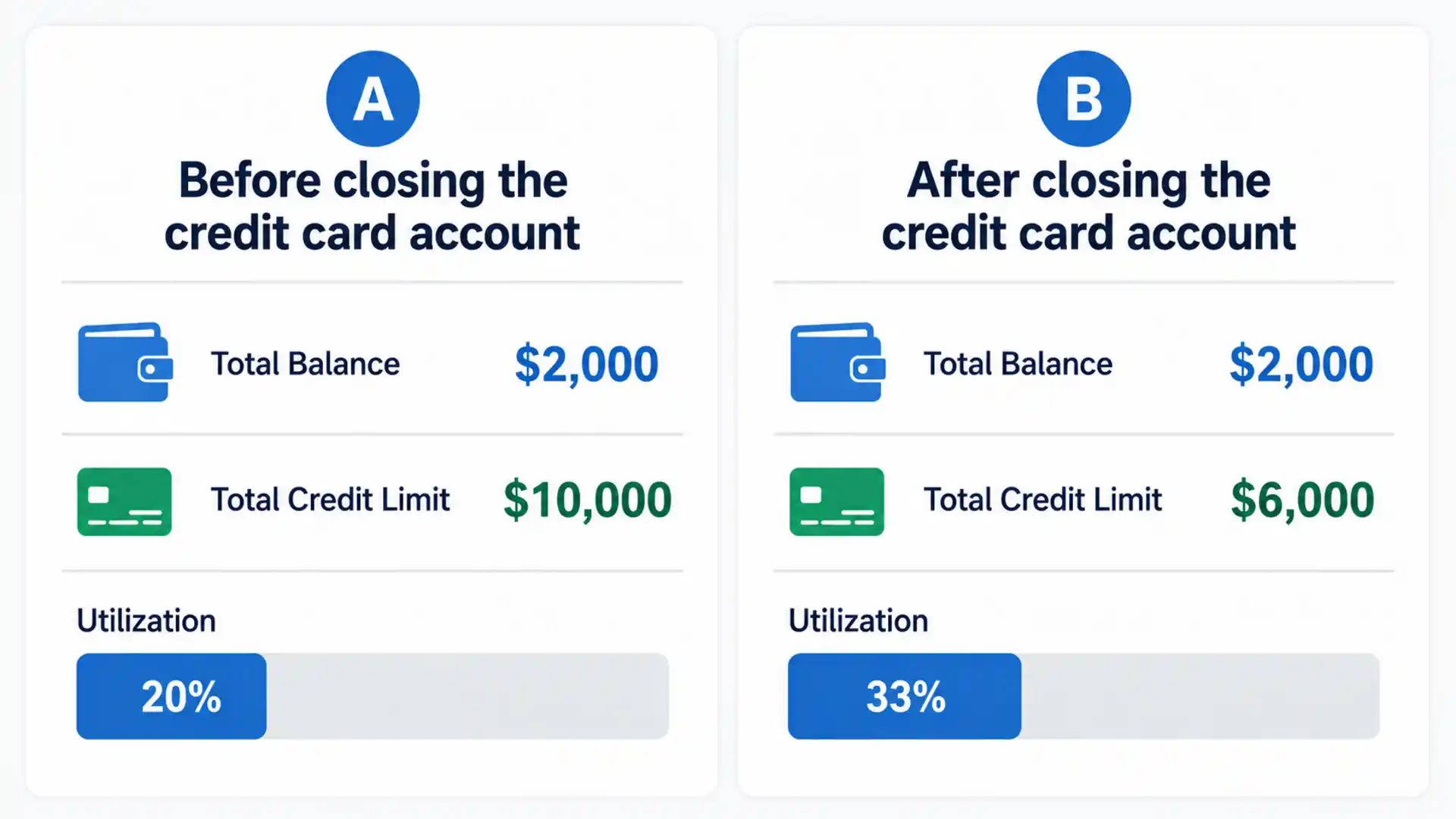
Example
Imagine that you owe $2,000 across credit cards and have $10,000 in total available revolving limits.
That represents 20 percent utilization.
Now imagine closing an unused card with a $4,000 limit while the $2,000 balance remains elsewhere.
Available revolving credit falls to $6,000.
The same $2,000 balance now represents roughly 33 percent utilization.
No new credit card debt was added.
But the utilization ratio changed.
Better Response
Before closing an account, ask whether the card has an annual fee.
Consider whether the available limit is helping your overall utilization.
Consider whether the account is older and how it fits into your broader credit profile.
Calculate how the utilization ratio could change if the account is closed.
Closing a credit card is not automatically a mistake.
The mistake is closing an account while assuming the decision must improve a credit score.
Mistake 5: Ignoring Errors on Your Credit Report
A lot of people assume that if information appears on a credit report, it must be correct.
That assumption can create problems.
Potential credit report errors can include accounts that do not belong to you, incorrect balances, duplicate reporting, inaccurate late payments, or mixed identity information.
Why This Matters
A credit score is generated from information in a credit file.
If inaccurate negative information is present, the resulting credit profile may not accurately reflect the consumer’s history.
That is why reviewing the actual credit report matters.
Credit monitoring can help alert you to changes or unusual activity, but monitoring should not replace reviewing the underlying reports.
A score app may show that something changed without giving you the complete context needed to understand why.
Better Response
Review your official credit reports.
https://www.annualcreditreport.com/
Document information that appears inaccurate or incomplete.
Use the appropriate dispute process when necessary.
CFPB dispute guidance
https://www.consumerfinance.gov/ask-cfpb/how-do-i-dispute-an-error-on-my-credit-report-en-314/
Credit repair should not mean disputing accurate negative information simply because it is unfavorable.
The dispute process is for information believed to be inaccurate or incomplete.
Mistake 6: Thinking One Big Payment Fixes Everything
A large payment can help.
It is just usually not the whole solution.
Credit scoring reflects information and patterns across the broader file rather than rewarding one dramatic act in isolation.
Someone may pay down a major credit card balance once and feel that the problem has been solved.
If credit card debt then climbs back to the previous level, the underlying pattern has not really changed.
Better Response
Think in systems rather than rescue moves.
Ask how you can prevent the next balance spike.
Ask how you can prevent the next missed due date.
Ask what would help maintain a cleaner pattern across several reporting cycles.
Use credit monitoring to observe whether reported balances are moving in the expected direction.
But remember that credit monitoring itself does not reduce credit card debt, correct a credit report, or directly improve a credit score.
The useful changes happen in the underlying financial behavior and reported information.
Mistake 7: Treating Credit Repair Like a Short-Term Project
This mistake sits underneath many of the others.
People sometimes want to improve a credit score for one upcoming application and then stop paying attention afterward.
That approach can lead to repeated setbacks.
Why This Matters
Credit strength is generally built through repeated signals of predictability.
Those signals can include on-time payments, lower and more stable revolving balances, fewer unnecessary applications, and fewer reactive financial decisions.
Credit repair and credit rebuilding are therefore better understood as ongoing processes than as one-time score projects.
Better Response
Think of credit as a maintenance system rather than a sprint.
Review payments regularly.
Watch credit card debt and utilization.
Review your credit report periodically.
Use credit monitoring for tracking, organization, reporting awareness, and unusual activity monitoring.
Do not treat every score fluctuation as an emergency.
The goal is a more stable credit profile, not a perfect score every day.
Credit Monitoring Versus Credit Report Review
These two activities are related, but they are not the same thing.
Credit monitoring can help you keep track of score changes, account updates, balance changes, new activity, or potential signs of fraud depending on the service being used.
A credit report provides the underlying credit information being reported about your accounts and history.
That difference matters.
Someone can check a credit monitoring app every day and still miss the larger issue if they never review the underlying credit report.
A useful routine is to use monitoring for awareness and organization while using official credit reports for a deeper review of reported information.
Credit monitoring itself does not improve a credit score.
Its value is in helping you notice and understand changes.
What Not to Do When Your Credit Score Is Under Pressure
Do not panic-apply for multiple new accounts simply because one application was denied.
Do not ignore a missed payment because the credit score has already fallen.
Do not close credit cards without understanding how available credit and utilization may change.
Do not assume one large payment means the broader pattern is fixed.
Do not rely only on a credit monitoring app while ignoring full credit reports.
Do not treat accurate negative information as an error simply because it hurts.
Do not expect legitimate credit repair to guarantee a specific score increase.
A Practical Reality Check
Ask yourself whether you know which mistake is most likely affecting your credit score right now.
Have you reviewed your credit reports rather than relying only on a score app?
Do you know whether the main problem involves payment history, utilization, credit card debt, recent inquiries, account closure, or inaccurate credit report information?
Do you know whether one card is creating most of the revolving stress or whether balances are high across multiple accounts?
Are you using credit monitoring for awareness rather than treating every score change as a command to take action?
Are you trying to reduce repeated risk signals rather than relying on one dramatic fix?
If several of those questions are difficult to answer, the first step may be identifying the real driver rather than trying additional credit repair tactics.
FAQ
What Is the Most Common Mistake That Lowers a Credit Score?
There is no single mistake that affects every credit file the same way.
Late payments and high utilization are two important score drags, particularly when the problem is recent or repeated.
The exact effect depends on the scoring model and the rest of the credit profile.
Can One Missed Payment Really Hurt That Much?
Yes, a reported delinquency can have a meaningful effect.
The exact impact varies depending on the credit profile, the scoring model, and other information in the file.
The useful response is usually to get current and avoid allowing one missed payment to become a repeated pattern.
Does Credit Card Debt Lower a Credit Score?
It can contribute to a lower score when revolving balances create high credit utilization.
Credit card debt and utilization are not exactly the same thing, but paying down revolving balances may reduce utilization when lower balances are reported and available credit remains otherwise unchanged.
The exact score response varies by credit file and scoring model.
Does Closing a Credit Card Always Help Your Credit Score?
No.
Closing a card can reduce available revolving credit.
If balances remain on other cards, that can increase utilization.
Whether closing an account makes sense depends on factors such as annual fees, spending risk, utilization, and the broader credit profile.
Can Credit Report Errors Really Lower a Credit Score?
They can if inaccurate negative information is included in the credit file used for scoring.
That is why reviewing your credit report matters.
If information appears inaccurate or incomplete, use the appropriate dispute process.
https://www.consumerfinance.gov/ask-cfpb/how-do-i-dispute-an-error-on-my-credit-report-en-314/
Does Credit Monitoring Improve My Credit Score?
No.
Credit monitoring itself does not improve a credit score.
It can help with tracking, organization, reporting awareness, and unusual activity monitoring.
Actual credit score changes depend on information in the credit file and the scoring model being used.
Is Credit Repair Mainly About One Big Fix?
Usually not.
Credit repair is more often about identifying the biggest current problem, stopping new damage, correcting inaccurate or incomplete information where appropriate, and building cleaner patterns over time.
A single payment, dispute, or account decision should not be expected to produce a guaranteed result.
Should I Review My Credit Report If I Already Use Credit Monitoring?
Yes.
Credit monitoring and credit report review serve different purposes.
Monitoring can help you notice changes.
Reviewing the underlying reports can help you understand account information, balances, payment history, inquiries, and possible inaccuracies in more detail.
Official credit reports are available through AnnualCreditReport.com.
https://www.annualcreditreport.com/
What Should I Address First If My Credit Score Drops?
Start by identifying what changed.
Look for recently reported late payments, higher revolving balances, new inquiries, new accounts, account closures, or changes to information on your credit report.
Then focus on the largest active problem rather than trying to change everything at once.
Next Steps and Related Content
How Late Payments Affect Your Credit Score
How Credit Utilization Affects Your Score With Examples
Does Checking Your Credit Score Lower It?
How to Fix a 500 Credit Score: Realistic Plan
Credit Score Ranges Explained: What Lenders Actually See
Better Credit Usually Starts With Fewer Repeated Mistakes
Credit score problems do not always come from dramatic or obvious events.
They often come from patterns that make the credit file look more risky than it did before.
That is why the practical goal is not perfection.
It is to identify what the credit file is reacting to.
Understand which problem is still active.
Review the credit report rather than relying only on the score.
Manage credit card debt and utilization when those are the main problems.
Use credit monitoring for tracking and awareness rather than expecting it to directly improve the score.
And make the highest-priority correction first.
Once the problem becomes clearer, credit repair becomes less about chasing a number and more about building a more stable credit profile over time.