A 90-Day Credit Score Improvement Case Study: What May Help in a High-Utilization Scenario
Last reviewed: August 14, 2026
Author Note
This article uses an illustrative credit rebuilding scenario to explain general consumer-credit principles and official public guidance.
It is not presented as Helen Xia’s personal credit history or as a documented individual credit repair result.
The example figures and timeline are illustrative.
Credit scoring models, score sources, credit files, lender standards, reporting dates, and individual results vary.
This article is for educational purposes only and is not individualized financial, legal, lending, or tax advice.
Why This Article Exists
A lot of credit content falls into one of two unhelpful categories.
Some content sounds like magic. It promises to boost a credit score fast, fix credit overnight, or reveal a shortcut that supposedly produces a predictable result.
Other content is so general that it does not help readers understand what may actually be affecting their credit file.
The usual advice to pay on time, keep balances low, avoid unnecessary applications, and review credit reports is useful.
But readers often want to know something more specific.
Which parts of a credit profile may change relatively quickly, and which problems generally require more time?
This article explores that question through an illustrative 90-day scenario.
The scenario represents a borrower whose main problems include high revolving utilization, significant credit card debt relative to available limits, several recent credit inquiries, and inconsistent payment habits.
It does not represent every credit repair situation.
The key point is that a credit file dominated by high revolving utilization may respond differently from a file dominated by collections, charge-offs, repeated late payments, bankruptcy, identity theft, or other serious negative information.
The scenario therefore focuses on understanding the credit file rather than promising a particular score result.
Key Takeaways
The illustrative scenario begins with a credit score around 580 and a credit file where high utilization is a major problem.
Credit card debt declines during the 90-day period, new credit applications stop, and payment behavior becomes more consistent.
Lower revolving balances may help when high utilization is one of the major factors affecting the file.
Reviewing a credit report for inaccurate or incomplete information can also be an important part of credit rebuilding.
Credit monitoring itself does not improve a credit score. Its value is in tracking, organization, reporting awareness, and unusual activity monitoring.
A large score increase over 90 days should never be treated as a standard or guaranteed credit repair result.
Because the original case materials do not identify the scoring model or score source used for the example figures, this article does not present the movement from approximately 580 to above 700 as a verified apples-to-apples 120-point change.
Why You Can Trust This Guide
This guide uses official consumer-credit guidance and primary scoring resources to explain the mechanics behind the illustrative scenario.
Important sources include the Consumer Financial Protection Bureau, AnnualCreditReport.com, and myFICO.
AnnualCreditReport.com
https://www.annualcreditreport.com/
Consumer Financial Protection Bureau credit report and score resources
https://www.consumerfinance.gov/consumer-tools/credit-reports-and-scores/
myFICO credit education
https://www.myfico.com/credit-education/
The article separates illustrative observations from official financial guidance.
When the article describes what happens inside the example, it uses language such as the scenario suggests, may have helped, appeared to matter, or could have contributed.
When it describes official consumer-credit principles, it identifies the source directly.
Who This Article Is For
This guide may be useful if your credit score appears to be affected mainly by high revolving utilization, elevated credit card debt, recent applications, or uneven payment habits.
It may also help if you want to understand what kinds of credit information can change over several reporting cycles.
The framework is designed for readers who want to understand credit repair without relying on promises about rapid score increases.
Who This Article Is Not For
This article is not designed to provide individualized guidance for serious or complex credit situations.
Those situations can include identity theft, fraudulent accounts, multiple collections, charge-offs, bankruptcy decisions, disputed legal debts, or other circumstances requiring individualized professional guidance.
A credit report containing serious derogatory information may follow a very different timeline from the high-utilization scenario described here.
Our Editorial Review Standard
We review credit information against a simple editorial standard.
Does the article clearly distinguish an illustrative example from a documented personal experience?
Does it avoid presenting an example credit score change as a universal result?
Does it explain several factors that may have contributed to changes in the illustrative scenario instead of attributing the result to one action?
Does it distinguish credit monitoring from actions that affect information in the credit file?
Does it use authoritative sources for statements about credit reports, credit utilization, payment history, inquiries, account closures, and credit rebuilding?
Does it avoid implying that a specific score guarantees approval, pricing, or a particular lending result?
This standard matters because personal-finance content can become misleading when an illustrative result is presented as though it were typical or guaranteed.
Official Resources to Review First
Understanding the Illustrative Starting Point
The scenario begins with a credit score around 580.
That number is included only to establish the example’s starting condition.
The available case materials do not identify the specific scoring model or score source associated with that number.
For that reason, the article does not claim that the later score above 700 represents a verified 120-point change measured through the same model and source.
Different scoring models can generate different numbers from the same underlying credit information.
When tracking your own progress, comparing scores from the same scoring model and the same score source can provide a more meaningful view than comparing unrelated score products.
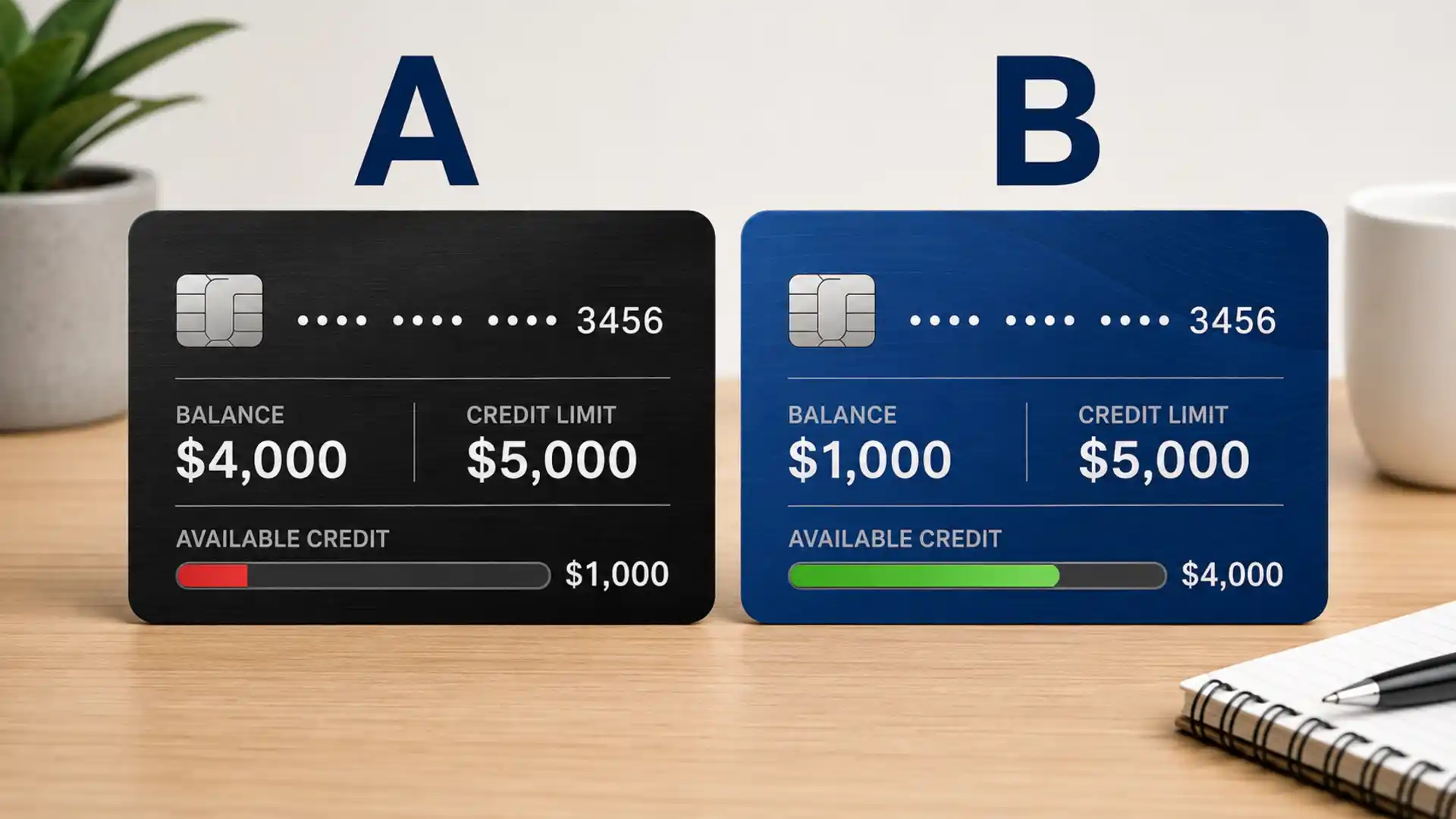
The example credit file also includes revolving utilization around 78 percent, one reported late payment, three open revolving credit card accounts, and several recent hard inquiries.
The central problem is high revolving utilization.
The borrower is using a large percentage of available revolving credit.
Credit card debt is therefore important in this scenario not simply because debt exists, but because reported balances are high relative to available credit limits.
Why High Utilization Matters in This Scenario
Credit utilization compares revolving account balances with available revolving credit limits.
The CFPB explains that credit scoring models consider how close a consumer is to being maxed out.
https://www.consumerfinance.gov/ask-cfpb/how-do-i-get-and-keep-a-good-credit-score-en-318/
myFICO also identifies amounts owed as one of the major categories used in FICO scoring and explains that revolving utilization is one component of that category.
https://www.myfico.com/credit-education/credit-scores/amount-of-debt
That does not mean utilization determines a credit score by itself.
Payment history, credit history length, new credit activity, credit mix, and other information may also matter depending on the scoring model and credit file.
In this illustrative scenario, however, utilization is treated as a major problem because revolving balances are unusually high relative to available limits.
What the Scenario Does Not Mean
This result does not mean everyone can gain 120 points in 90 days.
It does not mean utilization is always the most important problem.
It does not mean one late payment is unimportant.
It does not mean collections, charge-offs, or other serious negative information can usually be resolved quickly.
It does not mean credit monitoring directly raises a credit score.
It also does not mean paying a particular amount of credit card debt will produce a predictable number of credit score points.
Different credit files and scoring models can respond differently to similar actions.
Will a 90-Day Credit Improvement Be Realistic for You?
Sometimes visible change can occur over several reporting cycles, particularly when revolving utilization is a major problem and lower balances are subsequently reported.
A borrower dealing primarily with high utilization may have a different timeline from someone dealing with multiple late payments, collections, charge-offs, or a thin credit file.
A credit report error presents another type of situation.
If information is inaccurate or incomplete, the appropriate first step is to review the report and use the formal dispute process rather than trying to optimize a score around incorrect information.
CFPB dispute guidance
https://www.consumerfinance.gov/ask-cfpb/how-do-i-dispute-an-error-on-my-credit-report-en-314/
If Your Credit Problem Is Not Mainly Utilization
Different credit problems call for different priorities.
If a recent late payment is the main issue, preventing additional missed payments may matter more than trying to optimize utilization.
If collections or charge-offs appear on the credit report, accuracy and long-term payment stability may deserve more attention than a short-term score target.
If the credit file is thin, building positive history can take time.
If fraud or identity theft is suspected, protecting the file and addressing fraudulent information should take priority over score optimization.
If the report appears inaccurate or incomplete, review the information and use the appropriate dispute process.
The central lesson is that credit repair should begin with understanding the type of problem visible in the credit report.
A Practical Decision Framework
A high-balance file without a large amount of serious derogatory information can be viewed as a utilization-cleanup situation.
In that situation, lowering reported revolving balances may be an important focus.
A file with a recent missed payment is more accurately viewed as an active payment-history problem.
A file containing collections or charge-offs may require a longer rebuilding period.
A thin credit file may need additional time to establish positive history.
A score that appears inconsistent with expectations may justify a closer review of the underlying credit report before any other optimization strategy.
These categories are planning tools, not guaranteed timelines or predictions of specific score changes.
Step 1: Reducing Credit Card Debt and Revolving Utilization
The first major change in the illustrative scenario is a reduction in revolving balances.
The borrower stops adding unnecessary credit card debt and begins paying down existing balances.
The card with the highest balance receives particular attention.
Over time, lower balances are reported.
This could matter because the scenario begins with high utilization.
The CFPB explains that credit scoring models look at the amount of credit a consumer is using relative to available credit.
https://www.consumerfinance.gov/ask-cfpb/will-paying-off-my-credit-card-balance-every-month-improve-my-score-en-1293/
myFICO also identifies revolving utilization as an important part of the amounts-owed category.
https://www.myfico.com/credit-education/blog/accounts-credit-utilization-ratio
Credit card debt and credit utilization are related but not identical.
Credit card debt is the amount owed.
Credit utilization measures the balance relative to the available credit limit.
Paying down credit card debt can reduce utilization when the lower balance is reported and available credit remains otherwise unchanged.
That may help in a high-utilization file.
It does not guarantee a particular credit score increase.
Step 2: Making Payment Behavior More Consistent
The second major change is consistent payment behavior.
The borrower begins using automatic minimum payments as a safeguard and uses reminders to reduce the risk of missing due dates.
This should not be interpreted as a claim that autopay directly increases a credit score.
The value of the system is that it can reduce the risk of a new missed payment.
myFICO identifies payment history as the largest category in its general FICO Score factor breakdown.
https://www.myfico.com/credit-education/whats-in-your-credit-score
CFPB credit rebuilding guidance also emphasizes paying credit card bills on time.
https://www.consumerfinance.gov/consumer-tools/credit-reports-and-scores/how-to-rebuild-your-credit/
In the illustrative scenario, more consistent payment behavior may help by preventing new negative payment information while other parts of the file are being stabilized.
Step 3: Reviewing the Credit Report
The borrower then reviews the underlying credit reports instead of watching only a credit score.
A credit score is calculated from information in a credit file according to a particular scoring model.
The credit report contains the underlying account and payment information being reported by creditors and other furnishers.
Reviewing a credit report can help identify unfamiliar accounts, inaccurate balances, incorrect payment information, or other information that may deserve closer attention.
The CFPB states that checking your own credit report does not affect your credit score.
https://www.consumerfinance.gov/ask-cfpb/does-requesting-my-credit-report-hurt-my-credit-score-en-1229/
Consumers can obtain their official credit reports through AnnualCreditReport.com.
https://www.annualcreditreport.com/
If information appears inaccurate or incomplete, the CFPB provides instructions for disputing errors.
https://www.consumerfinance.gov/ask-cfpb/how-do-i-dispute-an-error-on-my-credit-report-en-314/
Credit repair should not mean disputing accurate negative information simply because it is unfavorable.
The dispute process is intended for information believed to be inaccurate or incomplete.
Step 4: Stopping Unnecessary New Credit Applications
The illustrative borrower had several recent hard inquiries before beginning the 90-day period.
During the example period, new applications stop.
That does not create an instant score increase by itself.
The purpose is to stop adding unnecessary new application activity to an already stressed credit file.
The CFPB explains that lender credit checks can create inquiries and that hard inquiries can affect credit scores.
https://www.consumerfinance.gov/ask-cfpb/what-is-a-credit-inquiry-en-1317/
The CFPB also explains that checking your own credit report is different from applying for new credit and does not affect the score.
https://www.consumerfinance.gov/ask-cfpb/does-requesting-my-credit-report-hurt-my-credit-score-en-1229/
The useful lesson is not that every hard inquiry should be avoided.
It is that repeatedly applying for credit without a clear reason may add unnecessary activity to the file.
Step 5: Thinking Carefully Before Closing Older Credit Cards
The illustrative borrower considers closing an older unused credit card but decides not to do so during the cleanup period.
Closing a credit card is not automatically harmful or automatically beneficial.
The relevant question is how the closure affects the broader credit profile.
The CFPB explains that closing a credit card can increase utilization when total available credit falls while balances remain.
https://www.consumerfinance.gov/ask-cfpb/does-it-hurt-my-credit-to-close-a-credit-card-en-1231/
In a file where utilization is already high, reducing available credit could make the utilization ratio less favorable.
That does not mean consumers should keep every account open indefinitely.
Fees, spending risk, fraud concerns, and other personal considerations can matter.
The point is that account closure should not be treated as an automatic credit score improvement strategy.
Step 6: Using Credit Monitoring for Tracking, Not Score Improvement
Credit monitoring itself does not improve a credit score.
A credit monitoring service does not lower balances, erase accurate negative information, create an on-time payment history, or guarantee that a lender will see the same score shown in a monitoring app.
Its useful role is tracking and organization.
It can improve reporting awareness.
It can help a consumer notice unusual account activity.
It can help track whether balances and accounts are being updated as expected.
In the illustrative scenario, the borrower uses a weekly review routine rather than checking the score constantly.
The routine includes balances, due dates, payment status, reported changes, and unusual activity.
The monitoring process supports better organization.
The underlying financial behavior is what changes the credit file.
What May Have Helped Faster and What Usually Takes Longer
In this high-utilization scenario, lower reported revolving balances may produce visible changes relatively quickly because utilization can change when card issuers update balances.
More consistent payment behavior helps prevent new damage but does not erase older negative history.
Stopping unnecessary new applications avoids adding more inquiry activity.
Correcting an actual credit report error can change the underlying information once the correction is completed and reported.
Older negative information and thin credit files generally require more time.
What Happens at the End of the Illustrative 90-Day Period
The example scenario assumes that the borrower’s credit profile looks materially stronger after several reporting cycles.
Revolving balances are lower.
Credit card debt has declined.
Payment behavior has become more consistent.
No additional unnecessary credit applications have been submitted.
The borrower has reviewed the credit report and has become more aware of what is being reported.
For illustration, the scenario may show a later credit score above 700.
However, the available source material does not identify the scoring model and score source used for either the starting score around 580 or the later score above 700.
Because the original case materials do not identify the scoring model or score source used for the example figures, this article does not present the movement from approximately 580 to above 700 as a verified apples-to-apples 120-point change.
Different credit score models can produce different numbers.
A valid before-and-after comparison is strongest when the same scoring model and comparable score source are used throughout the measurement period.
The important outcome in this illustrative case is the change in the underlying credit profile, not a specific number.
What This Scenario Suggests
Several things change at the same time in the example.
Utilization is a major problem at the beginning.
Credit card debt declines.
New inquiries stop.
Payment behavior becomes more consistent.
The credit report receives more attention.
Credit monitoring supports tracking and organization.
These changes together create a more stable illustrative credit profile.
It would be misleading to attribute the entire change to one action.
Common Mistakes During Credit Repair
One common mistake is focusing on the credit score while ignoring the information behind it.
Another is treating credit monitoring as if it directly improves a score.
Repeatedly applying for new credit during a period when the file is already stressed can also add unnecessary activity.
Paying down one card while immediately adding new debt elsewhere can limit progress.
Closing accounts without considering utilization can create an unintended tradeoff.
Disputing accurate negative information simply because it is unfavorable is also different from using the dispute process to correct genuine inaccuracies or incomplete information.
Credit repair works best as a process of understanding and improving the underlying file rather than chasing a specific number.
A Practical 90-Day Framework
The following framework is intended for organization.
Again, this is not a guaranteed formula.
During the first month, review your credit reports and identify what appears to be affecting the file most.
Look at revolving balances and available limits.
Review payment status.
If high credit card debt and utilization are major issues, create a repayment approach that fits your actual budget.
Set up reminders or automatic minimum payments if those tools help prevent missed payments.
During the second month, continue maintaining consistent payment behavior.
Avoid unnecessary new credit applications.
Watch for updated balances and account information.
Use credit monitoring for tracking and reporting awareness rather than treating each score change as a final result.
During the third month, continue the same process.
Review whether lower balances are appearing as expected.
Check whether genuine credit report inaccuracies or incomplete information still need attention.
Continue monitoring for unusual activity.
Evaluate the overall credit file rather than focusing only on one score number.
The goal is not to force a particular score increase within a fixed period.
What Matters More Than the Headline Score Change
The quality of the underlying credit file is more useful than a dramatic headline.
Look at whether utilization is improving.
Look at whether credit card debt is declining.
Look at whether payments are consistently current.
Look at whether new applications have slowed.
Review whether the credit report is accurate.
Check whether you are comparing the same scoring model when evaluating progress.
Those factors provide more context than simply asking how many points a score moved.
The Emotional Side of Credit Repair
Credit rebuilding can feel frustrating because actions and reported results do not always happen at the same time.
A payment can be made today while a creditor reports the updated balance later.
A consumer can review a credit report today while a dispute investigation takes additional time.
A credit monitoring service can show a score change without explaining every reason behind it.
That delay can make the process feel unpredictable.
The healthier approach is to focus on controllable behaviors.
Keep payments organized.
Reduce unnecessary credit card debt when possible.
Review reports for accuracy.
Avoid unnecessary applications.
Monitor the file for changes and unusual activity.
Emotional confidence itself is not a credit scoring factor.
The benefit of feeling more organized is that it may make consistent financial behavior easier to maintain.
A Simple Reality Check
Do I know what appears to be affecting my credit profile most?
Do I know whether high utilization is a major issue?
Do I know how much credit card debt I am carrying relative to my available limits?
Have I reviewed my credit report?
Do I know whether my credit problem involves utilization, late payments, report errors, serious derogatory information, or a thin file?
Am I comparing credit scores from the same scoring model and a comparable score source?
Am I using credit monitoring for tracking rather than assuming it directly improves my score?
Am I focused on sustainable behavior rather than a specific 90-day result?
If several of these questions are difficult to answer, understanding the credit file may be more useful than focusing immediately on the score.
FAQ
Can a Credit Score Really Improve in 90 Days?
Sometimes, yes.
Visible score changes can occur over several reporting cycles, particularly when high utilization or updated credit report information is an important part of the file.
The exact credit score outcome still varies because scoring models and individual credit profiles differ.
A 90-day period should not be treated as a guaranteed credit repair timeline.
Is a 120-Point Increase in 90 Days Normal?
No.
A 120-point increase should not be treated as a normal or expected 90-day result.
The original illustrative scenario referenced a starting score around 580 and a later score above 700, but the available source material does not establish that both scores came from the same scoring model and the same score source.
For that reason, this article does not present the difference as a verified 120-point apples-to-apples increase.
Does Credit Monitoring Improve My Credit Score?
No.
Credit monitoring itself does not improve a credit score.
Its value is in tracking balances and account changes, organizing due dates, increasing reporting awareness, and helping identify unusual activity.
Changes to the underlying credit file, not the act of monitoring, are what can affect a credit score.
Does Paying Down Credit Card Debt Help a Credit Score?
It can.
Paying down revolving credit card debt can lower credit utilization when lower balances are reported and available credit remains otherwise unchanged.
Because utilization is one factor used in common credit scoring models, that change may help some credit profiles.
The exact effect depends on the individual credit file and scoring model.
CFPB information about credit card balances and credit scores
https://www.consumerfinance.gov/ask-cfpb/will-paying-off-my-credit-card-balance-every-month-improve-my-score-en-1293/
myFICO information about amounts owed
https://www.myfico.com/credit-education/credit-scores/amount-of-debt
Should I Apply for a New Credit Card to Rebuild Faster?
Not automatically.
A new account may make sense in some circumstances, but repeatedly applying for new credit can add inquiries and new account activity.
The decision should depend on the borrower’s broader financial situation and credit-building needs rather than a promise of faster score improvement.
CFPB credit inquiry guidance
https://www.consumerfinance.gov/ask-cfpb/what-is-a-credit-inquiry-en-1317/
Should I Close Old Credit Cards While Rebuilding?
Not automatically.
Closing a card can reduce available revolving credit and may increase utilization if balances remain.
Other factors such as annual fees, overspending risk, and account security can also matter.
CFPB guidance on closing credit cards
https://www.consumerfinance.gov/ask-cfpb/does-it-hurt-my-credit-to-close-a-credit-card-en-1231/
Does Checking My Own Credit Report Hurt My Score?
No.
The CFPB explains that checking your own credit report does not affect your credit score.
Regular review can help you understand the information being shared with lenders and identify information that may be inaccurate or unfamiliar.
https://www.consumerfinance.gov/ask-cfpb/does-requesting-my-credit-report-hurt-my-credit-score-en-1229/
How Can I Review My Credit Report?
AnnualCreditReport.com is the official source for obtaining credit reports.
https://www.annualcreditreport.com/
Review account names, balances, payment status, credit limits, inquiries, and other reported information.
If something appears inaccurate or incomplete, use the appropriate dispute process.
https://www.consumerfinance.gov/ask-cfpb/how-do-i-dispute-an-error-on-my-credit-report-en-314/
What Is the Difference Between a Credit Report and a Credit Score?
A credit report contains information about a consumer’s credit accounts and credit history.
A credit score is a numerical result generated by a scoring model using information from a credit file.
That distinction matters because two different credit scoring models may produce different scores from the same underlying information.
For meaningful progress tracking, try to compare the same type of score over time when that information is available.
What Is the Most Important Lesson From This 90-Day Scenario?
The most important lesson is not the example score number.
It is that the underlying credit problem should determine the strategy.
In this illustrative scenario, utilization is a major problem.
Credit card debt declines.
New inquiries stop.
Payment behavior becomes more consistent.
Credit monitoring supports tracking and organization.
The credit report is reviewed more carefully.
No single action is presented as the sole reason for improvement.
The Honest Lesson From This Illustrative 90-Day Case
Credit repair should not be presented as a shortcut.
The more useful approach is to understand what the credit file is signaling and then work on the factors that can realistically be improved.
In a high-utilization scenario, reducing revolving balances may matter.
If payment behavior is inconsistent, preventing future missed payments may matter.
If a credit report contains inaccurate or incomplete information, the formal dispute process may matter.
If unnecessary applications are adding new inquiries, slowing that activity may matter.
Credit monitoring can support tracking, organization, reporting awareness, and unusual activity monitoring.
The goal is not to force a particular score increase within a fixed period.
It is to build a more stable credit profile and understand whether the underlying information is moving in a healthier direction.